
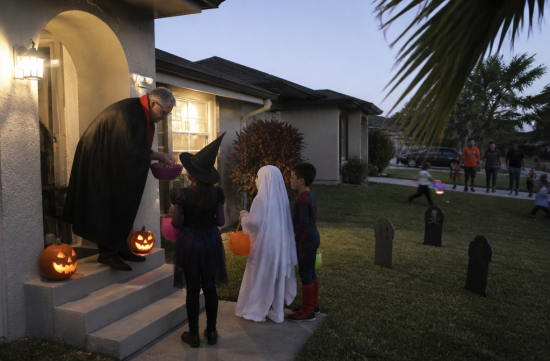
As soon as September arrived, one corner of the local grocery store was covered in orange and black. While I was still wearing short sleeves, a skeleton was grinning next to the checkout, and bags of candy were piled high.
When I first came to the U.S., I found this quite fascinating. Seeing fully grown adults wearing witch hats to work and setting up graves in their front yards made me think, "These people are serious about this."
However, after seeing this year's numbers, I realized it's not just serious; it's astonishing. The National Retail Federation (NRF) has announced that Halloween spending is projected to reach $13.5 billion this year.
Last year's record was $13.1 billion, so it looks like it will break another record. Honestly, it's surprising that this much money is spent on a single-day holiday.
The expected spending per person is $115.14, which is almost the same as last year's $114.45. Although prices are said to be rising, it seems people have no intention of cutting back on their Halloween budgets.
This survey was conducted from September 1 to 9, with 7,889 consumers participating. Seventy-four percent of respondents said they plan to celebrate Halloween this year.
It's even more interesting to see where the money is going. Costumes are expected to account for $4.4 billion, decorations for $4.3 billion, and candy for $4.1 billion, with these three categories almost neck and neck.
A whopping 96% of people plan to buy candy. Sending kids away empty-handed on Halloween is almost a taboo in American neighborhoods.
Spending on pet costumes is also expected to reach $920 million. The top choice is a pumpkin, followed by a hot dog. If I dress my dog in a hot dog costume, I'm sure he'll resent me for life.
The most popular adult costumes are witches and vampires. Even though new heroes come out every year, the classics still win, which is similar in both the IT industry and Halloween. Legacy systems don't die easily.
So why are Americans so serious about Halloween? Tracing its roots reveals a surprisingly deep history.
The origin of Halloween dates back over 2,000 years to the Celtic festival of Samhain. It was a time to light bonfires and dress up to ward off spirits as summer ended and the harvest was completed.
This tradition made its way to America in the 1840s when Irish and Scottish immigrants brought their customs with them during the potato famine.
So, Halloween has always been a holiday brought by immigrants. Just as we Koreans celebrate Chuseok, they maintained their holiday in a foreign land.
The phrase "trick or treat" didn't appear until the 1920s. It became a nationwide phenomenon after World War II when sugar rationing ended.
As suburban neighborhoods grew after the war, the culture of children going door to door for candy took hold. It became a day when neighbors would see each other.
The reason I came to enjoy Halloween is actually this. The elderly neighbor, who usually just exchanged greetings with me, dresses up in a Dracula cape and stands with a basket of candy that day.
This isn't an event that someone is forced to do. There's no government budget involved; everyone buys candy with their own money to give to the kids in the neighborhood.
I think this reflects a positive aspect of American society. People gather and enjoy themselves without needing directives from above.
For businesses, Halloween is a massive market. In this area, Universal Studios' Halloween Horror Nights is a prime example.
This event started in 1991 as "Fright Night" with just three nights and one haunted house. The admission fee that first year was $12.95, which seems almost free by today's standards.
This year, it runs for 49 nights from August 28 to November 1. It's the earliest opening ever, and there are reportedly 10 new haunted houses.
Having Halloween at the end of August seemed a bit early at first. But if tickets are selling, the duration will likely increase. In the market, supply follows demand.
Of course, not everyone is spending freely. Thirty-one percent of people said they would compare prices if they find things too expensive, and 26% said they would look for coupons or sales.
They enjoy themselves but still keep a tight grip on their wallets. I appreciate this sense of balance.
Ultimately, the reason Americans are so serious about Halloween can be summed up in one point. It started as an immigrant holiday and has become a festival that everyone in the neighborhood participates in, with the market growing alongside it.
This year, I plan to stock up on plenty of candy. However, it's a mystery why chocolate always disappears before the kids arrive, so this time I'll choose jelly that I don't like.
What kind of candy are you preparing for this year? If Korean families knock on their neighbors' doors with their kids, they might feel a little closer to this country.
 VelvetStone97








 daisypat |
 Anjollinya Blog |
 Anova US Beauty Information |
 anchor |
 Korea Tiger News |
 US Home Buying Information Home Insurance |
 You Only Live Once |
 Lando Mao |
 Mr Bull Jung |
 Sunshine Blog |
  History Repeats Itself |
  Doori Ark |
  Rainbow Bridge to the Sky |
  Sunny Fullerton |
  U.S. Weather Bureau News |
  GOGO SING |
  Gold Bar |
  Banana Style Life |
  Tesla X |
  Old English |
  urbanmint |
  forestcloud |
  forever young |
  Arlington house |
  liquid asset |
  Who's watching? |
  eclipse |
  quietwave |
  Hajiwon Blog Hair Salon |
  hoosierdaddy |