
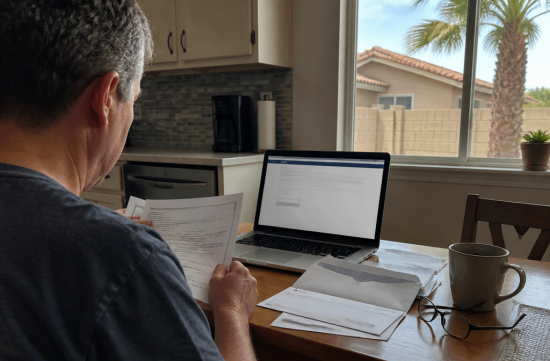
A while ago, a friend mentioned receiving mail addressed to their parents' house. It was a loan notice in the name of someone they had never heard of.
Fortunately, it turned out to be a simple misdelivery, but it immediately brought to mind a term: home title fraud, commonly referred to as title theft.
The method itself is surprisingly simple. The fraudster gathers the homeowner's personal information, forges a deed, and registers it at the county recorder's office.
Then, they attempt to take out a loan against the house using the fake identity, rent it out, or even sell it outright. This is exactly the process described by the California Department of Financial Protection and Innovation (DFPI).
There are patterns in the types of homes targeted. DFPI identifies elderly homeowners, inherited properties from recently deceased individuals, and absentee-owned homes as common targets.
Homes that have fully paid off their mortgages or have little loan activity are also at risk. Since there's no reason for the bank to contact the owner, it can take a long time for anyone to notice if something is amiss.
So, how common is this? Instead of guessing, let's look at the numbers.
According to the FBI's IC3 annual report for 2025, there were 12,368 reports of real estate-related fraud, with losses totaling $275.1 million. This is a significant increase from 9,359 reports and $173 million in losses in 2024.
However, this statistic includes all real estate fraud, including closing wire fraud, so it's important to note that it's not just about identity theft.
Therefore, I believe balance is necessary. There's no need to be swept up in fear, but once it happens, the time and cost to reverse it can be substantial, which is a hallmark of this crime.
I can't help but mention the title lock services that we often see advertised. They claim to lock your home for a monthly subscription fee.
The Federal Trade Commission (FTC) made it clear in an August 2024 consumer alert that these products are not title insurance and are not insurance at all.
The key point is that monitoring does not prevent fraud. The structure only alerts you after the documents have been recorded.
Instead, the FTC recommends checking with your local recorder's office for free notification programs. I agree. There's no reason to pay for something that can be done for free.
California also has some welcome changes. The SB 255 bill signed in October 2025.
Under this law, starting January 1, 2027, all county recorders in California will be required to operate a real estate fraud notification program. Los Angeles County, which already has its own program, is an exception.
When a deed, quitclaim deed, mortgage, or deed of trust is recorded, the parties who signed the documents will receive a mail notification within 30 days. Depending on the county, electronic notifications like emails may also be added.
The problem is that this is not yet in effect. Looking at the list of county notification services compiled by the California Department of Real Estate (DRE), Santa Clara County is not yet listed.
So, for the months leading up to the law's implementation, you need to take care of this yourself. The methods are not difficult at all.
First, check the records search on your county Clerk-Recorder's website to see if there are any recently recorded documents in your name. Just enter your name a few times a year, and you're done.
Next, watch for mail. Loan notices in the name of someone you don't know, notifications about deeds you didn't apply for, and suddenly stopped utility bills are all warning signs.
If your parents own a home, it's practical for their children to help with this check. Those homes are often the primary targets.
The third step is to freeze your credit. All three major credit bureaus—Experian, Equifax, and TransUnion—allow you to freeze your credit for free, adding another layer of protection against new loans in your name.
If you discover suspicious documents, the order of operations is important. First, verify with the recorder's office whether the document was actually recorded and obtain a copy.
Santa Clara County has a Real Estate Fraud Unit within the District Attorney's office. This unit only accepts written reports and advises attaching copies rather than originals.
DFPI recommends reporting to the police, the FTC, the state attorney general's office, and the title insurance company you joined when purchasing the home.
If the title has already been transferred, the process to reverse it varies by case. At this stage, consulting a real estate attorney is the quickest route.
In summary, here's what you need to do: check records every few months, monitor for suspicious mail, freeze your credit, and confirm the notification mail about recordings starting in 2027.
Ultimately, it's up to me to protect my property. While the free notification system is welcome, until then, I recommend making a 10-minute self-check routine instead of spending money on fear marketing.
 SnowballUnion








 |
| 
 Premium Gas Camp |
 CA Real Estate |
 cheesepup |
 breezem |
 good thinking |
 Living Economy Information Blog |
 DOCTOR MED |
 Breaking Bad Drama |
 Haha and Bomi Blog |
  monster |
  houston mama |
  Reggae Party |
  Thou Thou |
  Tennessee Land |
  custardnew |
  Chimhanbang Korea ACU |
  See South Carolina |
  dorex |
  Taek Jun |
  Choi Cho |
  Anova US Beauty Information |
  whiskerbread |
  Yo Lock Me Up |
  pecantop |
  self-evaluation |
  stalion |
  anchor |
  Smile Face |