
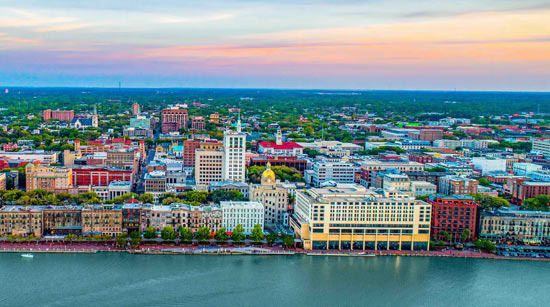
Savannah, Georgia, is not typically mentioned as a major city within the Korean community in the United States.
It doesn't have large Korean towns like LA, Irvine, or Atlanta, nor is it a city lined with Korean restaurants and markets. However, after hearing from Koreans who have lived there for several years, many express that their "satisfaction is higher than expected." The reasons are not solely due to the cost of living; Savannah has its own unique atmosphere and lifestyle rhythm.
The first thing to mention is the city's overall vibe. Savannah is often cited as one of the most beautiful cities in the southern United States. The historic downtown area features 22 historic squares, and the old oak trees are draped with Spanish Moss. In spring, azaleas bloom throughout the parks and streets, creating a soft and relaxed atmosphere across the city.
This feeling is completely different from the hustle and bustle of cities like New York or Atlanta. In fact, some people who have moved to Savannah after feeling exhausted from big city life describe it as a "change in breathing pace."
The racial composition is also relatively diverse. Savannah is one of the southern cities with a high percentage of Black residents, and the White and Black communities have coexisted for a long time. Recently, due to the influence of SCAD (Savannah College of Art and Design), the number of international students and foreign residents has increased significantly. Although the Asian population is not high, the atmosphere towards foreigners is relatively welcoming.
Generally, the ratio of Black to White residents is about equal, while the Asian population is a small percentage of the total. However, because it is a tourist city with many international students, many people experience a surprisingly open atmosphere.
The cost of living is also one of Savannah's advantages. Although housing prices have risen across the United States recently, Savannah remains less burdensome compared to other eastern metropolitan areas. Depending on the area, the median home price often ranges from $300,000 to $400,000. While historic districts and upscale riverfront areas are much more expensive, you can find relatively spacious single-family homes in suburban areas.
Compared to northern Atlanta, northern Virginia, and New Jersey, the entry costs are definitely lower. The property tax burden is also relatively light, which is one reason why middle-aged individuals considering retirement show interest.
The healthcare environment is rated quite well considering the city's size. Memorial Health University Medical Center operates a Level 1 trauma center, and the St. Joseph's/Candler hospital system provides stable medical services in the area. While it may not reach the level of large metropolitan cities, the basic healthcare infrastructure is relatively well established.
Of course, there are clear downsides. The most frequently mentioned issue is the lack of Korean infrastructure. There are not many choices for Korean restaurants, and to buy a variety of Korean ingredients, one may need to travel to Asian markets.
The weather can also be polarizing. Winters are mild, but summers are hot and humid. The unique humidity of southern Georgia makes the heat feel quite intense in the middle of summer. On the plus side, there is almost no worry about snow, and outdoor activities can be enjoyed year-round.
Ultimately, Savannah is a city where satisfaction can vary greatly from person to person. If you desire flashy shopping malls, large Korean towns, and a fast-paced urban lifestyle, it may feel dull. However, for those who value quality of life over competition and pace, it often turns out to be a surprisingly good fit.
In fact, among those who have lived there for a long time, some say, "It's not an incredibly convenient city, but strangely, I don't want to leave."
Savannah is a city that suits those who prioritize atmosphere and lifestyle rhythm over size.
 InfoUncle
 MacaronMaker

 cheesepup |
 breezem |
 yentra |
 virex |
 vexon87 |
 bravo777 |
 Bearded Strawberry Smoothie |
 InJung Gu |
 Sunny Mom |
 Idaho's Sumi's House |
  Mr. Midwest America |
  wildfire |
  kerkee |
  legalway |
  postcard |
  cheesecake07 |
  My Miami Stories |
  windylotus |
  Mia Flori |
  velaro29 |
  velaro |
  foxtrot83 |
  moname |
  mapleline |
  US Legal Consultation on Trials |
  UNI Lover |
  Karina's Blog |
  California Dreamer |
  Choco Mint Creator |