
Recently, I heard a story from a friend who went for a consultation about their child's orthodontics, and they said their expression froze when they received the estimate.
The amount quoted by the orthodontist was nearly six thousand dollars for the entire treatment, even though it was for metal braces.
In fact, the average cost of children's orthodontic treatment across the U.S. ranges from three thousand to seven thousand five hundred dollars, with the overall average according to the American Dental Association being between five thousand and six thousand dollars.
Ceramic braces cost between four thousand and eight thousand five hundred dollars, while clear aligners like Invisalign can go from three thousand five hundred to nine thousand dollars, so the material choice makes a significant difference.
Even if your dental insurance covers orthodontics, you shouldn't feel too secure. Typically, it only covers about fifty percent of the total cost, and often has a lifetime limit of one thousand five hundred to three thousand dollars.
So, don't let having insurance make you complacent; it's good to know in advance that any amount exceeding the limit will ultimately be out of pocket.
The first step to reducing costs actually comes before treatment begins. The American Association of Orthodontists recommends that children have an evaluation around age seven, as identifying issues early can prevent the need for more extensive treatment later.
However, a seven-year checkup doesn't necessarily mean treatment will start right away; most children will just be monitored for a few years until their permanent teeth come in before starting actual treatment.
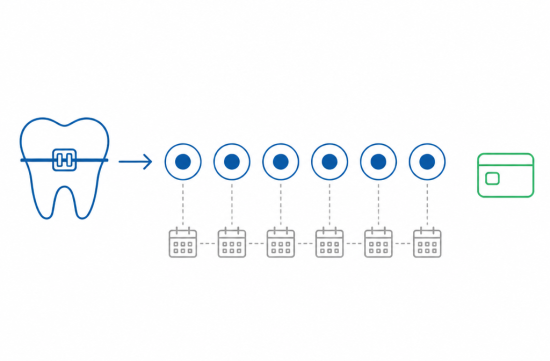
That's why many people look for payment plans offered directly by orthodontist offices, where the most common method is to pay about twenty-five percent of the total cost as a down payment.
These days, more places are lowering the barrier to entry with down payments as low as three hundred dollars, and the remaining balance is typically paid in monthly installments of one hundred to three hundred dollars over twelve to twenty-four months.
It's fortunate that many places offer interest-free options, but it's essential to check the contract to confirm that there really is no interest before signing.
In addition to the office's payment plan, some people use separate medical credit cards like CareCredit, but if you don't understand the terms well, you could end up worse off. While it may be interest-free for six to twenty-four months if paid in full, if you don't pay it off in time, interest can retroactively apply from the original payment date, potentially resulting in a hefty interest rate of around seventeen percent.
Also, even for the same treatment, estimates can vary significantly between offices, so it's often much more beneficial to get consultations from at least two or three places before making a decision.
Using an FSA can significantly reduce your actual out-of-pocket expenses, but surprisingly, many people are unaware and just pay with a card.
As of 2026, the annual limit for FSA is three thousand four hundred dollars, which is a hundred dollars more than last year, and up to six hundred eighty dollars of any unused amount can be rolled over to the next year.
However, there is a unique regulation regarding orthodontic treatment costs that differs from other medical expenses. The IRS has made an exception for orthodontics, allowing claims based on the payment date rather than the date of actual treatment.
While FSA claims are generally based on the date of service, for orthodontics, it means you can claim from the time you make the down payment, allowing for a strategy to use the limit in the first year.
However, since the rules can vary by company plan regarding whether you can claim the down payment all at once or only in monthly installments, it's best to check with your HR or FSA administrator first.
If it were me, I would compare estimates from several consultations and plan to align the FSA limit with the timing of the down payment. It's worth the effort to double-check the paperwork when thousands of dollars are at stake.
Orthodontic treatment for children is tricky to delay and involves a significant upfront cost, so I've come to realize how much these systems can really make a difference.
 MeatballSun


 holy cheese |
 Softy |
 Michigan Enthusiast |
 Anna Life |
 JESIKYEOALBA BLOG |
 gravity |

 Seattle - Emerald City |
 timemachine |

 bluebird |
  wildfire |
  kerkee |
  legalway |
  postcard |
  cheesecake07 |
  My Miami Stories |
  windylotus |
  Mia Flori |
  velaro29 |
  velaro |
  foxtrot83 |
  moname |
  mapleline |
  US Legal Consultation on Trials |
  UNI Lover |
  Karina's Blog |
  California Dreamer |
  Choco Mint Creator |
  Chili Boy Club |
  NE Hodori Preik |