
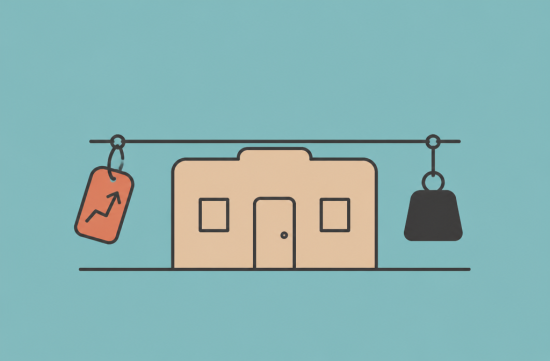
To summarize the Albuquerque market in October in one line: home prices are mostly stagnant while interest rates remain around 7%, increasing the burden on buyers, and rents are gradually rising.
Tenants and landlords interpret the same numbers differently. So today, I will lay out both perspectives side by side and examine them one by one.
First, let me clarify the data being referenced. The sales data comes from the Greater Albuquerque Association of Realtors (GAAR), which released a weekly report as of October 26, based on Southwest MLS data.
The transaction totals for October have not yet been released, so the most recent monthly figures are from the end of September. When looking at the weekly indicators for October alongside the interest rates, the trends become quite clear.
The median sale price in September was $375,000, which is a 1.4% increase from a year ago. It's notable that it has remained at the same $375,000 for four consecutive months since June.
In simple terms, prices are stuck at a ceiling, unable to rise or fall. Compared to the national median existing home price of $417,500, Albuquerque is still a step below.
The average time properties stayed on the market was 39 days, which is actually shorter than the 42 days from a year ago.
Homes sold for about 98.6% of their original listing price, which is the same as last year. If the terminology is unfamiliar, think of it this way: a house listed at $400,000 sold for an average of about $394,400.
Inventory stood at 3.1 months, which is a 3.3% increase from a year ago. This means that if no new listings come onto the market, all current inventory would be sold in just over three months, with a typical balance point being around 5 to 6 months.
For the week ending October 17, there were 226 new listings, 185 contracts signed, and total inventory of 2,553 properties. The 8.8% increase in contracts signed compared to a year ago was somewhat surprising.
The issue is the interest rates. The average 30-year fixed rate from Freddie Mac started at 7.28% on October 1 and rose to 7.40% by the 15th.
It then dipped slightly to 7.32% on the 22nd and 7.24% on the 29th, but it remains in the 7% range. Compared to 6.17% at this time last year, that's over a point difference.
The 15-year fixed rate was 6.60% as of October 29. For those who find monthly payments burdensome but want to reduce total interest, this is a viable option to consider.
The impact of these rates can be seen in the housing affordability index. The index for September was 82, down 7.9% from 89 a year ago.
In simpler terms, this means that a median-income household can only earn 82% of the income needed to purchase a median-priced home. A score above 100 indicates a comfortable purchasing level, so the current situation is quite tight.
Now, let's move on to rents. According to data updated by Zumper on November 1, the rent for a one-bedroom in Albuquerque is $995, which is a 4% increase from a year ago.
The rent for a two-bedroom is $1,250, up 1%, and for a three-bedroom, it's $2,025, which is a 4% increase. Larger units tend to show more significant increases.
However, rent statistics can vary greatly between sites. Data from RentHop in August even showed a decline, so I recommend checking multiple sources rather than relying on just one.
From a tenant's perspective, it's important to note that those who find it difficult to buy homes are remaining in the rental market, which supports demand for single-family home rentals. Expecting a percentage increase upon lease renewal is realistic.
New Mexico state law prevents cities or counties from implementing rent control. A bill, SB 138, was introduced to lift this ban by the 2026 session but has been indefinitely postponed.
Instead, the city is focusing on improving housing conditions. This year, the city council passed an ordinance requiring landlords to address reported habitability issues within 72 hours.
The city has also created a so-called lazy landlord list, publicly naming ten landlords who have repeatedly neglected property maintenance. After a seven-day grace period, fines start at $500 per violation.
If you're a tenant, it's advisable to report issues like broken air conditioning or leaks not just verbally but also through text or email with a timestamp. If unresolved, you can report it to the city code enforcement at 311.
From a landlord's perspective, now is a good time to organize maintenance records. Keeping track of repair requests and completion dates will make disputes much easier to handle.
If you live out of state and manage a rental in Albuquerque, be sure to check your local management company's contact information. The 72-hour deadline can be surprisingly short for finding a contractor from afar.
Comparing buyers and renters, here's the situation: buyers face less upward pressure on home prices and have a bit more room for negotiation, but they must manage interest rate burdens, while renters have no interest rate concerns but should brace for annual increases.
If it were me, I would prefer to maintain renting rather than buying aggressively right now, waiting for interest rates to drop to the 6% range. However, if it's a long-term home and the monthly payment is manageable, now might not be a bad time given the price stagnation.
By mid-November, we will have the monthly figures for October. Let's keep an eye on whether the median sale price holds at around $375,000 and if inventory continues to rise.
 AutoOkay





 Choco Choco Star |

 gentle |
 neapolis |

 moo moo |

 ultron78 |
 silents |

 Southwestern |

 Mrs New Mex |

 frostbite |

 New Mexico Friends MAX |
 butter 90 |
 Flying Shooting Star |
 ROLDU WAY |
 dreamming |
 greenloop |
 Glow Yo |
 heartwarming |
 Jersey City |
 content |
 FROM Wyoming |
 My Love Bambino Alaview |
 Lord Island |
 fantastic |
 nero kim |
 Alaska Salmon Buyer |
 solvix18 |
 California Information News |
 HAWAII Korean Church News |
 Raomi News |