
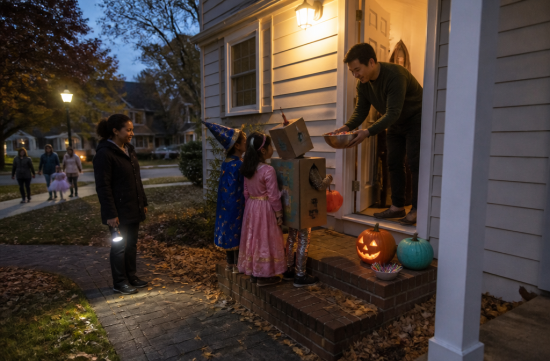
Last year around this time, after the sun went down, the doorbell kept ringing, and since I hadn't bought any candy, I turned off the living room lights and held my breath.
Later, I found out that the issue wasn't the candy but the porch light. If the porch light is on, it means candy is ready.
This year, I wanted to do it right, so I looked up various tips. I hope this helps those who are feeling a bit lost for their first Halloween.
This year, Halloween falls on Saturday, October 31. Since there's no school the next day and kids will have plenty of time during the day, it seems likely that they will start trick-or-treating earlier and in larger numbers than on weekdays.
The most basic signal in America is the porch light. If it's on, it means you're welcome to stop by, and if it's off, it means to just pass by.
This isn't a law but an old neighborhood custom. Still, most people seem to follow this signal quite well.
Putting out a lit pumpkin lantern or decorations in front of your house is read the same way. If you have decorations but don't open the door, it might disappoint the kids.
On the other hand, if you don't plan to participate or will be away, just turning off the porch light is enough. There's no need to feel guilty at all.
Each town may announce recommended times separately. I couldn't find our neighborhood's official times this year, so it's best to check the borough website or police announcements.
Candy should be individually wrapped store-bought products. Homemade cookies or unwrapped snacks are appreciated for the effort, but most parents throw them away for safety reasons.
People are surprisingly serious about candy. According to a survey by the National Retail Federation (NRF), total Halloween spending is expected to reach $13.5 billion this year, with $4.1 billion of that on candy.
The same survey found that 61% of respondents plan to hand out candy. Seeing the numbers helped me understand why the neighborhood was so lively.
One important thing to know is about teal pumpkins. The Teal Pumpkin Project by the food allergy organization FARE indicates that homes with these pumpkins have non-food treats available.
Common non-food treats include stickers, bubbles, glow bracelets, pencils, and spider rings. You can get a bag of these from the dollar store, and kids tend to respond positively to them.
The FARE website also has a map showing participating houses. Parents of children with allergies use this map to plan their routes.
One thing to be cautious about is keeping the non-food treats separate from the candy. Some allergies can react to very small amounts, so you can let the kids choose which bowl to go to.
When kids come, they usually shout, "Trick or treat!" You can give them one or two pieces or hold out a bowl for them to pick from. If a shy little one doesn't speak up, just smile at them first, and a compliment about their costume will brighten their faces.
The types of visitors change throughout the evening. Early on, there are many little ones holding their parents' hands, and as it gets darker, more older kids come in groups.
You might feel a bit surprised when tall teenagers come by. However, since it might be their last year trick-or-treating, it's better to smile and give them candy just like everyone else to keep the neighborhood spirit alive.
If you find it hard to stay home, some people leave a bowl outside with a note saying, "Please take one." Just be prepared that it's rare for there to be leftovers for the latecomers.
If you run out of candy, just turn off the porch light. That's the cleanest way to signal that you're done.
Also, make sure to check the path to your door. Keep the driveway lit, and clear away any leaves, hoses, or pots from the steps.
If you have a dog, it's best to keep them in a room inside on Halloween night. Even a gentle dog can become sensitive with the doorbell ringing dozens of times, and there's a chance they might dart out when the door opens.
If you're using real candles inside pumpkins, place them somewhere they won't tip over in the wind. It's easy for costume fabric to brush against them, so I decided to use LED candles for peace of mind.
Drivers should slow down on neighborhood streets that evening. Kids in dark clothing can suddenly pop out between cars.
Honestly, it still feels a bit strange to open the door to strangers. However, according to long-time neighbors, it's a day to get to know the faces in the neighborhood all at once.
Even those you usually just wave to will naturally ask for names when standing at the door with kids. Hearing that made me feel a bit regretful about last year.
So, there's no need to stress over expensive candy or elaborate decorations. Just keeping the light on and opening the door with a smile is enough.
If it were me, I'd do this: one bag of individually wrapped candy, one small bag of non-food treats, and a porch light.
This year, I plan to sit outside with a chair instead of hiding. I'm already looking forward to that evening when I can hear the sound of kids laughing amidst the crunch of leaves.
 CrystalStone96


 Giant Squid and Sweet Potato Soup |

 choi family |

 What can make money? |

 road98 |

 Baguette Blog |

 mygoddess blog |

 springwaltz |

 Living in New Jersey blog |

 midnight blue |

 Delicious Food Finder |

 Soy Angelino |
 autumn |
 K-POP TV News |
 cortiva6 |
 Nevada Teppanyaki |
 aerion99 |
 Golado |
 Maximum Pro |
 Joyce blog |
 Atlanta Business Information |
 Ansaso |
 Soft Feeling That Feeling |
 assa man |
 Yugo Girl I'm So Hot |
 nexaro |
 Experiences Living in America |
 arsnack |
 Nebraska Center Director TOP |
 Florida Gario |
 menmo |