

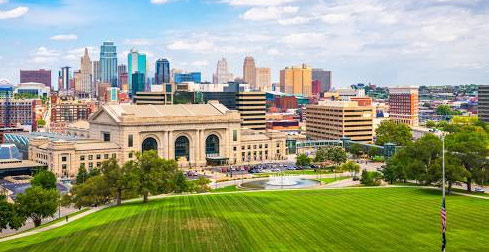
Kansas City, Missouri, established in 1838, is located west of the Mississippi River. Initially centered around agriculture and trade, it rapidly grew with the development of railroads in the mid-19th century. The railroads made Kansas City an important transportation hub, leading to the flourishing of commerce and manufacturing.
In the early 20th century, Kansas City played a significant role as a center for manufacturing and the military industry during World War II. After the war, the economy diversified with the growth of finance, healthcare, and technology industries. In particular, agricultural technology and service industries developed significantly, supporting the stability and growth of the local economy.
Culturally, it is known as a center for jazz and blues, hosting various music festivals and art events each year, attracting many tourists. Additionally, sports teams are actively involved, contributing to the identity and pride of the local residents.
Population
As of 2023, the population of Kansas City is estimated to be around 500,000. This makes it one of the largest cities in Missouri, forming a large metropolitan area with nearby regions. Kansas City is a multicultural city where various races and cultures coexist, with the following demographic composition:
- White: approximately 48%
- Black or African American: approximately 40%
- Asian: approximately 4%
- Hispanic or Latino: approximately 5%
- Other races: approximately 3%
Kansas City has a balanced distribution of young populations and various age groups, allowing for a vibrant urban life. Additionally, several universities and educational institutions are located here, with many students and researchers residing, contributing to the city's intellectual capital.
Median Income
The median household income in Kansas City is reported to be around $60,000 (USD). This is slightly lower than the national average but represents a moderate income level within Missouri. Key factors supporting the median income level include:
- Diverse industrial structure: Various industries such as manufacturing, finance, healthcare, and technology have developed, providing a range of job opportunities. In particular, the healthcare and financial services industries contribute to higher median incomes.
- Education level: Residents of Kansas City generally have a high level of education, often working in professional occupations. Major universities and educational institutions provide abundant educational opportunities.
- Employment market: The development of various industries has led to high employment stability and relatively low unemployment rates. Particularly, the growth of technology and service industries has increased high-income job opportunities.
- Business environment: Many innovative startups and multinational corporations are established here, adding economic vitality. This contributes to the improvement of the median income level alongside regional economic growth.
Kansas City also has a relatively stable housing market, offering various housing options that allow households with median incomes and above to reside conveniently. The high median income reflects the city's quality of life and housing environment, with a variety of amenities and educational institutions well-established.
Additional Information
Average Housing Price: As of 2025, the average housing price in Kansas City is estimated to be around $250,000 (USD). This is relatively lower than the national average, providing a more accessible environment for home purchases. Various housing types exist, and in suburban areas, one can find larger spaces and reasonably priced homes.
Demographic Information: In addition to the previously mentioned population composition, Kansas City is home to residents from diverse cultural backgrounds, creating an environment where various races and cultures harmoniously coexist. This adds to the community's diversity through various cultural events, food, and artistic activities.
Education: Kansas City hosts several prestigious universities and research institutions. Educational institutions like Kansas City University maintain high educational standards and closely collaborate with the community. Additionally, public and private primary and secondary schools offer excellent educational programs.
Culture and Arts: Kansas City has a rich cultural heritage. Jazz clubs, art galleries, and museums are spread throughout the city, hosting various cultural events and art festivals each year, providing rich cultural experiences for residents and tourists. In particular, jazz and blues have established themselves as representative music genres of Kansas City.
Transportation: Kansas City has an efficient public transportation system and a well-developed road network, making travel convenient. Additionally, Kansas City International Airport is located here, facilitating domestic and international travel, with various transportation options such as rail and bus connections.
Kansas City, Missouri, plays an important role in the state, based on its rich historical background, diverse population, and stable median income. With the development of various industries, it also stands out in culture, arts, and education, providing a high quality of life for its residents. In the future, Kansas City is expected to further strengthen its status through continuous economic growth and innovation. Kansas City, where families, professionals, and people from diverse backgrounds live together, is establishing itself as an ideal residence with both economic stability and cultural diversity.







 ultron78 |
 garlic bread |
 Sugar Cream Door Bulletproof Noodles |
 urbanmint |
 |
| 
 roma |
 calviro |
 Kansas City Representative Singer |
 calvix |
 Iri Jori Missouri |
  Korean Mom |
  My NYC |
  moo moo |
  Mr Oh |
  forevergee |
  festival |
  manchester |
  constant |
  Leapfrog Move |
  vibranto |
  Tora Tora |
  yellowbutter |
  Dolly |
  US Embassy |
  NYC saladbar |
  Finding Superfoods |
  lightyear |
  song bang |
  vexomo |
  Indiana Jones |