
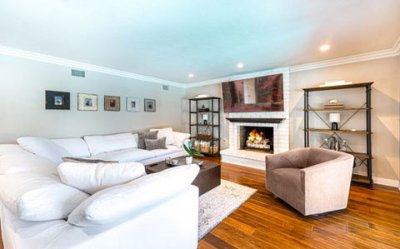
The first question that comes to mind is probably, "Should I start with a 1-bedroom or go for a 2-bedroom right away?" This is a common question I hear when talking to people planning to move to Irving. I will outline the rental prices and square footage by unit type while going through the items to check.
Studios have an average rent of $1,272 and an average area of 554 square feet. Since Irving is conveniently located between Dallas and Fort Worth, many single professionals looking for short-term stays tend to seek out studios.
A 1-bedroom averages $1,305 in rent and has an average area of 719 square feet. The rent difference from a studio is not significant at about $30, while the area increases by 165 square feet, so I generally recommend considering a 1-bedroom over a studio in Irving.
A 2-bedroom averages $1,692 in rent and has an average area of 1,035 square feet. This category is popular among two roommates, newlyweds, or families with one child. In Irving, the demand from professionals near Las Colinas and families prioritizing school districts overlaps, making competition for 2-bedrooms quite fierce.
A 3-bedroom averages $2,155 in rent and has an average area of 1,299 square feet. Families with two or more children primarily seek these units, and since Irving has good access to Korean markets and educational institutions, there is a steady demand for 3-bedrooms from Korean families.
- Studio: about $1,272 / 554 square feet
- 1-bedroom: about $1,305 / 719 square feet
- 2-bedroom: about $1,692 / 1,035 square feet
- 3-bedroom: about $2,155 / 1,299 square feet
Looking at the supply, new developments in Irving have the highest proportion of 1-bedrooms and 2-bedrooms, while studios are relatively scarce. The share of 3-bedrooms is also not large, so families with children should consider looking for listings a bit earlier than they might expect.
When examining the rent gap, the difference between moving from a studio to a 1-bedroom is not significant, but the gap becomes noticeably larger when moving from a 1-bedroom to a 2-bedroom and from a 2-bedroom to a 3-bedroom. This can be attributed to the increase in shared space and area as the number of rooms increases. For Korean families, it may be more comfortable to budget for a 1-bedroom when settling in alone and plan to transition to a 2-bedroom or 3-bedroom as the family grows.
 TidyEarnTdy
 ImmigrantLife







 moo moo |
 ultron78 |
 garlic bread |

 urbanmint |
 TOUCHE NEWS |
 Coco Chanel |

 wexlin84 |
 Texas Lone Star Longhorn Spirit |
  Texas Migration Story |
  Scade Studio |
  love ya |
  biscuit90 |
  chicpo |
  Helpful Life Stories |
  Kitchen Ideas |
  Diana Blues |
  Agenda Center |
  Community Cross |
  journey |
  heeve |
  leman |
  corner kick |
  treasure |
  strawberry |
  Augusta Univ |
  B.I.G. Victor |
  Victory 1988 |