
As mid-October approaches, the breeze in the French Quarter alleys has become quite cool. This morning, while enjoying a freshly baked biscuit and a cup of coffee, I recalled a question a guest had asked me.
The question was why people in this area do not bury their dead in the ground but instead place them in stone houses. Almost everyone who visits for the first time asks the same thing.
Tourist brochures always provide the same answer: the water table is high, so when you dig into the ground, it fills with water, and when it rains heavily, the coffins float up.
This is not incorrect. However, if that's all there is to it, you would only know half of what this city is about.
The story goes back to 1788. That year, a great fire, flood, and yellow fever outbreak hit simultaneously, quickly filling the cemetery on St. Peter Street.
As a result, the Spanish colonial government established a new cemetery just outside the city limits in 1789. This is now known as St. Louis Cemetery No. 1.
Interestingly, in the beginning, many burials were likely still done in the ground here. It wasn't until 1803, when a city ordinance mandated above-ground burials, that the landscape we know today began to take shape.
Of course, the ordinance didn't change things overnight. Enforcement was lax, and during the McCarthy Crevasse flood in 1816, the cemetery was closed for a time.
So, is it just because of the water? Not quite. The people who founded this city came from France and Spain, where above-ground burial in mausoleums or family tombs was the norm.
So, while the water pushed up from below, the customs from their homelands shaped the way it looks today. I find this explanation much more appealing.
Moreover, as the surrounding swamps were filled and drained, the water table has dropped significantly over the past 200 years. Yet, this method of burial continues.
What started as a practical solution has ultimately become a cultural practice, much like food and music.
If you look inside a family tomb, the structure is quite clever. The shelves are divided into upper and lower sections, where coffins are placed in the upper section, and the entrance is sealed with bricks and mortar.
The hot and humid southern weather heats the stone houses like ovens. This is why it is said that after a long time, a very slow cremation occurs.
The phrase that comes from this is "a year and a day." After this period, the remains are moved down to make room for the next family member in the same space.
The origin of this period is debated. Some say it is a custom to observe a year of mourning, while others connect it to the belief that we come from the earth and return to the earth.
Since several generations can share a single tomb, this is a wise solution for a city with limited land. It reminds me of the way southern grandmothers reuse biscuit dough multiple times.
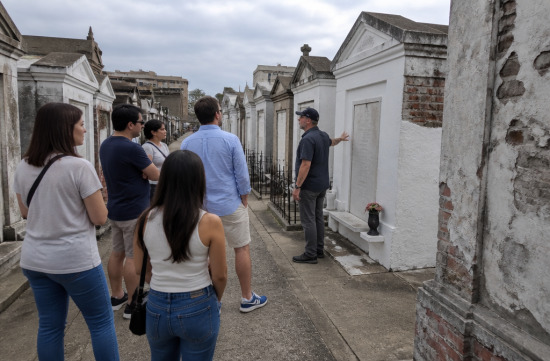
With these stone houses lined up like alleys, people have come to call this place the city of the dead. In reality, walking through, you'll see small roofs, iron fences, and nameplates resembling house numbers, creating a miniature neighborhood.
This small city is also home to some famous residents. There's a tomb believed to belong to Marie Laveau, known as the Voodoo Queen, where people draw X marks to make wishes, causing quite a headache for the authorities.
Homer Plessy, the plaintiff in the landmark Plessy v. Ferguson case that legalized racial segregation, is also buried in a family tomb here. Each grave is like a page in the history book of America.
We can't forget about the film connections either. The famous hallucination scene from the 1969 movie Easy Rider was filmed right here in this cemetery, and the church was quite displeased as it was done without permission.
I remember watching that scene in theaters back then, and everyone was whispering. Nowadays, that would be unthinkable, and in fact, the archdiocese does not allow filming unless it's for educational or documentary purposes.
These days, there's one more striking sight. There's a 9-foot tall white pyramid tomb that actor Nicolas Cage purchased, but it has yet to be engraved with a name.
The local reactions are mixed. Some question whether such a structure should be erected in an old cemetery, while others laugh it off as part of the city's quirky character.
One important thing to note is that since 2015, you cannot enter St. Louis Cemetery No. 1 alone; you must go with a guide registered with the Catholic archdiocese.
This decision was made due to severe vandalism. Initially, I was disappointed, but seeing people graffitiing on someone else's grave, I think it was the right choice.
This cemetery culture is also connected to jazz funerals. When heading to the cemetery, a brass band plays slow hymns, and on the way back, the second line switches to lively tunes, dancing down the street.
This city does not bury its sorrow in the ground but keeps it above ground, playing music in front of it again. I have yet to see a scene that better describes New Orleans.
As All Saints' Day approaches on November 1, families gather to clean the tombs and repaint them white. This is not much different from how Koreans visit graves during Chuseok.
If you happen to visit this city this fall, I recommend taking a guided tour. On your way back, if you enjoy a warm biscuit, you'll realize that the city of the dead is warmer than you might expect.
 GoldenWave


 Community Cross |

 Conflite Teacher |

 SEVEN SEVEN |

 Korean Mom |

 novapixel |

 ORAVEZIN Oppa |

 melon90 |


 AUTO OK |

 Certified Authentication Blog Page |
 love ya |
 biscuit90 |
 chicpo |
 Helpful Life Stories |
 Kitchen Ideas |
 Diana Blues |
 Agenda Center |
 journey |
 heeve |
 leman |
 corner kick |
 treasure |
 strawberry |
 Augusta Univ |
 B.I.G. Victor |
 Victory 1988 |
 Swift Falcon |
 venture |