
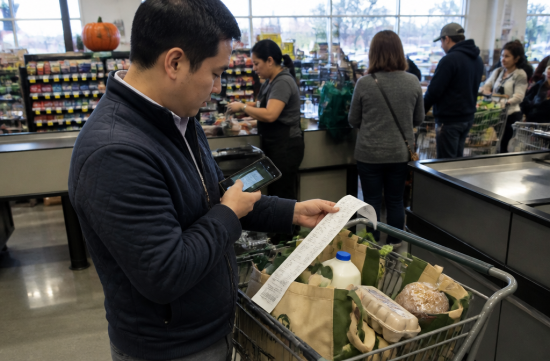
There are quite a few people around who pull out their phones as soon as they receive a receipt at the grocery store. This is due to rebate apps like Ibotta and Fetch.
Honestly, I was skeptical at first. I thought, how could taking a few pictures of receipts actually earn money? It seemed like the efficiency wasn't worth the time.
So today, instead of just guessing, I'll calculate based on the official rules of each app and actual user data over the course of a month.
First, the two apps have different structures. Ibotta requires you to select offers on specific products in advance, and you earn cash only when you purchase those items.
On the other hand, Fetch allows you to earn basic points just by scanning any store receipt, and you get bonus points if you purchase items from partner brands.
In short, Ibotta is targeted, while Fetch is more broad-based. This difference significantly affects monthly earnings.
Looking at Fetch first, the point value is 1,000 points for $1. You earn 25 points for each receipt scanned, which is about 2.5 cents.
If you scan 20 receipts in a month, you'll earn 500 points, or 50 cents, just from the basic points. I found that number a bit disappointing.
Ultimately, meaningful amounts from Fetch come from brand bonuses and referral bonuses. The basic earnings are essentially just a bonus.
Fetch's official blog explains that active users who consistently scan and take advantage of bonus offers earn about $5 to $15 in gift card value each month.
However, this is the company's explanation, so it should be taken with a grain of salt. A NerdWallet reporter who used it for a month reported earning just under $4.
It's also worth noting Fetch's rules. Paper receipts must be scanned within 14 days of the purchase date, and you can upload a maximum of 35 receipts every 7 days.
Many gift cards can be redeemed starting at 3,000 points, or $3. However, the points required can vary by brand, so it's safest to check directly in the app.
Now, let's move on to Ibotta. Ibotta's earnings are based on cash, making the calculations much more straightforward.
The minimum withdrawal amount is $20, and you can receive it via bank transfer, PayPal, Venmo, or gift card. The ability to withdraw actual cash is definitely an advantage over Fetch.
The issue is how quickly you can reach that $20. If you frequently find offers on the items you usually buy, you can reach it in a few weeks, but if the offers don't match your shopping cart, it can take several months.
The receipt submission deadline is also stricter than Fetch. According to Ibotta's customer service, purchases requiring receipt submission must be uploaded within 7 days of the purchase date, and if you wait until the 8th day, it may be considered expired.
And this is something that must be emphasized. Ibotta deducts $3.99 from the balance of accounts that have been inactive for 180 days, every 30 days.
There's no fee during the first 6 months after signing up, and deductions only occur within the remaining balance. However, if you forget about it for a few months, the money you've saved can quietly disappear.
The way to avoid this is simple. Just use one offer within 180 days or receive a referral bonus once.
Now, let's imagine a month of grocery shopping for an average working person. Let's assume they go to the grocery store once or twice a week and occasionally stop by a drugstore or gas station.
With Fetch, the basic earnings of 50 cents plus a few bonuses would realistically range between $2 and $5. This aligns with figures reported by independent reviews of typical users.
Ibotta's earnings can vary greatly depending on how carefully you select offers. Some weeks, you might earn several dollars if there are offers on basic items like milk, eggs, and bread, while other weeks, you might earn nothing.
In conclusion, using both apps together would realistically yield about the cost of a few cups of coffee each month. It's not enough to change your rent or grocery prices.
Still, I think it's worth using. It only takes about 10 seconds to scan a receipt, and it's money coming from items you were already planning to buy.
The only caution is this: the moment you buy something you wouldn't have purchased just to get a rebate, it becomes an expense rather than a savings.
If the brand on offer is more expensive than the private label products you usually buy, you could end up losing money even with the rebate. Ultimately, you need to compare based on the final payment amount.
And it's also worth remembering why these apps are free. The purchase data we upload is used for brand marketing, and that's the reward we receive.
If you don't like that, you can choose not to use them, and if you're okay with it, it's a reasonable trade-off. The choice is yours, but it's important to know what you're giving up and what you're getting in return.
If it were me, I would use Fetch habitually for all my receipts and check Ibotta for offers for just 5 minutes before shopping. That seems to be the best combination for the time invested.
It may be small amounts, but after a year, you could accumulate a few gift cards. Knowing the numbers from the start means you won't be disappointed or overspend.
 redvalleywalker1995








 SKy Face |

 gleeful |

 forevergee |

 mortrix |

 cherrydino |

 Living with a Consistent Heart |

 U.S. Weather Bureau News |

 quanta7 |

 same same life |

 Texas Migration Story |
 lumbus |
 Scade Studio |
 love ya |
 biscuit90 |
 chicpo |
 Helpful Life Stories |
 Kitchen Ideas |
 Diana Blues |
 Agenda Center |
 Community Cross |
 journey |
 heeve |
 leman |
 corner kick |
 treasure |
 strawberry |
 Augusta Univ |
 B.I.G. Victor |