
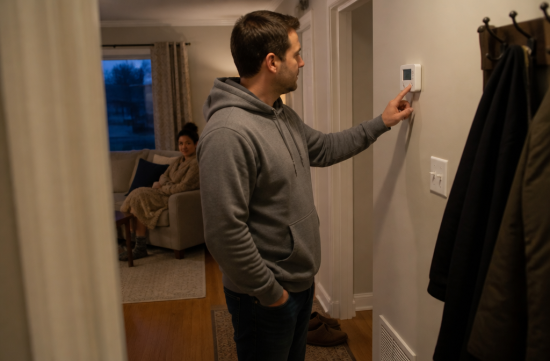
Last weekend, after early soccer, we gathered at a charcoal grill restaurant, and before the meat was even cooked, the table was buzzing with discussions about the thermostat. One guy complained that someone had set it to 72 degrees again, while another confessed he was the one secretly lowering it.
Everyone laughed, but there was a strange sincerity behind the laughter. In mid-October, when the mornings and evenings start to get chilly, a quiet war begins over that small square box attached to the wall in every American home.
This isn't just our little group. According to a survey released by the Canadian power company BC Hydro in 2019, more than 40% of couples reported having arguments over home temperature.
What's even funnier is the next statistic. Nearly 60% of respondents admitted to adjusting the thermostat when their partner wasn't looking, and more than half said they waited for their partner to leave before turning the dial.
About 20% even reported intentionally changing the settings to annoy their partner, which is almost like a sneaky offside trap in football.
Of course, since this survey was conducted as part of a promotional effort by the company, we shouldn't take every number at face value. Still, the trend is clear: people living together often have different perceptions of comfort.
So why is there such a mismatch? One of the most interesting studies I found was published in the journal Nature Climate Change in 2015, which involved research from the Netherlands.
The researchers pointed out that the office heating and cooling standards were based on the metabolic rate of a 40-year-old, 70-kilogram male from the 1960s. When they measured 16 young women doing light office work, their metabolic rates were significantly lower than the standard.
It's natural to feel colder at the same temperature if your body generates less heat. However, the sample size was only 16, and the American Society of Heating, Refrigerating and Air-Conditioning Engineers raised objections to the interpretation.
So, it's not something that can be solely attributed to gender. Factors like age, body size, and whether you're sitting all day or moving around can greatly affect how we perceive temperature.
For instance, I experience this myself. On days when I'm working on my laptop at home, by around 3 PM, my fingertips get cold, and I pull out a hoodie, but on days when I come in from playing soccer, I feel warm even in a T-shirt.
For those who have lived in Korea, there's another factor. Bodies accustomed to the warm ondol heating system find themselves in a strange state when they encounter American air heating, feeling warm on top but cold on their feet.
Since the heated air from the furnace rises to the ceiling, when you're lying on the sofa, your face feels hot, but your toes are cold. This leads to constantly raising the temperature, while the person next to you says it's too hot, creating an endless cycle.
So, what should the standard be? The U.S. Department of Energy recommends setting the thermostat to around 68 degrees when you're awake at home in winter, and lowering it further when you're sleeping or out.
According to the Department of Energy, lowering the temperature by 7 to 10 degrees for about 8 hours a day can save you up to 10% on heating and cooling costs annually.
For homes using heat pumps, the situation is a bit different. If you lower the temperature too much and then raise it again, the auxiliary heater may kick in, reducing efficiency, so it's better to make small adjustments.
Also, for those living in apartments or rentals, it's good to know this: New Jersey regulations require that from October 1 to May 15 of the following year, rental properties must maintain a temperature of at least 68 degrees from 6 AM to 11 PM, and at least 65 degrees from 11 PM to 6 AM.
So, if you're in a building where the landlord controls the central heating, 68 degrees isn't just a number you can argue for; it's the legal minimum. If the heat isn't working, take a picture of the thermometer and contact the management office or city hall.
There's also a common misconception that if it's cold, setting the thermostat to 80 degrees will heat the house faster.
Most residential furnaces don't heat the house faster just because you set a higher temperature. They run at the same speed and just take longer to reach the target temperature, which means you'll end up turning it down again and wasting heating costs.
In football terms, it's like pushing all your defenders up when you're losing 0-1; you don't score, and you just get countered.
So, to summarize the solutions that came up at the charcoal grill restaurant table: First, agree on a number around 68 degrees, and have the cold person add layers with clothes and blankets.
Second, set a schedule for the thermostat. If you pre-set the morning, afternoon, evening, and night temperatures, the suspicion of who adjusted it secretly will decrease.
Third, gift slippers and a small rug to the person with cold feet. The conclusion from the guys was that covering your feet is much cheaper than raising the air temperature by 2 degrees.
Also, since many people say that dry air makes it feel cooler even at the same temperature, some households have added a humidifier. Just be careful to keep the humidity at a reasonable level to avoid mold.
In my opinion, the thermostat battle is less about the numbers and more about who holds the remote. So, if you set the number in advance, the chances of conflict decrease significantly.
Personally, I lean towards 68 degrees. If I feel too hot, I just pull off a blanket instead of opening a window, and if I feel too cold, I throw on a hoodie.
However, before heading out to play soccer after work, I turn the house temperature down significantly. It's nice to come back and cool off, and it makes the heating bill less painful to look at.
As the ribs were almost done, one guy said that our thermostat needs a peace treaty.
This fall, how about we all avoid sneaking our fingers around that square on the wall and instead sit down together like we do in front of the grill and agree on a number? Because in the end, warmth is about coming together, not just the temperature.
 TeacherJung


 Community Cross |

 Conflite Teacher |

 SEVEN SEVEN |

 Korean Mom |

 novapixel |

 forevergee |


 Delicious Food Finder |

 Reeno |

 Ready for sunshine |

 Hodong Prince Over Flex |
 Scade Studio |
 love ya |
 biscuit90 |
 chicpo |
 Helpful Life Stories |
 Kitchen Ideas |
 Diana Blues |
 Agenda Center |
 journey |
 heeve |
 leman |
 corner kick |
 treasure |
 strawberry |
 Augusta Univ |
 B.I.G. Victor |
 Victory 1988 |
 Swift Falcon |