
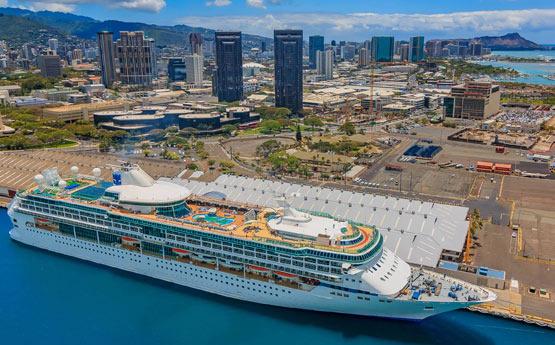
When you live in Hawaii, you can easily tell when cruise ships are coming into port. You can feel it even without an alarm.
From the morning, Waikiki suddenly gets crowded, and there are noticeably more tourists in the malls and on the beaches. At first, you might think, "Today is going to be a great day for business." However, if you observe for a while, you'll realize that the number of people doesn't always correlate with actual sales.
According to data from the Hawaii Tourism Authority, the number of visitors to Hawaii in 2025 is expected to be about 9.64 million, with total tourism spending reaching $21.75 billion. Interestingly, while the number of visitors decreased by about 0.6% compared to the previous year, overall tourist spending actually increased. This indicates that the quality of tourists—how much they spend—is more important than just the number of visitors.
Cruise tourists are a prime example. Cruise travel typically includes accommodations and most meals on the ship. Since the ship has restaurants, entertainment venues, and shopping facilities, tourists have relatively fewer opportunities to spend money on land. They often disembark for a few hours to buy souvenirs and visit attractions before returning to the ship. This is why, even with crowds on the streets, local restaurants and shops may not see the expected increase in sales.
Resort-type tourists exhibit similar behavior. Travelers staying at all-inclusive resorts or large hotels tend to handle their meals, activities, and shopping within the hotel. While this does help employ hotel staff, the amount spent in local restaurants or small shops may be relatively low. Particularly in the case of global hotel chains, some of the profits return to the headquarters, meaning the portion that remains in the local economy may be less than expected.
In contrast, tourists who use short-term rentals or small accommodations behave differently. They often seek out local cafes for breakfast, eat lunch at local restaurants, and shop at supermarkets, frequently buying souvenirs from local shops. This type of spending is directly connected to local small businesses, leading to a greater economic impact on the local economy.
Therefore, in Hawaii, there has long been a saying that "the quality of tourists is more important than the number of tourists." It's not just about how many millions visit, but rather how much each person spends and how much of that money stays in the community that matters more. The slight decrease in visitor numbers in 2025, coupled with an increase in overall spending, exemplifies this trend.
If you operate a business in Hawaii, it's definitely important to check the cruise ship schedules. Since foot traffic increases significantly during those days, it can be a good opportunity for businesses that sell souvenirs, simple food, or short experience programs. However, in the long run, relying solely on cruise tourists has its limitations.
Instead, providing 'real local experiences' that can only be found in Hawaii, such as local eateries sought by overnight tourists, cultural experiences, and hidden gem tours, is the way to ensure steady revenue. Travelers are increasingly seeking out restaurants and cafes recommended by locals rather than large chains.
Ultimately, what matters in Hawaii's tourism industry is not the number of people. Just because there are many people on the streets doesn't mean that money is flowing abundantly. To understand the true economic impact, we need to look at where tourists are spending their money and who benefits from that spending. It seems that Hawaii's businesses have entered an era where understanding the quality of spending is more important than just counting visitors.
 skyroadtraveler1983
 TunaSnackRec



 Coding Elf |
 Dragon Lee |
 gravity |
 Agenda Center |
 Texas Migration Story |
 Unknown Dog Walk blog |
 cococo now |
 Duke Ducks |
 Hawaii Fox |
  solid90 |
  elion |
  xylora |
  Study Abroad Life Know-How Tips |
  cheesepup |
  carpflow |
  mapsina |
  Softy |
  Mr. Largo |
  breezem |
  Omelet Rice for Strength |
  Vermont Capt |
  waltz |
  Shoot Me |
  Michigan Enthusiast |
  festive |
  Supplemental Security Income (SSI) Information |
  Sams Market |
  ansdal |
  VVV 80 |