

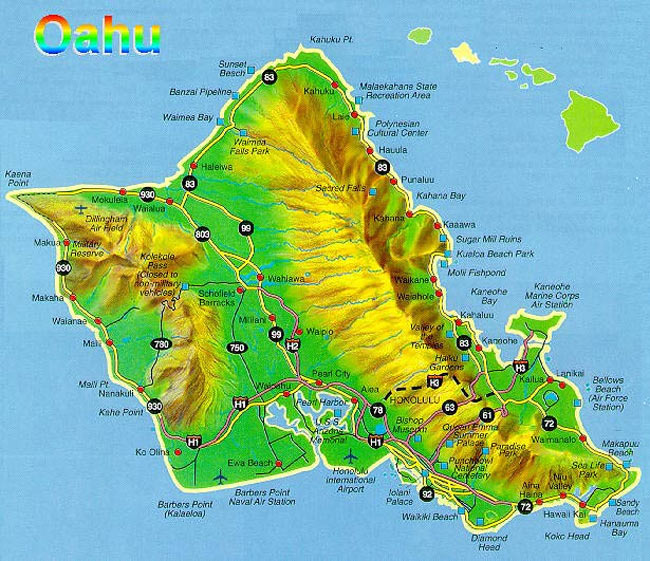
Living in Oʻahu feels quite strange.
It is the heart of Hawaii, home to Honolulu, the island where two-thirds of Hawaii's population resides, making it the most 'urban' island, yet it is also an isolated space surrounded by the ocean. The sky is always blue, the wind is warm, and the ocean is visible wherever you go, but this island is undoubtedly a world with boundaries.
Living in Oʻahu means, in a way, living in a 'beautifully confined world.'
At first, this place seems like a paradise. When you open the window in the morning, palm trees sway, and you can hear the sound of waves from afar. A short drive leads to a scenic coastal road, and on weekends, you can go to Waikiki beach or Kailua and feel the sand beneath your bare feet. Thanks to the warm weather year-round, there's hardly a need to pull out heavy clothes.
Oʻahu is smaller than you might think, as it only takes about two hours to drive around the island. From the northern tip at North Shore to southern Waikiki takes just over an hour, and the same goes from eastern Waimanalo to western Waiʻanae. The central part of the island is blocked by hills and mountain ranges, leaving no straight roads, so you ultimately have to take a winding route wherever you go.
Thus, the people of Oʻahu always live trapped in the 'roads of the island.' Even if one day you suddenly want to drive far away, the only places you can go are ultimately to the ocean. As you drive, the ocean appears, and at times, it feels like an insurmountable wall.
In that sense, Oʻahu is a beautiful yet frustrating place. Downtown Honolulu feels like a miniature city, small and charming. The skyline connects beautifully, and large shopping malls and office buildings line the streets, but whenever you look up, mountains always surround you.
With everything packed into the narrow flatland between the sea and the mountains, it's difficult to even build an apartment, and land prices soar. Therefore, most people live in cramped spaces, feeling both the reasons they cannot leave and the reasons they want to leave at the same time.
The road conditions on this island also make you feel those boundaries. Oʻahu's main roads consist of only three highways: H1, H2, and H3, which do not completely traverse the island. Especially during rush hour, the traffic congestion in Honolulu is notorious. Even in this paradise by the sea, thousands of vehicles are stuck on the road every morning.
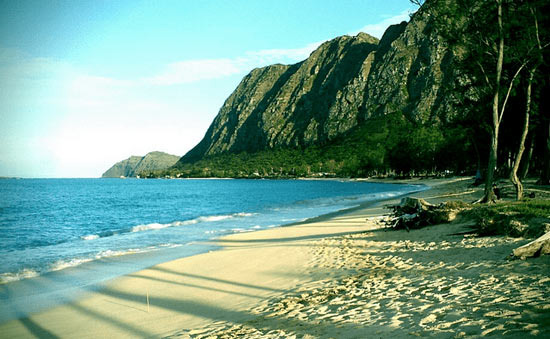
But that very aspect makes Oʻahu special. Because everything must be resolved within the island, the people here cherish relationships and have a strong sense of community.
A culture where family, friends, and neighbors rely on each other naturally forms. Even at the market, clerks greet you with a smile saying, "How are you, my friend?" and it's common for strangers to strike up conversations in coffee shops.
Living in Oʻahu also means being in constant touch with nature. There's always the ocean next to your commute, and during lunch breaks, a breeze from the mountains brushes against your cheek. On weekends, people go kayaking or hiking, and children learn how to play on the sandy beaches.
Ultimately, living in Oʻahu means 'living within the most beautiful fence in the world.'
Everywhere you look, picturesque scenery unfolds, but within it lies an invisible boundary. The ocean is free yet unreachable, close yet too far to cross. However, within that confined boundary, people learn true freedom.
It teaches us that we can be happy without going far, and the peace that this small yet vast world surrounded by the ocean provides shows us that. Oʻahu is thus an island that feels disconnected from the world yet holds a heart wider than the world itself.





 candytip |
 Gold Bar |
 Pirate Ship Popcorn Maker |
 Montgomery Mom |
 Anjollinya Blog |
 victoria 68 |
 Hawaii Tourist Information |

 TEX MEX STAR |
 HAWAII Korean Church News |
  laro90 |
  MEDBIO American Doctor Blog |
  SWAT TEAM BLK |
  DREAM BIG |
  frostbite |
  330 Forever My Love |
  El Dorado |
  dralix58 |
  Gorama Round |
  Skydiving |
  dreamport |
  Yellow Snowman |
  Toaster Pizza Magic Show |
  velvetnom |
  Anytime Journey |
  Mrs. Duluth |
  jaxter |
  Atlanta Mama |
  Baguette Blog |
  Tan Sol |