

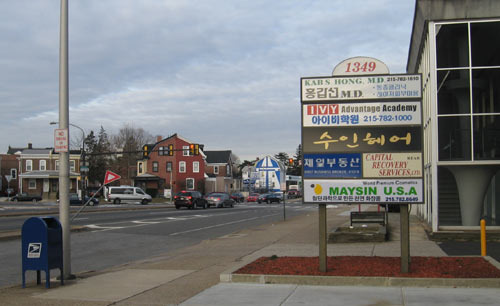
Philadelphia has a long history of Korean immigration, making it one of the older cities for this community in the eastern United States.
For Koreans who immigrated in the 1970s and 1980s, Philadelphia served as an important settlement area, distinct from New York or LA.
At one time, North 5th Street and the Olney area were lined with Korean signs, and there were many Korean businesses such as restaurants, grocery stores, laundries, delis, and beauty supply shops.
However, these days, the feeling of a Korean town in downtown Philadelphia has significantly diminished.
Population data reflects this change. In 2010, the Korean population in Philadelphia was about 7,074, but by 2020, it had decreased to approximately 6,011.
This represents a decline of about 15% over ten years. So where have the Koreans in Philadelphia gone?
They haven't all returned to Korea, nor have they all moved to other states.
A significant number have moved to the suburbs beyond the city limits of Philadelphia.
Initially, Koreans settled in the Logan area, then moved to Olney in the 1980s, and later, first-generation families who became economically stable began relocating to areas like Cheltenham and Montgomery County.
Especially when children are involved, the reasons become more practical.
They want larger homes, quieter neighborhoods, and decent schools.
As a result, more Koreans are now living in the suburbs while running businesses in the city. For example, they might operate a business in Olney but reside in Cheltenham.
Subsequently, Korean residential areas have expanded further into Montgomery County, including North Wales, Blue Bell, Horsham, and Lansdale.
To the west, there are Korean communities in Upper Darby, and across the Philadelphia River in New Jersey, areas like Cherry Hill and Marlton have also developed Korean enclaves.
Thus, interpreting the decline of the Korean population in Philadelphia simply as "Koreans are disappearing from Philadelphia" is somewhat misleading.
It is more accurate to say that the Korean community no longer needs to cluster in one urban area.
During the first generation of immigrants, language barriers made it essential to have close access to Korean grocery stores, churches, travel agencies, and insurance companies.
However, as the community transitions to the second and third generations, the situation changes.
Jobs may be located in Center City or King of Prussia.
Korean groceries can be purchased at H Mart by car, and Korean news and TV can be accessed online. Families in Korea can be connected instantly with just a smartphone.
The necessity to live next to a Korean town has significantly decreased compared to the past.
Additionally, there is the issue of generational change in long-standing Korean businesses.
It is no longer common for children of parents who have run a laundromat or restaurant for 30 years to inherit that business, as it once was.
Children naturally gravitate towards industries that align with their American upbringing and move to different regions for work.
As a result, when parents retire, a Korean business may close, and the small Korean community that revolved around that business gradually disappears.
In fact, while there are still many traces of Korean businesses on North 5th Street in Olney, it is difficult to say that it remains a Korean-only commercial area.
With the influx of Latinx, African American, and Southeast Asian immigrants, it has transformed into a much more diverse immigrant commercial district.
Ultimately, the Korean community in Philadelphia is not disappearing.
Instead, the once-concentrated Korean town is dispersing throughout the broader Philadelphia metro area.
 ElecLicense
 NBABall





 Peter Pan Pet |
 timemachine |
 Fortress K |
 RV Samuel's Dad |
 Uptown |
 DelphiaMo |
 American Grape Shine Muscat |
 heartwarming |
 American General Knowledge Expert |
  Texas Migration Story |
  California Dreamer |
  Bearded Strawberry Smoothie |
  Heart Ticker |
  Unknown Dog Walk blog |
  virex |
  Yoyma |
  Taco Seattle |
  zenvior |
  breaddough |
  arion9 |
  starfall |
  Kims Spring |
  vexon87 |
  seouljung |
  My Two Way |