

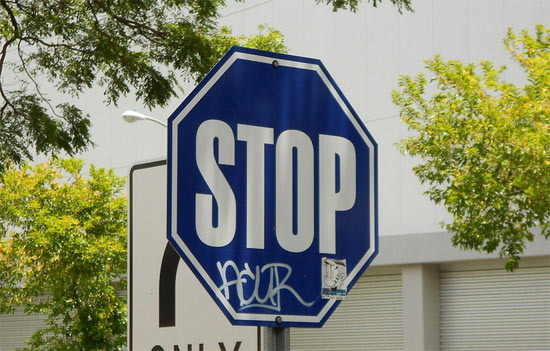
In Hawaii, you can occasionally see the fascinating 'STOP signs'.
While the red STOP signs look the same anywhere in the United States, strangely, in Hawaii, you sometimes see STOP signs with blue or green backgrounds. At first, I thought, "Is this just for decoration?" But it turns out there is quite an interesting local characteristic behind it.
The first time I saw a blue STOP sign in Hawaii was in a small town on the northern part of Oahu. It was an ordinary intersection, but instead of the familiar red, there was a blue background with white letters spelling 'STOP'. At that time, people were curious about what it was.
Such signs are not official government installations; they are signs made directly by local communities or private landowners.
In Hawaii, many roads are classified as private property or Private Roads, rather than under state or city jurisdiction. In such places, the regulations requiring the use of red are lax, allowing residents to install blue or green STOP signs that they purchase themselves.
Blue STOP signs are mainly seen at condo entrances, resort complexes, and farm roads.
They are not just for aesthetics; they also indicate that the area is not a public road. In other words, while traffic violations can incur fines on public roads, the legal implications are different on private roads.
However, from a driver's perspective, it can be confusing. In mainland America, STOP signs of colors other than red are almost illegal. Yet in Hawaii, this 'flexibility' has somehow become a part of the culture.
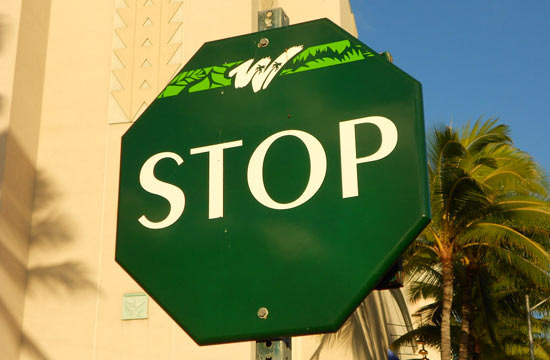
Green STOP signs are similar. They are occasionally found in rural areas, near beaches, or in local neighborhoods.
The green background is generally preferred by environmental protection groups or farming communities. They want to express Hawaii's unique eco-friendly atmosphere by creating signs that resemble nature. So from a distance, it feels more like a suggestion to "take a break" rather than a strict "stop". Perhaps that reflects the philosophy of the people of Hawaii.
Overall, Hawaii's traffic culture is laid-back. For motorcyclists, not wearing a helmet is not illegal. There is hardly any fighting over merging while driving, and most cars stop for pedestrians at crosswalks. Therefore, even when seeing a blue STOP sign, ignoring the signal is rare. The "Aloha spirit" is present on the roads as well.
Tourists often post about these STOP signs on social media. Some take photos in front of the blue signs, saying, "In Hawaii, even STOP is a healing color." In fact, these signs are not officially recognized as standard traffic signs, so the state government does not officially acknowledge them.
However, residents view them more as a 'uniqueness of our neighborhood' rather than an inconvenience. In some resort complexes, the color of the STOP signs is matched to the building design. For example, a beach resort with a turquoise sea background might have blue STOP signs that match the color of the sea. This becomes an 'Instagram point' for tourists and a promotional element for the resort.






 victoria 68 |
 TEX MEX STAR |
 Vacation on Hawaii |
 Hawaii Tourist Information |
 manchester |
  constant |
  Leapfrog Move |
  vibranto |
  Tora Tora |
  yellowbutter |
  Dolly |
  US Embassy |
  NYC saladbar |
  Finding Superfoods |
  lightyear |
  song bang |
  vexomo |
  Indiana Jones |
  meloncat |
  novapixel |
  mortrix |
  Esther 1983 |
  fortbliss |
  Moscow Kim |