
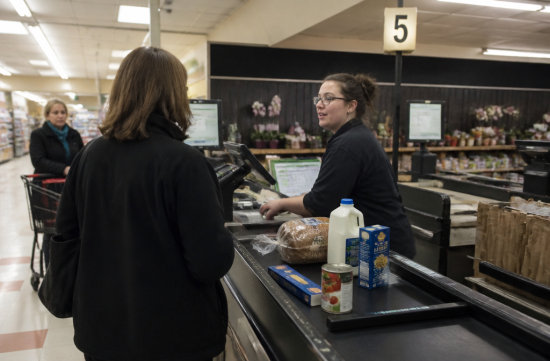
When I placed two bags of pasta and a can of tomatoes on the checkout counter, the cashier paused scanning and asked, "What are you making for dinner tonight?"
There were three people waiting in line behind me. I reflexively replied, "Oh, just pasta," and the cashier immediately continued the conversation by asking how many cloves of garlic I was going to use.
By the time we finished checking out, we had even had a brief discussion about whether or not to melt anchovies in the pan. I never expected to leave the store after a recipe consultation.
At first, I thought it was just that cashier's personality. But even when I switched stores or neighborhoods, similar questions kept coming up.
"Do you have any plans for the weekend?" "The weather is crazy today, right?" "Is this cereal good?"
If a cashier in a Korean store had asked me about my dinner menu after looking at my shopping cart, I probably would have dropped my cart and run away.
So, I looked into what this chatter is all about.
First, let's talk about the scale. According to the U.S. Bureau of Labor Statistics, there will be 3,106,300 cashiers by 2025.
The median wage is reported to be $15.81 per hour, or $32,880 annually.
This occupation is projected to decrease by 206,000 jobs, or 6 percent, by 2035. As self-checkout stations increase, the overall amount of chatter is structurally decreasing.
But why do the cashiers that are still around engage in conversation?
In 2014, researchers Gillian Sandstrom and Elizabeth Dunn from the University of British Columbia conducted an experiment in a coffee shop.
They divided customers into two groups: one group interacted with the barista by making eye contact and having short conversations, while the other group simply placed their orders as efficiently as possible.
The results showed that the group that engaged in conversation felt better, and the researchers attributed this difference to a sense of belonging. The title of their paper was "Is Efficiency Overrated?" which I found amusing right from the title.
In the same year, Nicholas Epley and Juliana Schroeder from the University of Chicago conducted a similar study with over 800 commuters.
When they encouraged people to talk to strangers on trains or buses, those who engaged in conversation reported a more positive commuting experience than those who traveled quietly alone.
Interestingly, before the experiment, people predicted that being alone would be more comfortable and enjoyable.
This suggests that our belief in wanting a quiet checkout line is different from the actual experience of feeling good in a quiet checkout line.
This isn't just a matter of personal preference.
In 2023, the U.S. Surgeon General issued a report declaring loneliness and isolation as public health issues.
The report stated that a lack of social connection increases the risk of early death by 26 percent, which is comparable to smoking 15 cigarettes a day. I was a bit surprised when I first saw that number.
Interestingly, this habit varies greatly from country to country. In Europe, there is often a stronger perception that light chit-chat with strangers is an invasion of privacy.
Conversely, people in the U.S. tend to find that silence cold. The same 30-second conversation can be seen as polite in one place and rude in another.
Some countries have even reflected this in their store designs. The Dutch supermarket chain Jumbo opened its first so-called "chatter checkout" in 2019.
These checkouts intentionally take longer to process transactions while providing customers with someone to talk to, and they have since expanded to 200 locations.
According to the Dutch statistics office, one in three people over 75 experiences moderate to severe loneliness.
Of course, interpreting the chatter in American stores as entirely warm-hearted is a bit naive.
Many chains have scripted greetings, eye contact, and closing remarks that are part of their training and evaluation processes.
So, on some days, that friendliness is emotional labor and part of a job description that pays just over $15 an hour.
I tend to acknowledge both sides. Genuine conversation and scripted conversation can come out in the same sentence, and it can often be hard to distinguish from the listener's perspective.
So, I've found my own compromise.
On days when I'm feeling good, I pass by the self-checkout and stand in line with a cashier. On days when I'm in a hurry or don't want to talk, I stand in front of the machine.
Both are normal, and I don't think there's any need to feel guilty about choosing either option.
However, one thing is clear. Thanks to that cashier who reminded me to melt the anchovies, my pasta that day was definitely more delicious.
Learning that someone will always strike up a conversation when there's pasta in the cart is the most absurd yet useful rule I've learned in this neighborhood.
 CabbageMagic




 lavender |
 logger |
 Conflite Teacher |
 Unknown Dog Walk blog |
 Khan Film Blog Production |
 Nevada Teppanyaki |
 zoryan |

 Two LaLa World |
 Reno Cop |
 solid90 |
  elion |
  xylora |
  Study Abroad Life Know-How Tips |
  cheesepup |
  carpflow |
  mapsina |
  Softy |
  Mr. Largo |
  breezem |
  Omelet Rice for Strength |
  Vermont Capt |
  waltz |
  Shoot Me |
  Michigan Enthusiast |
  festive |
  Supplemental Security Income (SSI) Information |
  Sams Market |
  ansdal |
  VVV 80 |