

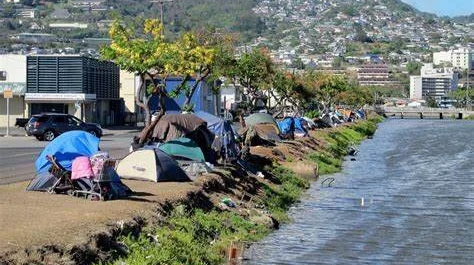
When living in Hawaii, you often see homeless individuals in tourist areas and neighborhoods alike, leading to a story you might hear at least once.
"All these people are homeless from the mainland who bought one-way tickets to come to Hawaii."
At first, it sounds plausible. If someone lives in Hawaii, they might have a foundation even if they are economically struggling, so it seems unlikely they would be homeless.
Isn't it better to be homeless in Honolulu than to endure the cold winters of New York or Chicago?
With warm weather in winter, beaches, and less worry about freezing to death, the idea is that many people come to Hawaii to experience homelessness if they have a few hundred dollars for a plane ticket.
In the 2026 Oahu PIT survey, 4,539 homeless individuals were counted. And it's not entirely untrue that some people fit this description.
There are confirmed cases of individuals who came from the mainland to Hawaii and ended up homeless after running out of money or failing to find a job. The homeless support organization IHS in Hawaii has been running a program to help return these individuals to their families on the mainland by covering their airfare. In 2022, it was reported that 599 people returned to the mainland from Oahu through this program.
So, the idea of "people flying in and becoming homeless" does exist.
However, the narrative has shifted strangely. At some point, it became perceived that "most of the homeless in Hawaii are people who flew in from the mainland."
Past government studies in Hawaii indicated that about 10% of recent arrivals in Oahu were from the mainland.
The report explained that, contrary to the belief that other state governments are sending homeless individuals to Hawaii in large numbers, most of them come on their own and then face economic collapse.
Above all, there is a significant issue of original residents losing their homes in Hawaii.
Housing prices and rents are extremely high, and the cost of living is also elevated.
The significant presence of Native Hawaiians and Pacific Islanders among the homeless population cannot simply be explained by saying, "mainland people have flocked here."
In the 2024 statewide PIT survey in Hawaii, 6,389 homeless individuals were counted, with about 70% or 4,494 of them located in Oahu.
Of the total, 63% were unsheltered, living on the streets, in cars, or on beaches.
The 2026 Oahu survey counted 4,539 individuals, revealing a somewhat unusual change.
The number of people living on the streets decreased by about 20% compared to 2024, and for the first time since 2018, more than half of those counted were in shelters.
Ultimately, the term "migrant homeless" is half true and half exaggerated.
Some people come from the mainland considering Hawaii's weather, while others arrive with hopes of tourism or a new life, only to end up homeless after running out of money.
However, the idea that homeless individuals disembark from planes in groups and set up tents on Waikiki Beach is far from reality.
Interestingly, the opposite direction of flights is more telling.
Hawaii has long operated a program that supports airfare for homeless individuals with family or housing on the mainland to return home.
If the issue of homelessness could be solved with just a plane ticket, Hawaii's homelessness problem would have been resolved long ago.
There are indeed homeless individuals who fly into Hawaii.
However, the reality of people losing their homes after living in Hawaii is a much more pressing issue.
While the paradise-like weather may create a favorable environment for homelessness, the paradise-like housing prices can also lead to homelessness.
 Brighto







 Yoyma |
 breaddough |
 Sunshine Blog |
 Tony Park |
 AliAluAlo Blog |
 Hawaii Fox |
 Unknown Dog Walk blog |
 cococo now |
 Duke Ducks |
  Texas Migration Story |
  California Dreamer |
  Bearded Strawberry Smoothie |
  Heart Ticker |
  Peter Pan Pet |
  virex |
  timemachine |
  Taco Seattle |
  zenvior |
  Fortress K |
  arion9 |
  starfall |
  Kims Spring |
  vexon87 |
  seouljung |
  My Two Way |