
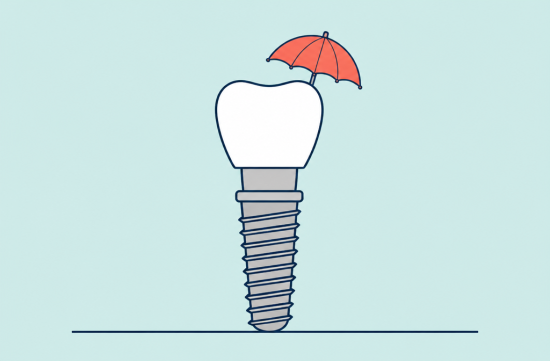
When you get a quote for an implant at the dentist, it makes you check your bank balance first. It's a bit frustrating that your dream of saving a million dollars is shaken by just this one thing.
What's even more frustrating is what comes next. When you ask, "I have dental insurance, right?" you find out that the amount covered by insurance is much less than you expected.
Let's look at the prices first. According to MetLife, the cost of one implant ranges from $3,000 to $6,000.
If we break it down, the post that goes into the jawbone costs between $1,000 and $3,000, the abutment that connects the parts costs $500 to $1,000, and the crown that goes on top ranges from $800 to $3,000.
So, be cautious about the low prices advertised. Make sure to ask if they only list the cost of the post and charge separately for the rest.
So why does insurance cover so little? The first reason is the annual limit.
According to data released by the National Association of Dental Plans (NADP) in November 2025, 73% of PPO members are enrolled in plans with an annual limit of over $1,500.
$1,500 is an amount that could be used up with just one crown. It's practically a discount coupon in front of an implant.
Let's do the math. If the estimate is $4,500 and the insurance covers 50%, you would expect to receive $2,250 on paper.
However, if the annual limit is $1,500, that's where it stops. Even without considering the deductible, you would still end up paying $3,000 out of pocket.
The second reason is that there are separate limits specifically for implants. Some plans have unlimited overall limits but make exceptions for implants.
The United Concordia 2027 High Option for federal employees is a perfect example. General treatments are unlimited, but services related to implants are capped at $2,500 per person per year.
The third reason is the alternative treatment clause. If there's a cheaper method available, the insurance company will calculate based on that cheaper option.
The MetLife Federal Plan 2027 booklet is quite straightforward. It states that if they determine that restoration can be done with general prosthetics, they won't provide benefits for implant procedures.
The fourth reason is the frustrating 'missing tooth clause.' This regulation states that if you already have a missing tooth before getting insurance, they won't cover the cost of filling it.
This isn't in every plan, so be sure to look for the term "missing tooth" in the policy before signing up. If you don't know this and get insurance thinking you can get an implant, you'll be disappointed.
Medicare is also unlikely to help. Official guidance lists dentures and implants as examples of dental services that are not covered.
Now, let's look at alternatives. The first thing to do is to request a predetermination from the dentist.
The Office of Personnel Management (OPM) also recommends getting this before starting implants or bridges. This way, you can see how much the insurance will cover and how much you will have to pay out of pocket.
If you or a family member is a federal employee or a retiree receiving federal pension, now is the time. The open season for the 2027 plan ends on December 14.
According to OPM, FEDVIP has no waiting period for new enrollees for implants and bridges. However, the limits mentioned earlier vary by plan, so you need to check the booklet.
Next, there's the option of splitting the procedure over different years. According to the FDA, it can take several months for the implanted post to heal, so the surgery and crown placement may naturally occur in different years.
This way, you could potentially use the annual limit twice. Be sure to confirm with the insurance company which dates they consider for payment.
You also need to consider taxes. The health FSA limit will increase from $3,400 in 2026 to $3,500 in 2027.
If you pay with FSA or HSA, you're using pre-tax dollars, which is better than just swiping a card. Just make sure to check if your plan recognizes it and what the receipt requirements are.
The IRS also considers the cost of artificial teeth as medical expenses. If you itemize deductions, only medical expenses exceeding 7.5% of your adjusted gross income are deductible.
Dental schools are also an option. The VCU School of Dentistry in Richmond charges $79 for the initial screening, which includes a panoramic X-ray.
Student clinics are cheaper than having a professor do it directly, but you may need to go multiple times, and they may not accept all patients. You should also factor in the cost of gas on Route 95.
Bridges and dentures are also available. Generally, they are cheaper than implants, but bridges may require grinding down adjacent teeth and need to be replaced every 5 to 15 years, so consider the long-term comparison.
The FDA explains that smoking or uncontrolled diabetes can also affect the results. Be sure to discuss your medications and pre-existing conditions with your dentist and doctor.
If it were me, I would start by getting a predetermination, then compare the total costs from two places, and finally, I would set aside my FSA for next year. A million dollars may be far off, but I can prevent money from leaking out without knowing it.
 ChzPotatoFae



 monica hong |

 zentar |


 victoria jung |









 Cool Beach Freeway |

 Sammy Beach |

 molten |

 Joyce 77 |
 Something is popping in the situation |
 Exciting FM Radio |
 vexon87 |
 Helpful Life Stories |
 leaves |
 glenview 89 |
 Wang Ga Nae |
 Life in the US |
 Alright Twain |
 cloud0 |
 Allaston New Yorker Notebook |
 MBTI Detective Agency |
 biscuitz |
 John Denver |
 Iri Jori Missouri |
 road98 |
 American Airlines Mileage |
 Whoever It Is, I Don't Know |
 meloncat |
 kimchi warrior |