
These days, as morning temperatures drop, many people are pushing their sunscreen to the back corner of the bathroom shelf. I used to do the same until a few years ago, thinking it was just a summer item.
However, what I heard during my regular check-up at the dermatologist last winter was quite shocking. Just because it's winter doesn't mean that UV rays take a break. So, I decided to look up official data and summarize it based on numbers.
First, let's look at the basic criteria. The American Academy of Dermatology (AAD) recommends three conditions.
First, it should be broad-spectrum, meaning it blocks both UVA and UVB rays. Second, it should have an SPF of 30 or higher. Third, it should have a water-resistant label indicating it can withstand water or sweat.
These criteria are not different for summer and winter. According to the Academy, they apply equally on any day you go outside, regardless of the season.
The term broad-spectrum cannot just be used by anyone. Only products that have passed FDA testing and can prove they block both UVA and UVB rays can carry this label. You should check for this term on the label.
So, why should you apply it in winter? The most common counterargument is that it's okay because it's cloudy today.
According to FDA data, up to 80 percent of UV rays can penetrate through clouds on overcast days. The AAD presents the same figure. It's a misconception that clouds provide adequate protection.
The second point is reflection. According to the Skin Cancer Foundation, the eyes can reflect up to 80 percent of UV rays. This means they can hit you from above and below.
If you have plans for a ski trip, you should also consider the altitude. According to the same foundation's data, UV exposure increases by 4-5 percent for every 1,000 feet of elevation. Spending a day on the mountain means you're exposed to much more than you might think.
Don't think you're safe just because you're in a place without a view of the ocean. Water and sand are also surfaces that reflect UV rays. Those who enjoy winter beach walks or golf should be even more cautious.
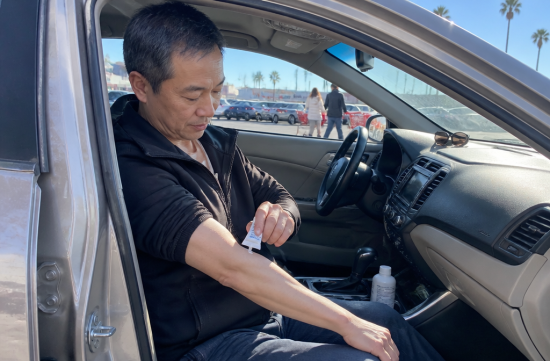
The third point was the most surprising to me. It's the side windows of cars.
A study conducted in 2016 examined 29 vehicles. The front windshield blocked an average of 96 percent of UVA rays, while the side windows only blocked 71 percent.
The reason is the difference in glass types. The front windshield is laminated glass, which is treated to block UVA, while the side and rear windows are tempered glass, which does not filter UVA effectively.
UVA penetrates deep into the skin, damaging collagen and contributing to both aging and skin cancer. The Skin Cancer Foundation points to the driver's side window as a reason why skin cancer is more prevalent on the left side of the face and arm in the U.S.
For someone who drives one to two hours a day for commuting, this is not just someone else's problem. After seeing this data, I immediately started protecting my arm on the driver's side.
Now, let's talk about how to apply it. The amount needed is more than you might think.
According to FDA guidelines, an average-sized adult needs at least 1 ounce to apply evenly from head to toe. This is about the amount that fills a shot glass, not a small liquor glass.
And applying it once is not enough. You need to reapply at least every two hours, and more often if you sweat or go into the water.
There are also many misconceptions about the water-resistant label. The effective time is indicated as either 40 minutes or 80 minutes, and the AAD states that there is no such thing as a waterproof sunscreen.
There are areas that are particularly easy to overlook in winter. Even if your body is covered, your face, head, and neck remain exposed, and these are the areas where skin cancer most commonly occurs.
I also looked into the costs. According to Target online, Neutrogena Clear Face SPF 30, 3 ounces, is priced at $12.49, which comes to $4.16 per ounce.
The same brand's body spray SPF 30, 8.5 ounces, is $13.49, or $1.23 per ounce. It's more economical to buy facial sunscreen at a higher price and body sunscreen in larger quantities. Prices change frequently, so be sure to check again before purchasing.
In Korea, sunscreen is often considered a cosmetic product, but in the U.S., the FDA regulates it as an over-the-counter drug. This is why there is a separate drug facts section on the label.
To summarize, check for broad-spectrum, SPF 30 or higher, and water-resistant. Apply it even on cloudy days and reapply every two hours.
However, if you have skin conditions or are sensitive to certain ingredients, it's best to consult with a doctor or pharmacist before choosing a product. This article is just a summary of official data and does not replace medical advice.
My conclusion is simple. I believe it's much more beneficial to apply sunscreen daily now rather than saving $12 on a bottle and later spending much more on treatment costs.
This winter, I decided to keep a small bottle in my car's console and a larger one next to my front door. Habits ultimately start from keeping things within reach.
 MEDBIO








 zestorbit |

 hihihi |

 fruitflash |

 Anjollinya Blog |

 United States Army |

 seouljung |




 Vision XT |
 Yo Lock Me Up |
 Joyce 77 |
 ANSLO NEWS |
 maplebyte |
 Shining Our Own World |
 Raymond K. |
 gravity |
 714 Success Era Real Estate |
 Investment Beginner Company Information Encyclopedia |
 musicque |
 The Gelaton |
 ovelion |
 Chicagonian |
 Freedom Yea |
 AZ Road Master |
 glenix39 |
 Something is popping in the situation |
 orvella |
 vella |
 comets |