
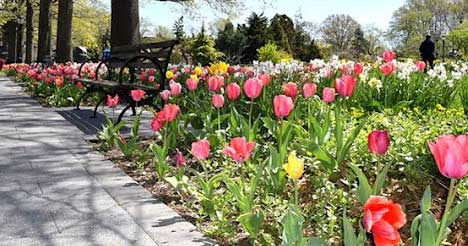
Flushing is a neighborhood located in the borough of Queens, New York City, characterized by a distinct four-season climate. The monthly average temperature and precipitation are as follows:
- January: Average high temperature about 38°F (3°C), average low temperature about 25°F (-4°C), precipitation about 3.2 inches (80.5mm)
- February: Average high temperature about 40°F (4°C), average low temperature about 27°F (-3°C), precipitation about 3.0 inches (76.7mm)
- March: Average high temperature about 48°F (9°C), average low temperature about 34°F (1°C), precipitation about 3.6 inches (91.2mm)
- April: Average high temperature about 58°F (14.6°C), average low temperature about 43°F (6°C), precipitation about 3.9 inches (99.1mm)
- May: Average high temperature about 68°F (19.8°C), average low temperature about 52°F (11.3°C), precipitation about 3.8 inches (96.5mm)
- June: Average high temperature about 77°F (25°C), average low temperature about 62°F (16.6°C), precipitation about 3.6 inches (92.7mm)
- July: Average high temperature about 83°F (28.2°C), average low temperature about 68°F (20.1°C), precipitation about 3.8 inches (96.5mm)
- August: Average high temperature about 82°F (27.7°C), average low temperature about 67°F (19.6°C), precipitation about 3.4 inches (86.6mm)
- September: Average high temperature about 75°F (23.9°C), average low temperature about 60°F (15.6°C), precipitation about 3.3 inches (83.8mm)
- October: Average high temperature about 65°F (18.2°C), average low temperature about 49°F (9.6°C), precipitation about 2.9 inches (73.2mm)
- November: Average high temperature about 54°F (12.1°C), average low temperature about 40°F (4.7°C), precipitation about 3.6 inches (92.7mm)
- December: Average high temperature about 42°F (5.9°C), average low temperature about 31°F (-0.8°C), precipitation about 3.4 inches (86.9mm)
Due to these climatic characteristics, Flushing experiences hot and humid summers, and cold winters with many snowy days.
In particular, January and February record average snowfall of about 8.4 inches (213.3mm) and 9.2 inches (233.1mm) respectively, indicating frequent snowfall.
In terms of natural disasters, New York City is vulnerable to flooding due to its long coastline and low-lying areas. The Queens area where Flushing is located is not free from these risks. Climate change is increasing the frequency of sea level rise and heavy rainfall, heightening the risk of flooding.
New York City authorities are making efforts to mitigate these risks by expanding urban forests, restoring coastlines, and improving infrastructure.
Additionally, New York City is exposed to various natural disasters such as hurricanes, strong winds, and winter storms. It is important for Flushing residents to prepare emergency measures and follow the guidance of city authorities.
The NYC Emergency Management provides disaster preparedness information for citizens, so it is advisable to refer to it for safety.
Flushing is a region with distinct seasonal changes and consistent precipitation throughout the year.






 ultron78 |
 garlic bread |
 Sugar Cream Door Bulletproof Noodles |
 urbanmint |
 |
| 
 nova nova |
 TwinBee |
 Living in the Eastern United States |

 Whisper |
 MintO |
  Korean Mom |
  My NYC |
  moo moo |
  Mr Oh |
  forevergee |
  festival |
  manchester |
  constant |
  Leapfrog Move |
  vibranto |
  Tora Tora |
  yellowbutter |
  Dolly |
  US Embassy |
  NYC saladbar |
  Finding Superfoods |
  lightyear |
  song bang |
  vexomo |
  Indiana Jones |