
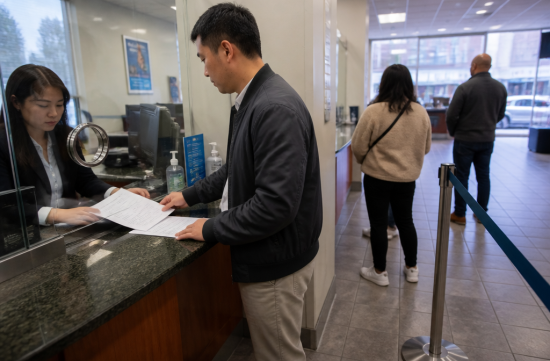
Many people receive emails like this from their loan officer right before closing: "Please explain where this large deposit came from." This is the moment when the down payment sent by parents in Korea hits the account.
The money itself is not the issue. The problem lies with the paperwork. If the source is not clearly documented, the closing can be delayed, and it may lead to complications with taxes later on.
So today, I will outline the steps. We'll break it down into three parts: loan documents, U.S. tax reporting, and remittance and gift tax from Korea. Dividing it into these three categories makes it much less confusing.
First, let's talk about the loan aspect. We'll use the personal gift section of the Fannie Mae Selling Guide as our standard, since many conventional mortgages follow this guideline.
The donor must be a relative. This includes spouses, children, and anyone connected by blood, marriage, or adoption. Parents definitely qualify.
The key document is the gift letter. The donor must sign it directly, and it should state the gift amount or maximum amount. It must also include a statement that the money does not need to be repaid.
The letter should include the donor's name, address, phone number, and their relationship to the recipient. If the parents are in Korea, they can simply write their Korean address and contact information. Each bank has its own form, so it's best to get that and use it.
But the letter alone is not enough. You also need to show how the money was actually transferred. This includes records of the electronic transfer from the donor's account or copies of checks and deposit records.
If it's an overseas remittance, prepare the remittance confirmation from the Korean bank along with the deposit record in the U.S. account. Since the amounts in Korean won and U.S. dollars may differ, you should be able to explain the exchange rate difference as well.
If it's a primary residence, there is no minimum amount that must come from your own funds according to Fannie Mae guidelines. This means you can cover the entire down payment with gift funds. I was surprised at how lenient this is.
However, for 2-4 unit residences or second homes, if the LTV exceeds 80%, you must first contribute 5% of your own funds. Additionally, gift funds cannot be used for down payments on investment properties. If you're considering a rental property, you'll need to rethink your plans here.
FHA or bank-specific products may have slightly different criteria. The letter format, timing of the deposit, and verification documents may vary. It's best to inform your loan officer early in the application process that you will be receiving gift funds.
The second aspect is U.S. tax reporting. To put it simply, money received from parents who are non-resident aliens is generally not subject to income tax for the recipient. The IRS also states that gifts received from foreigners are typically excluded from taxable income.
However, there is a reporting obligation. If a U.S. taxpayer receives gifts totaling more than $100,000 from foreign individuals in a year, they must file Form 3520. This $100,000 is a fixed amount that is not adjusted for inflation.
Many people overlook this part. If both the father and mother send money separately, they are considered related individuals and the amounts are combined. If you received $60,000 from each, that exceeds the threshold.
If you exceed the threshold, any gift over $5,000 must be reported individually. The submission deadline is the same as for income tax returns, April 15. If you apply for an extension, you can delay it until October 15.
Form 3520 is not a tax bill; it is a report. However, the penalties for not filing can be steep. You could incur a penalty of 5% of the gift amount for each month it is not filed, up to a maximum of 25%.
For example, if you received $200,000 and forgot to report it, theoretically, the maximum penalty could be $50,000. It's frustrating that this number arises from a single document when the tax itself is $0. There may be grounds for exemption if a valid reason is recognized, but it's not something to count on.
The third aspect is the situation in Korea. Parents also have things to check. In Korea, the amount of money that can be sent overseas without supporting documents is capped at $100,000 per year across all financial institutions.
If the cumulative amount exceeds $10,000 in a year, the excess will be reported to the National Tax Service. Given the size of the down payment, almost all of it will likely be subject to reporting. Since there's nothing to hide, it's best to clarify it as a gift from the start.
You also need to consider Korean gift tax. If the recipient child is a non-resident of Korea, they will be subject to Korean gift tax when receiving property located in Korea. The gift property exemption for residents does not apply to non-residents.
This aspect can vary significantly depending on the composition of the parents' assets, the method of remittance, and the residency status of the child. I recommend consulting both a Korean tax advisor and a U.S. CPA at least once. My article serves as a checklist, but the answers can differ based on individual circumstances, so expert confirmation is essential.
In summary, the basic documents you need are three: a gift letter signed by your parents, a remittance confirmation from the Korean bank, and the deposit record from the U.S. account.
Additionally, keep a memo of the total gifts received by year. This will help you easily see if you've exceeded $100,000. You can simply hand this over to your CPA when filing taxes in April.
Timing is also important. If a large sum of money comes in right before the contract, it will take longer to verify the source. It's more convenient to complete the remittance and gather the documents beforehand, if possible, before you start house hunting.
If I were doing this myself, I would first get the gift letter template from the loan officer before the remittance. Then, I would ask my parents to clearly state the purpose of the remittance as a gift, and at the end of the year, I would review the need for Form 3520 with my CPA. As long as you follow the steps, it's not a difficult task.
Getting help from your parents to buy a house is not a bad thing. However, that money needs to be clearly explained to avoid issues with the house or taxes. This article is based on the Fannie Mae Selling Guide and IRS guidelines as of October 2026, as well as information from Korean banks regarding foreign exchange.
 HotSeatDrum








 garlic bread |
 Sugar Cream Door Bulletproof Noodles |
 urbanmint |
 |
| 
 Premium Gas Camp |
 MintO |

 Vasila's Newlywed Blog |

 Round and Round Children's Song Kingdom |
  Mia Flori |
  nova nova |
  healthy |
  leaves |
  sparkling |
  maryland park |
  persiste |
  conte |
  blueman |
  Going Once |
  Eldorado 88 |
  cherrydino |
  middlekick |
  Moscow Kim |
  nivex85 |
  quanta7 |
  Tomato Health Club blog |
  horse |