

 '
'
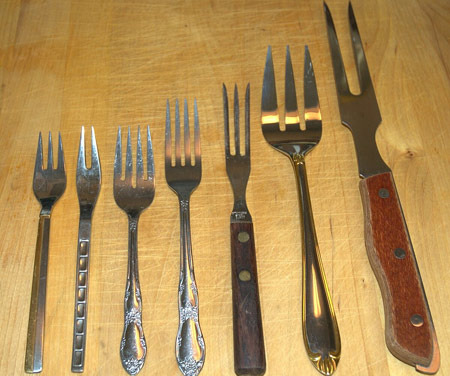
The fork that we use every day at the dining table.
In Korea, there is a saying that children use forks while adults use chopsticks.
Forks were probably not used during the Joseon Dynasty, and I was curious about when they started being used in the West, so I looked it up. Forks actually have a very long history. They didn't always look like this, and they weren't used simultaneously around the world.
For a long time, people ate with their hands or solved almost all meals with just a knife. Then, one day, an object resembling 'a two-pronged metal stick' appeared, and humanity's dining culture began to change gradually.
The origin of the fork dates back about a thousand years. The first places known to use forks were in the Middle East, particularly Persia and the Byzantine Empire (now Turkey). At that time, forks had two prongs instead of four and were made of gold or silver, used by nobles to eat fruits or sweet foods. It was a 'symbol of etiquette' and a 'luxury item' for nobles who wanted to avoid dirtying their hands.
There was a decisive moment when this Byzantine eating habit was transmitted to Europe. Around the 11th century, a Byzantine princess married into a noble family in Venice, Italy, bringing her fork with her. She used the fork to eat at every meal, shocking the Venetians, as eating with hands was the natural culture in Europe at that time.
The church condemned the use of forks as an impious act, stating that "it is proper to eat with the hands given by God." There was even a time when forks were referred to as 'the devil's tool.'
However, European dining tables eventually changed. Forks were convenient and neat in many ways.
By the 16th century, the use of forks gradually spread, centered around Italy, and by the 17th century, they crossed over to France, establishing themselves as 'elegant dining etiquette' among the nobility. Particularly, the French court during the reign of Louis XIV was the center of dining culture. From this time, forks became not just tools but symbols of 'refinement.'
During the same period, the upper class in England began to adopt Italian culture and started using forks, although initially, there were still criticisms that it was "not manly." It wasn't until the 18th century that ordinary citizens began to use forks regularly, and during the Industrial Revolution, advancements in steel processing technology led to the mass production of inexpensive metal forks.
It wasn't until the 19th century that forks finally settled into the four-pronged shape we know today, and they began to spread in the United States as well.
In the early pioneering days of America, knives and spoons were still more common than forks. During the westward expansion, people often cut rough steaks with knives and ate them with their hands. Forks were a 'symbol of civilization' that came along with urbanization.
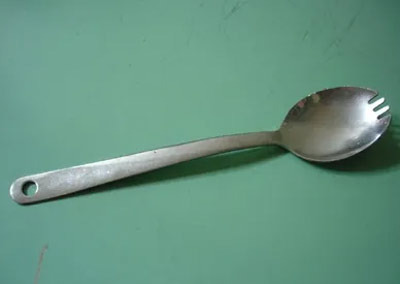
Let's talk about the spork that all men in the military have used.
It is commonly referred to in various ways, such as fork-spoon or fork-spoon. Just by looking at the name, you can immediately tell that it is a combination of a spoon and a fork. In English-speaking countries, it is called a spork, derived from the words spoon and fork.
Surprisingly, it is a utensil with a deep history. It is not known exactly who made it or when, but similar tools existed since the medieval period in Europe. The concept of the 'spork' was officially patented in 1874 in the United States, and the spork of that time was made of metal, not plastic as it is today.
Interestingly, the product at that time had a blade in the middle, so it served not only the functions of a fork and spoon but also somewhat of a knife. Thus, the early spork was referred to as a '3 in 1 utensil' and was used as outdoor tools or military equipment. Ultimately, the spork that we commonly see in convenience store lunch boxes or camping supplies today is a modern version of an old practical invention.
This small tool that we use thoughtlessly at the dining table carries a long history of cultural clashes, religious debates, and technological advancements. The fork is not just a tool for picking up food; it is a symbol of how humanity has transitioned from hands to tools in culture.







 Enjoyable American Life Diary |
 Utah, the Most Livable State |
 morvex37 |

 manchester |
  constant |
  Leapfrog Move |
  vibranto |
  Tora Tora |
  yellowbutter |
  Dolly |
  US Embassy |
  NYC saladbar |
  Finding Superfoods |
  lightyear |
  song bang |
  vexomo |
  Indiana Jones |
  meloncat |
  novapixel |
  mortrix |
  Esther 1983 |
  fortbliss |
  Moscow Kim |