
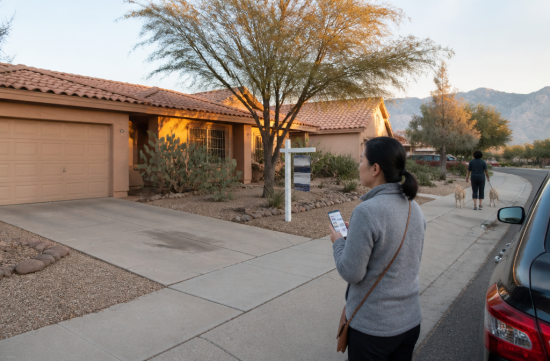
To summarize the Tucson market in October, home prices are holding steady, but sellers are increasingly showing signs of concern. Rent prices have remained mostly unchanged, and interest rates have risen back to the 7% range.
First, let's clarify the reference point. The official MLS transaction statistics for October typically come out in mid-November, so the sales figures in this article are based on the closing data from September, which was released at the end of last month.
The data on rent and interest rates reflects trends up to October. I will include sources and reference months for each number, so you can refer to them when making comparisons.
The most frequently asked question is whether home prices have dropped. According to the September report compiled by Tierra Antigua Realty using MLSSAZ data, the median sales price for all housing types in Tucson is $350,000, which is a 1.4% increase from a year ago.
When looking specifically at single-family homes, the median sales price was $369,000, down 0.3% from the previous year. It's more accurate to consider this as stable.
Condos and townhomes are reported to have a median sales price of $262,500, which is a 9.5% increase. However, with only 89 transactions, it's difficult to interpret this as a trend.
For reference, the MLS of Southern Arizona website lists the median sales price for September as $365,000. This figure is based on all 1,129 transactions in Southern Arizona, not just Tucson, which accounts for the difference.
So, if you see different home prices in the news, there's no need to be surprised. Most discrepancies can be explained by the geographic scope and types of homes considered.
More important than price is the transaction volume. The number of closed transactions in Tucson for September was 675, which is an 8.5% decrease from the previous year.
The number of new pending contracts is 631, down 14.6%. This signals that it will be difficult to see a significant increase in closed transactions in the coming month or two.
On the other hand, inventory is piling up. As of October 20, there are 3,279 active listings, and the months of inventory stands at 4.86 months.
Typically, a balance point is considered to be around six months, so it's not yet a fully buyer's market. However, the atmosphere is certainly different from the seller's advantage period of one to two years ago.
This month, the most talked-about statistic is the price reduction rate. 49% of active listings have lowered their prices at least once.
The median time to the first price reduction was 23 days. This means that half of the homes adjusted their prices in less than a month after listing, which surprised me when I saw the numbers.
Among the homes sold in September, 42% had their prices reduced before going under contract, finishing an average of 8.4% below the initial listing price. While the median sales price is holding steady, the initial asking prices are not being accepted by the market.
The time on the market has also increased slightly. The median days on market for closed transactions in September was 34 days, up from 32 days in August.
There are significant regional differences. In September, Oro Valley had a median price of $606,000, up 5.9%, while Marana had a median of $406,900, up 2.2%.
Vail saw a median price of $415,000, which is a 5.1% increase, but the number of transactions decreased by 16.5%. Many people look at these areas due to school districts, but I recommend also considering how active the market is in terms of transactions.
The background to these trends is interest rates. According to Freddie Mac's weekly survey, the average 30-year fixed rate rose to 7.40% on October 15, then slightly decreased to 7.32% on October 22.
A year ago, the rate was 6.19%. This means it has increased by over 1 percentage point in a year, significantly raising the monthly payment burden for first-time homebuyers.
The rental market is much quieter. According to Apartment List's November report, the median rent in Tucson is $1,041, which is a 0.4% decrease over the month of October, remaining nearly flat.
A one-bedroom apartment averages $869, while a two-bedroom averages $1,115. Compared to a year ago, this is only about a 0.4% increase.
This figure represents a median value primarily for apartments, so single-family home rentals are typically much higher. Those looking for rental houses should check the actual market prices in the same neighborhood separately.
The reason for the stagnation in rent is attributed to supply. Northmarq analyzed that the completion of delayed apartment projects has pushed into 2026.
When new complexes come online simultaneously, existing complexes compete with incentives like one month of free rent. This is a time when Tucson renters have room for negotiation on lease renewals.
So, the question remains: should you buy now? If it's for personal use, the current environment with plenty of inventory and frequent price adjustments is not a bad time to negotiate.
However, considering the 7% interest rate, you should first calculate how much higher your monthly payment would be compared to current rent. Requesting seller credits to lower the interest rate as part of the deal is also an option.
If it's for investment purposes, I would take a more conservative approach. With rents stagnant and high interest rates, there aren't many properties that will provide positive cash flow.
Once the official October transaction statistics are released, I plan to check whether the decrease in pending transactions has translated into actual closings. Until the end of the year, it would be wise to monitor both transaction volume and price reduction rates alongside prices.
 MagicOcean
 Hennesix







 B.I.G. Victor |

 Amber H |
 uplifted |

 Dr. Kelso |

 silents |

 Arizona Cowboy |

 Who's watching? |

 Project Tomorrow |

 U.S. Weather Bureau News |

 strawberry |
 US Regional Information Local News |
 USA Business News |
 Blondee |
 E whisper |
 Potato House |
 freshmint |
 Ansaso |
 Golado |
 babybay |
 honeycom |
 French Macarons |
 Exploring American Life Information |
 Sunshine Blog |
 Community Cross |
 Sayonara H |
 What can make money? |
 Information Search LifeMAN |
 morvex37 |
 neontrail |