
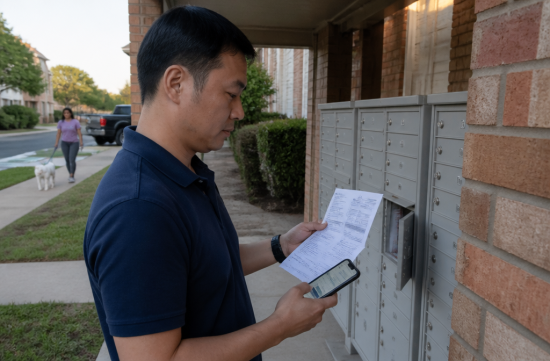
When I open my mailbox and find an envelope from a government agency like the IRS or a county office, it can feel quite heavy on my mind.
Even if I've been living in English for a while, official documents feel like a different language. The sentences are long, legal terms are unfamiliar, and what I need to do is often hidden at the very end.
These days, when I receive such letters, I first ask AI for help. However, simply taking a picture and asking for a translation is quite different from asking the right questions.
Today, I want to share the methods I've organized while writing this. It's not a complicated technique; anyone can do it as long as they know the steps.
The first step is to redact personal information. It's essential to remove or cover up your Social Security number, account number, date of birth, and home address before inputting them into AI.
OpenAI and Google also advise against entering sensitive information in chat windows. It's good to remember that once information is entered, it's hard to delete it at will.
You don't need names or numbers to understand the letter's content. Just copying the main text or taking a photo while covering sensitive parts is sufficient.
The second step is to ask specific questions. Instead of just saying "translate this," it's much better to ask for a summary in Korean of which agency sent the letter, what actions are required of me, and what the deadlines are.
I also add one more line: I ask what will happen if I do nothing.
By asking this way, AI doesn't just translate the letter; it extracts and presents the key points. The essence of official documents is ultimately about what needs to be done and by when, so this approach works well.
The third step is to ask about unfamiliar terms separately. If terms like "balance due," "proposed changes," or "penalty abatement" come up, just ask for an explanation in simple Korean.
If it's an IRS letter, there's a specific place to check. On the top right of the first page, there's a number starting with CP or LTR, which is the key to understanding the type of letter.
For example, CP2000 is a letter proposing changes when the reported income doesn't match the information the IRS has received. CP14 is a notice that there are taxes owed without any math errors.
By telling AI this number and asking what situations this letter typically arises from, you'll understand much faster. Then you can look it up directly on IRS.gov using the same number for comparison.
The fourth step is to always double-check the deadline in the original letter. The response deadline varies by letter type, and the date printed on the letter is what actually matters.
Even if AI says it's 30 days, that could be a general case. I make sure to find the date with my own eyes and write it down on my calendar.
The fifth step is to develop a habit of questioning whether the letter is genuine. The IRS states that they do not initiate contact via email, text, or social media, and most correspondence starts by mail.
They also do not ask for tax payments via gift cards, wire transfers, or cryptocurrency. If the letter contains such requests, it's good to ask AI about the possibility of fraud, but the warning signs are already lit up.
In such cases, it's safer to call the number listed on the official agency website rather than the number on the letter. The general inquiry number for the IRS is 800-829-1040.
Sixth, you can also get help from AI in drafting a response. If you explain your situation in Korean and ask for a polite and simple English reply, you'll get quite a usable sentence.
However, before sending it, you should read through it line by line to ensure it matches your facts. AI might have added details that don't align with your situation.
For letters like water bill notices from the city or jury summons from the county, the same methods apply. Just ask for the four key points: the sender, requirements, deadlines, and contact information.
In the DFW area, the city, county, and school district each send separate letters, so there are more types than you might think. At first, they all look similar, but organizing them this way makes it easy to distinguish.
Of course, AI won't solve everything. If the letter involves a large amount or could lead to legal disputes, it's best to consult a professional like a tax advisor or attorney.
If you're stuck with an IRS issue, there's also the Taxpayer Advocate Service, which helps taxpayers' rights. Just knowing about such resources can ease your mind more than suffering in silence.
The biggest advantage I've found with AI is that it alleviates fear. The anxiety of not knowing what the content is transforms into just a task once you know what needs to be done.
If I were to do it, I would redact personal information, ask about the agency, requirements, and deadlines, and double-check the dates and contact information against the original document and the official site.
Next time you encounter a government envelope in your mailbox, try not to panic. If you calmly ask the questions in order, it will be easier than you think.
 SaladFlash








 choi family |

 What can make money? |

 road98 |

 Baguette Blog |

 Khan Film Blog Production |

 TOUCHE NEWS |

 Coco Chanel |


 wexlin84 |

 Texas Lone Star Longhorn Spirit |
 Pronunciation Yo |
 nuvex11 |
 Living in Florida |
 axelon47 |
 lumbus |
 Texas Migration Story |
 Scade Studio |
 love ya |
 biscuit90 |
 chicpo |
 Helpful Life Stories |
 Kitchen Ideas |
 Diana Blues |
 Agenda Center |
 Community Cross |
 journey |
 heeve |
 leman |
 corner kick |