

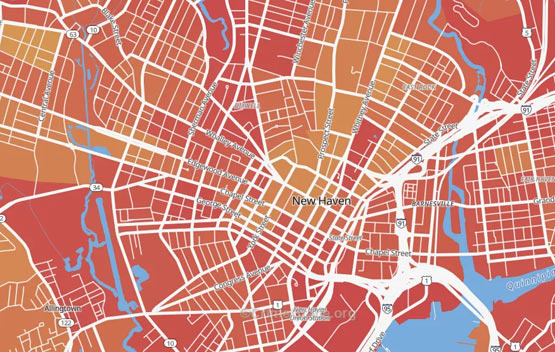
One of the most common questions from those considering moving to New Haven is, "Is it safe in a city with Yale University?"
Honestly, if you think of New Haven only by the name of Yale University, the safety might come as a surprise.
This is because, while a world-renowned university is in the heart of the city, just a few blocks away, the atmosphere can change dramatically.
Statistics show that New Haven has a crime rate of about 43 incidents per 1,000 residents, which is relatively high.
The likelihood of being a victim of violent crime is about 1 in 186, while property crime is about 1 in 26.
Just looking at the numbers might make you wonder, "Is this really the neighborhood with Yale?"
So, why is this the case?
One major reason is the economic disparity within the city. New Haven has many professionals living there, but it also has areas with a high percentage of low-income residents. While a massive educational and medical industry has developed around Yale University and Yale New Haven Hospital, the economic benefits do not equally reach all residents of the city.
The age of the city itself also plays a role. New Haven is one of the older industrial cities in New England and has experienced a decline in manufacturing, leading to job and population loss. Issues like poverty, aging housing, and unemployment that have appeared in many old cities in the Northeastern U.S. are also present in New Haven.
Additionally, problems like drug and gun-related crimes and car thefts are concentrated in certain areas, raising the overall crime rate for the city.
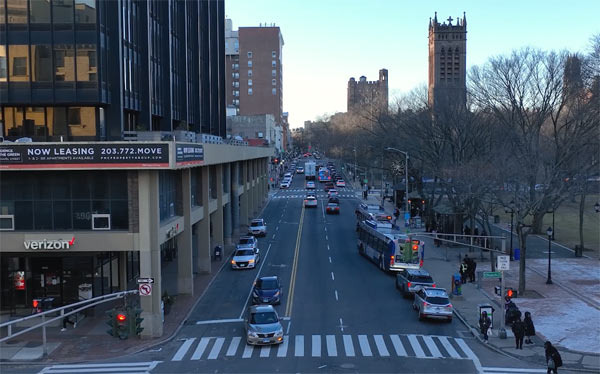
However, it would be incorrect to think that all of New Haven is dangerous. The most important aspect of this city is the neighborhoods.
Westville is known as a relatively stable residential area, with a median household income of about $104,730.
East Rock is also a popular area for Yale professors, graduate students, and professionals, often sought after by Korean families looking for homes. Prospect Hill and Beaver Hills are also considered relatively stable residential areas.
Conversely, some southern areas or economically challenged regions see a significant increase in crime rates. According to some data, the likelihood of being a crime victim in certain southern areas is about 1 in 25, while the relatively safe western areas show a rate of about 1 in 51. Even with the same New Haven address, the actual living environment can be quite different.
The area around Yale is somewhat special. Yale Police operates separately, and there are university security personnel and emergency phone systems in place. The area is quite lively during the day, with students, hospital staff, and tourists constantly moving around. However, just a few blocks away from the campus, the atmosphere can change, which newcomers may not realize.
The recent situation is not all worsening. Data from 2024 shows that violent crime has decreased by about 1% from the previous year, property crime by about 3%, and there is an overall trend of decreasing crime.
Ultimately, it is difficult to categorize New Haven as simply "safe" or "dangerous." While the crime rate is indeed higher than the national average, crime is not evenly distributed throughout the city.
If a Korean family is moving in for the first time, it is advisable to look at residential areas like East Rock or Westville rather than signing a lease just because the rent is slightly cheaper, and to take a walk around the neighborhood during both day and night.
Depending on which neighborhood you choose, New Haven can feel like the Yale college town you know or like a completely different old industrial city in America.
 ImTheOne
 TONCOFFEE




 American Hardcore Band |
 Rice Shop Uncle BLOG |
 Baguette Blog |
 solvix18 |
 novapixel |
 Jenny's Mom blog |
 Dream Mong |
 Ted 600 |
 My Heart Popper |
 Valley Bang |
  pravix22 |
  Cohesive Kong |
  werehere |
  problemo |
  galaxy88 |
  breezelove |
  Minnesota Sonata N |
  hazelnut |
  Korean News American Blog |
  AH LALA |
  Savion |
  pintos |
  Good Good |
  oh my salami |
  Lemonade Cider Planning Director |
  Way to easy |
  Dala Dala |