
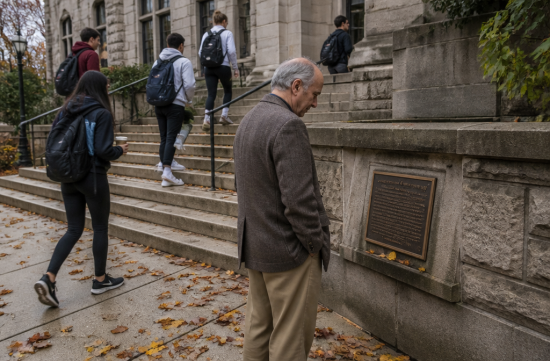
Last week, I stopped in front of the plaque next to the stairs at Michigan Union early in the morning. Leaves were half covering the edge of the plaque.
Students hurried past with coffee in hand. I wondered how many people knew what had happened there.
On the early morning of October 14, 1960, Senator John F. Kennedy stood on those stairs while campaigning for the presidential election. It was well past midnight, often said to be around 2 AM.
It was an unscheduled speech. There was no script, and it was recorded to be just over three minutes long.
They say that students filled the area in front of the stairs at that late hour. The size of the crowd varies slightly in different accounts.
Kennedy asked the students if there were any who would be willing to go to developing countries to work for a few years as doctors or engineers.
It wasn't a grand policy announcement, just a single question. Yet that question lingered among the students for a long time.
Students from Ann Arbor gathered signatures and formed a group to respond to that question. For a politician's words to become actual policy, someone must persistently hold onto them.
Then, on March 1, 1961, Kennedy, now President, signed an executive order to create the Peace Corps. The question thrown out on those early morning stairs became a national institution in less than six months.
Anyone who has built a house knows that the most important day is the day you break ground, not the blueprint.
It still gives me a strange sense of pride that that first groundbreaking was on these neighborhood stairs. I appreciate that it's not a grand memorial but an ordinary staircase that students use every day.
This story holds special significance for us because the Peace Corps came to Korea as well.
The first volunteers set foot in Korea in September 1966, a time when the scars of war were still evident everywhere.
I can imagine how young Americans fresh out of college endured unpaved roads, the smell of coal, and wells that froze in winter. Those who remember that time can picture it even more vividly.
By 1981, about 2,000 young Americans had been dispatched to Korea over 15 years, according to retrospective materials. They taught English in middle school classrooms, worked in health clinics, and traveled to rural villages.
One of them was Kathleen Stevens. She taught English at Yesan Middle School in Chungcheongnam-do in the mid-1970s and even had a Korean name.
That young teacher returned as the U.S. Ambassador to Korea in 2008, over 30 years later. She served as ambassador until 2011 and revisited Yesan after her appointment.
She said she learned the qualities needed for a diplomat in Yesan's rural school classroom. In a way, that classroom produced an ambassador for a country.
The Peace Corps program in Korea closed in 1981. The headquarters decided to end the program in Korea as the overall budget for the Peace Corps was expected to decrease.
Some volunteers hurriedly packed their bags and left before completing their terms. It's a disappointing ending, but on the other hand, it signifies that Korea was no longer in a position to receive aid.
In fact, since 1990, Korea has begun sending volunteers abroad at the government level. In 2009, various ministries combined their efforts under the name World Friends Korea.
The country that once received aid has now become one that sends aid. I believe this is the most significant outcome of that three-minute speech.
Korea has not forgotten those young people. Since 2008, the Korea International Cooperation Agency has been inviting former volunteers back to Korea, and over 800 have visited.
On September 16 of this year, a dinner was held in Seoul to commemorate the 60th anniversary of the arrival of the first volunteers. Local media reported that this gathering might be the last.
As I read that article, I gazed out the window for a long time. Those who were in their twenties in 1966 are now mostly in their eighties. Time solidifies like concrete on a construction site, silently passing by.
No matter which political side one stands on, I believe sending young people to a foreign land to become neighbors was a good investment. It accomplished what military aid or financial assistance could not.
These days, there is a strong tendency to evaluate international relations solely based on trade balances or defense costs. However, lasting relationships are ultimately built by the faces that meet in classrooms and health clinics.
Students who remember their English teachers from that time have now become adults with grandchildren. Among those of us who immigrated and settled here, there are likely many who carry such memories.
If you ever pass through this neighborhood, please take a moment to stop in front of the Union stairs. One plaque holds a connection that spans over half a century.
A good question can also become a bridge across the ocean. Remembering the early morning air on those stairs, I quietly build up today as well.
 SuchAHeel


 Glow Yo |

 Michigan Enthusiast |
 xylora |
 Tan Zoo |

 hot chocolate |

 crumb |
 rosem |

 saffronroute |


 mygoddess blog |

 garlic bread |
 Cheese Hill Restaurant Exploration |
 gentle |
 tamarindbay |
 Yes Dorian |
 Hedgehog Baggu Story |
 Good Riddle |
 Well Done Sir |
 struct |
 Vision XT |
 Way to easy |
 Joyce 77 |
 dreamer20 |
 business lim |
 lorixa |
 Que Buena |
 Street Smart Blog |
 butter 90 |
 Flying Shooting Star |
 silents |