
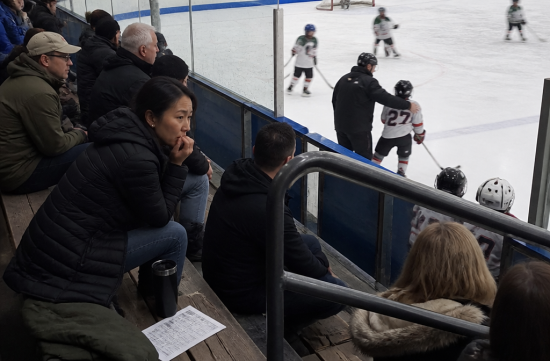
As November arrives, our weekend schedules have changed dramatically. Many families in our area are now going back and forth between indoor basketball courts during the day and ice rinks in the evening.
It's an exciting season, but there's a conversation that comes up every year around this time. It's about kids who bump their heads during games and insist they're fine, continuing to play.
So this time, I've organized the signs of concussion and the guidelines for returning to play. I looked into CDC materials and Texas law for this.
First, it's important to know that a concussion doesn't only occur from a hard hit to the head. The CDC explains that it can also happen from a strong jolt to the body that causes the head to move violently.
In basketball, players might hit their heads on the court floor or get elbowed during a rebound battle. In hockey, the moments when players hit the boards or fall on the ice can be dangerous.
Additionally, symptoms may not appear immediately. The CDC states that signs can show up hours or even days later.
So even if a child seems fine after the game, it's important to keep an eye on them that evening and the next day. This is more crucial than you might think. Also, check if they are sleeping more than usual or having trouble waking up.
Signs to watch for at home include headaches, dizziness, sensitivity to light or noise, and saying they feel dazed.
There are also signs that parents can observe. If a child is slower to respond than usual, repeats the same questions, or seems unusually irritable with mood swings, these are red flags.
Make sure to remember the signs that require immediate emergency care. The CDC mentions seizures, not recognizing people or places, and slurred speech as critical signs.
Weakness or numbness in limbs, loss of balance, worsening headaches, one pupil appearing larger than the other, or seeing double are also warning signs.
In such cases, the CDC advises not to hesitate to call 911 or go to the nearest emergency room. Vomiting without any other reason right after an injury is also a warning sign.
So what should be done at the sports venue? The CDC's basic principle is that if a concussion is suspected, the player should be removed from the game immediately and not allowed to play again that day.
Texas has made this a law. House Bill 2038, commonly known as the Natasha Law, was passed in 2011.
This law applies to public school student-athletes. Coaches, doctors, athletic trainers, and even parents must remove a student from a game or practice if they suspect a concussion.
I was surprised to learn that parents are included in that list. This means that if something seems off from the stands, moms and dads can speak up.
The return-to-play conditions are quite specific. A doctor chosen by the student or parent must examine the child and provide written clearance that it's safe for them to return.
Additionally, the student must complete all return steps set by the school's concussion management team. Finally, both the student and parent must sign a return-to-play agreement.
Coaches are not allowed to grant permission for a return. Even if a game is urgent, a coach cannot make that decision alone.
The return steps typically follow the six-step process recommended by the CDC. Step one is to return to daily activities like school first.
The key point is that school comes before sports. Only after a student can attend classes and do homework without symptoms can they move on to the exercise phase.
Step two involves light aerobic exercise, and then the intensity gradually increases. Contact training is introduced later in the process, and only at step six can they participate in actual games.
Each step usually takes at least 24 hours. If symptoms reappear, the principle is to go back a step or take a break before starting again.
So, even if there's a big game next week, returning after just three days doesn't add up. The timing for each step may vary slightly by school, so be sure to check your school's regulations.
Club leagues or private teams may have different circumstances. The Natasha Law applies to school sports, so you should check the specific regulations for each league. Some club leagues may follow the school standards.
If you have a hockey-playing family, there's one more thing to keep in mind. USA Hockey allows body checking starting at the 13-14 age level, but checking to the head or neck is prohibited at all levels.
When registering, take a moment to look for the concussion section in the league's regulations document. Knowing whether a doctor's note is required and who makes the return decision can help you feel more prepared.
Since each child's condition is different, if symptoms are unclear, consulting with a pediatrician is the most reliable option. This is not something to judge based on internet articles.
If it were me, I would make one promise with my child before the season starts: if they bump their head, they should speak up immediately.
Missing one game might be disappointing, but it's quickly forgotten. I hope everyone enjoys a safe and exciting winter season!
 TongkiDodge
 Dyno




 Well Done Sir |

 butter 90 |

 MacMorningBlog |
 Texas Migration Story |
 seadoll |

 BIODOCTOR NEWS |

 orvian89 |


 nexaro |

 Texas Lone Star Longhorn Spirit |

 Coco Chanel |
 tamarindbay |
 Yes Dorian |
 Hedgehog Baggu Story |
 Good Riddle |
 struct |
 Vision XT |
 Joyce 77 |
 Way to easy |
 dreamer20 |
 business lim |
 lorixa |
 Que Buena |
 Street Smart Blog |
 Flying Shooting Star |
 silents |
 ROLDU WAY |
 dreamming |
 greenloop |