
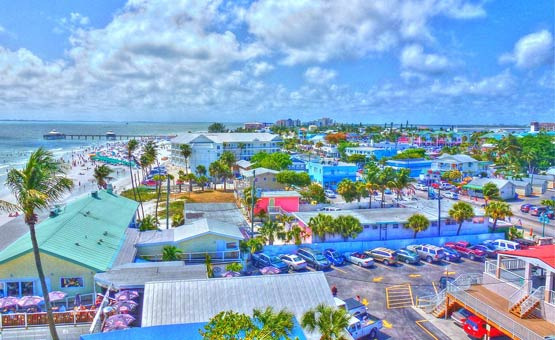
To sum up Fort Myers weather, it features hot and humid summers with a lot of rain, and warm, dry winters.
If you move from a region with distinct seasons, you might be surprised by how nice the winter weather is at first, and then be amazed again during your first summer.
The best time is from November to April. In December and January, the daytime highs are usually in the mid to upper 70s Fahrenheit, around 24-26 degrees Celsius. Mornings and evenings can drop to the 50s to 60s Fahrenheit, making it feel chilly, but there aren't many days when you need a heavy winter coat. Snow is practically not a concern.
So, people visiting Fort Myers for the first time in winter often think living here would be like paradise. With low humidity and warm sunshine, it's great for golfing, fishing, walking, and biking. This weather is also why snowbirds from the north come down every winter.
The problem starts in May. From June to September, daytime highs are usually in the 90s Fahrenheit, around 32-33 degrees Celsius, and at night, they don't drop much below the upper 70s. While the numbers may seem lower than Arizona, the high humidity makes it feel completely different. Getting into a car parked in the lot can feel suffocating, and it's common to start sweating on your back after just a 10-minute walk.
The rain is unique as well. Fort Myers receives about 55 inches, or around 1,400mm, of annual rainfall, which is quite a lot, with most of it concentrated in the summer rainy season. Mornings often start with blue skies, but around 2 to 5 PM, the sky can suddenly darken, and heavy rain with thunder is common.
However, it doesn't rain all day. Florida-style downpours can last for 30 minutes to an hour, after which the sun often comes back out. Because of this, locals don't cancel their plans for the day if rain is in the forecast during the summer. Instead, it becomes a habit to keep an umbrella in the car.
Another important thing to know is about hurricanes. The Atlantic hurricane season officially runs from June 1 to November 30. Fort Myers experienced significant damage from Hurricane Ian in 2022, so residents are quite sensitive to hurricane forecasts. If you move here, it's essential to have bottled water, emergency food, flashlights, and backup batteries ready, and to check if your home is in a flood-prone area.
Ultimately, Fort Myers weather has clear pros and cons. In winter, there aren't many places in the U.S. that are as comfortable to live in. However, in summer, you have to deal with heat, humidity, heavy rain, and hurricanes. Rather than deciding to move based solely on January in Fort Myers, it's better to visit in July or August if possible. If you feel okay during that summer, then you can consider yourself well-suited to the climate in Fort Myers.
 CocoChute






 Street Smart Blog |

 solvix18 |

 Moscow Kim |

 Shinbaram Dr. Blog |

 Encyclopedia of New York and Surrounding Areas |
 Way to easy |

 Joyce 77 |
 seouljung |

 tamarindbay |
 Yes Dorian |
 Hedgehog Baggu Story |
 Good Riddle |
 Well Done Sir |
 struct |
 Vision XT |
 dreamer20 |
 business lim |
 lorixa |
 Que Buena |
 butter 90 |
 Flying Shooting Star |
 silents |
 ROLDU WAY |
 dreamming |
 greenloop |