


Last week, I received an email from the company HR about next year's payroll deductions. I was about to skim through it when my eyes stopped at one line.
It mentioned that the salary cap for Social Security taxes has increased again. If you're in your 60s and still working, this is something you shouldn't overlook.
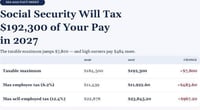
Let's take a look at the numbers released by the Social Security Administration (SSA) on October 14. The Social Security tax cap for 2027 will be $192,300.
This is an increase of $7,800 from this year's cap of $184,500. While it does increase every year, this jump is quite significant.
For example, if your salary is $190,000, almost your entire salary will be subject to Social Security taxes next year. The 6.2% tax will also apply to the $5,500 range that was capped this year.
The tax rate remains the same. Employees pay 6.2%, and employers also pay 6.2%, which means the burden increases for companies with high-salaried employees.
Therefore, the maximum Social Security tax an employee can pay next year will be $11,922.60, which is $483.60 more than this year's maximum of $11,439.
If your salary is below the cap, nothing changes for you. You will continue to pay 6.2% on what you earn.
The impact will be felt by those earning over $184,500. This year, if you hit the cap at some point, your take-home pay slightly increased as Social Security taxes stopped, but next year, that point will be pushed back a bit.
Many people get confused about Medicare taxes. The Medicare tax of 1.45% has no cap, so it applies regardless of how much you earn.
Additionally, if your salary exceeds $200,000, an extra 0.9% will be added on the excess amount. For married couples filing jointly, the threshold is $250,000.
For self-employed individuals, the calculation is a bit different. Since they pay both the employee and employer portions, the Social Security portion is 12.4%.
If you hit the cap, your Social Security tax alone next year will amount to $23,845.20. Seeing that number surprised me a bit.
If you work two jobs, there's something important to keep in mind. Since each company deducts 6.2% separately, you might end up paying more than the cap.
Any excess Social Security taxes paid can be refunded as a credit during your year-end tax filing. Just check if the total in the Social Security tax box on your two W-2 forms exceeds the cap.
These days, I see many people in their mid-60s working full-time. They range from weekend jobs at stadiums to corporate executives.
Now, let's talk about those who are already receiving retirement benefits while working. This is actually the crucial part.
If you start receiving retirement benefits before your full retirement age while working, you will hit an income limit. For 2027, the threshold is $25,560 annually, or $2,130 monthly.
If you exceed this limit, for every $2 over, $1 of your benefits will be withheld. This year's threshold was $24,480.
In the year you reach your full retirement age, the limit becomes much more generous. In 2027, it will be $67,920, and for every $3 over, $1 will be withheld.
This limit only applies to income earned before the month you reach full retirement age. Once you pass that age, there are no income limits.
It's also important to note that withheld benefits do not just disappear. The SSA will adjust your monthly benefit amount after you reach full retirement age to reflect that withholding.
Continuing to work has its advantages as well. Social Security benefits are calculated based on your highest 35 years of earnings.
If your salary in your 60s is higher than in your younger years, it can replace those lower-earning years, potentially increasing your benefit amount. So, even though you pay more taxes, you may receive more later.
As a side note, the cost-of-living adjustment (COLA) for retirement benefits has been announced at 3.6% starting in January. This is good news for recipients, and the increase in the tax cap aligns with the overall trend of rising average wages nationwide.
While an increase in COLA is beneficial, it may also affect other figures, such as Medicare Part B premiums. Be sure to check your net benefit amount when you receive your January benefit statement.
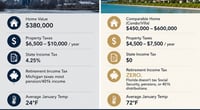
Texas has no state income tax, so you only need to look at the federal side on your pay stub. People moving from other states often find this quite convenient.
If I were in my 60s and working, I would first check my January pay stub to ensure Social Security and Medicare are being deducted correctly.
If you are receiving benefits early, it's wise to inform the SSA of your expected income to see if you might exceed the threshold. It can be painful to have to repay a lump sum later.
However, retirement timing, benefit receipt timing, and tax issues vary by individual circumstances, so consult with a professional. Even with the same salary, the answers can differ based on your spouse's income or other sources of income.
While it may seem like just a few numbers have changed, these are quite significant changes for working seniors. Before flipping the calendar to next year, take a moment to review your pay stub and your my Social Security account.
 silverfoxwalker1906
 midnightdreammaker1985



 looksee 78 |

 vivavida |

 MEDBIO American Doctor Blog |

 Burbank Lee |
 vibranto |

 BIODOCTOR NEWS |
 nexaro |

 orvian89 |

 Mental Health Psychiatrist |
 ssome |
 skykong |
 Shining Our Own World |
 gardener 007 |
 golfmaster |
 Nanana Nanana Nanana |
 Who's watching? |
 endone |
 RockStar |
 Casa Mia |
 You Only Live Once |
 Hardworking CPA |
 Joyce 77 |
 Runner Kim |
 My Town My Way Blog |
 My Miami Stories |
 Entip |
 Tony Park |
 Jean Claude Bundang Blog |
 DJ DC BLOG |