
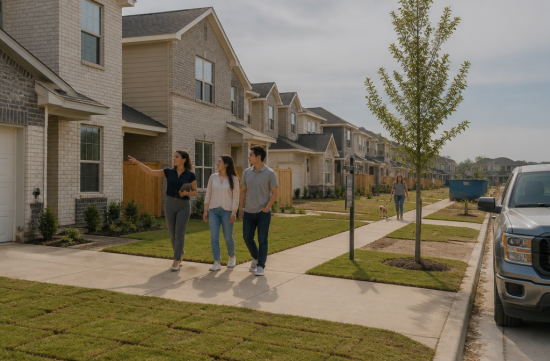
These days, when driving around the outskirts of Fort Worth, you often see dozens of new single-family homes with the same rooflines lined up in developments. I thought they were for sale, but the sign at the entrance says "Now Leasing." This is a build-to-rent development that has been frequently asked about lately.
If the term is unfamiliar, think of it this way: it's a neighborhood of single-family homes built with the intention of renting them out from the start. It's managed by a company like an apartment complex, but the homes come with yards.
This neighborhood is particularly at the center of this trend. According to an analysis by rental information company Point2Homes, in early 2025, 8,470 rental single-family homes are expected to be built in the Dallas-Fort Worth metro area, making it the second highest in the nation after Phoenix.
Fort Worth accounts for the largest share of that. The same data shows that 1,816 homes are being built in Fort Worth alone. In contrast, downtown Dallas has only 64 homes being built, indicating that these developments are concentrated in the cheaper land areas to the west and outskirts.
Some may ask if building so many homes will lead to an oversupply. However, a report citing Northmarq data indicates that over 4,000 build-to-rent units were absorbed in this metro area in 2025, with a vacancy rate of 6.3%, lower than the national average of 9.4%. This suggests that demand is still strong.
So, how much is the rent? According to a report from the Dallas Business Journal in July of this year, the new St. Paul development by Taylor Morrison's rental brand Yardly, which consists of 151 single-family homes, starts at $2,725 per month.
Let's also consider a comparison point. According to Yardi Matrix, the average rent for single-family homes in this metro area was $2,250 in September 2025. This indicates that there is a premium of several hundred dollars for new homes.
Now, let's compare this to buying a home for the same amount of money. This comparison is the crux of this article.
According to Redfin, the median sale price of homes in Fort Worth in May 2026 was $348,000. If you're unfamiliar with the term median price, think of it as the price of the home that is exactly in the middle when lined up.
Interest rates are currently quite high. According to Freddie Mac, as of October 1, the average 30-year fixed mortgage rate has risen to 7.28%. This is a significant increase from 6.34% a year ago.
With these conditions, if you put down 20%, which is $69,600, and finance the rest with a 30-year fixed mortgage, your principal and interest payments would be about $1,905 per month. On the surface, this seems cheaper than renting.
However, that's not the whole story. Texas has no income tax, but property taxes are high, and homeowners insurance is an additional cost. When you add these two together, your monthly expenses can rise to be similar to or even exceed rent.
There are also favorable changes for buyers. In a November 2025 referendum, the homestead exemption amount for school district property taxes was increased from $100,000 to $140,000. In simple terms, this means that this amount is deducted from the taxable value of your primary residence when calculating school taxes.
The advantages of build-to-rent are clear. You don't have to tie up tens of thousands of dollars in a down payment, and if the roof or air conditioning breaks, the management company takes care of it. Property tax bills also do not come to tenants.
If you're new to the area and still unfamiliar with the school districts or commute routes, this can be a significant advantage. You can use the first 1-2 years to figure out where you want to settle down.
On the flip side, it's fair to point out the disadvantages as well. Rent can increase with each renewal, and no matter how long you live there, you won't build any equity. From what I've observed, this difference can become quite significant after about 10 years.
You should also carefully review the management company's rules. The number and size of pets, painting or shelf installation, and yard maintenance responsibilities can vary by development.
Here's a checklist of what to confirm in the contract. First, check if there are any monthly management fees or service charges separate from the rent. Second, ask if there's a predetermined cap on rent increases at renewal.
Third, confirm how many months' rent the early termination penalty is. Fourth, check if it states that repair requests will be handled within a few days. Verbal promises are useless if they're not in the contract.
Be cautious of scams as well. New developments often have clean photos, making it easy for fake rental ads using someone else's property photos to slip in. If someone asks you to wire a deposit before seeing the house, it's best to stop and reconsider.
You can roughly verify if the management company is legitimate by checking the owner's name for that address on the county appraisal district's website. Most of Fort Worth falls under the jurisdiction of the Tarrant County Appraisal District.
The expectations set by the company that created Yardly are interesting. They hope that people who rent will eventually become customers who buy their homes. I also believe that this development is most valuable when used as a temporary stop before purchasing a home.
So, I'll provide two different criteria. If you plan to live in the area for more than five years and have both a down payment and emergency funds ready, it's worth seriously considering buying, even with high interest rates.
Conversely, if there's a possibility of changing jobs or you're still deciding on a neighborhood, it's more comfortable to rent a new home for about two years while monitoring interest rate trends. If rates go down, you can buy without worrying about refinancing.
If I had to make a decision right now, I would choose to rent but ensure that I lock in the rent increase cap in the contract. Then, during those two years, I would save the difference between rent and purchase costs as a down payment.
All numbers are based on the points mentioned above, and interest rates and rents fluctuate weekly. Please double-check Freddie Mac's weekly rates and the latest rental listings for the development before signing a contract.
 CarrotDetect





 moo moo |
 ultron78 |
 garlic bread |
 Sugar Cream Door Bulletproof Noodles |
 urbanmint |
 horse |

 kevin Kim |
 Dala Dala |
 jaxter |
  Anytime Journey |
  Mrs. Duluth |
  Atlanta Mama |
  Baguette Blog |
  US Embassy |
  Korean Mom |
  My NYC |
  Mr Oh |
  forevergee |
  festival |
  manchester |
  constant |
  Leapfrog Move |
  vibranto |
  Tora Tora |
  yellowbutter |
  Dolly |
  NYC saladbar |