

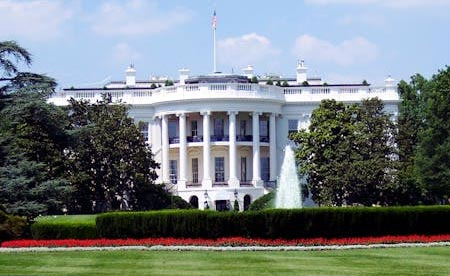
The White House is the official residence and office of the President of the United States, with deep historical and architectural significance. It is one of the most iconic buildings in America, where many historical events have taken place.
Construction of the White House began in 1792. At that time, the first President of the United States, George Washington, planned to establish a presidential residence in the new capital, Washington D.C., and hired Irish architect James Hoban for the design. However, James Hoban died during the architectural design, and architect James McHale took over as his successor.
Construction of the White House began in October 1792 and was finally completed eight years later in 1800, when President John Adams became the first to reside there.
The architectural style of the White House is Georgian. The building is constructed using stone and brick, consisting of three floors, with a central portico and marble stairs. The exterior of the White House follows a classical style, particularly known for its iconic large central staircase and white facade.
During the War of 1812, the British Army invaded Washington D.C., causing significant damage to the White House. On August 24, 1814, the British occupied the White House and set fire to it, destroying most of the interior. While the external structure of the White House was preserved, the interior was nearly completely burned. Subsequently, President James Madison called architects back to restore the White House, and by 1817, it was returned to a usable state.
Over time, the White House has undergone several renovations and expansions. Notably, in the late 19th century, a major renovation took place under President Teddy Roosevelt, during which the west wing of the White House was expanded. Additionally, in 1902, Douglas McKinley completely renovated the interior of the White House, adding modern office spaces.
Since the early 20th century, the White House has continued to evolve as an important space for presidential duties. Under President Harry S. Truman, the White House underwent significant reconstruction, and during his term, the west wing was converted into office space.
In the 1950s, President Eisenhower improved the security and facilities of the White House, and in the 1970s, President Richard Nixon renovated the east wing to create galleries and more spacious areas. Since then, several presidents have made important domestic and foreign decisions and held meetings here.
Today, the White House is not just the residence of the President of the United States but also a significant political symbol worldwide. It plays a central role in various national events, meetings, and diplomatic dialogues. The symbolic value of the White House has been further strengthened not only by the history of the building itself but also by the important political decisions made there.
Having gone through the early construction difficulties, a history of burning, and several renovations and expansions, the White House has established itself as a symbol of American democracy and power.







 lightyear |
 Moscow Kim |
 coloradoman |
 Montgomery Mom |
 GOGO SING |
 Eldorado 88 |

 Washington Monument |
 heartbreaker |
  US Embassy |
  Korean Mom |
  My NYC |
  moo moo |
  Mr Oh |
  forevergee |
  festival |
  manchester |
  constant |
  Leapfrog Move |
  vibranto |
  Tora Tora |
  yellowbutter |
  Dolly |
  NYC saladbar |
  Finding Superfoods |
  song bang |
  vexomo |
  Indiana Jones |