
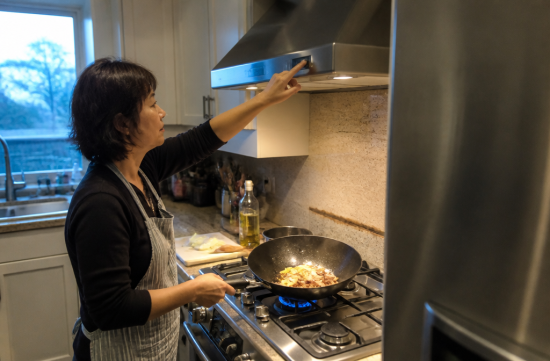
Last night, I made stir-fried pork for the first time in a while. As soon as I put the meat on the high heat, smoke started rising, and I realized I had forgotten to turn on the range hood.
At that moment, I recalled an article I had read recently. It mentioned that lung cancer is particularly prevalent among Asian women who have never smoked.
At first, I was honestly a bit puzzled. When you think of lung cancer, smoking usually comes to mind. So, I started looking up official data and research papers one by one.
According to a research team from UCSF, Asian women in the U.S. who have never smoked are twice as likely to develop lung cancer compared to non-smoking women of other races.
The same data indicated that 57% of Asian American women diagnosed with lung cancer had never smoked in their lives. I put down my fork and read that number again.
There is also a study that combined data from Sutter Health and Kaiser Permanente Hawaii. It reported that the incidence of lung cancer among non-smoking Chinese women was the highest at 22.8 cases per 100,000 people.
All groups of non-smoking Asian Pacific women, except for those of Japanese descent, had higher incidence rates than non-smoking white women. The differences ranged from 66% to more than double.
The part about it "increasing" should be viewed with some caution. While the overall lung cancer rates in the U.S. are declining, medical professionals at Kaiser Permanente Northern California have warned that there is actually an increasing trend among non-smoking Asian women.
Since there isn't a definitive conclusion at the national level yet, I take it as a sign that "there is clearly something going on."
So, what are the causes? There isn't a single answer yet, but researchers have identified several common candidates. Let's break them down one by one.
The first is genetic characteristics. A university hospital in Korea analyzed 198 cases of lung adenocarcinoma in non-smoking Asian women and found that 63% had EGFR gene mutations.
This suggests that it could be a different disease from lung cancer caused by smoking from the very start. Interestingly, this is somewhat hopeful because EGFR mutations are a type that has targeted therapies available.
The second factor is air pollution. A study published in Nature in July 2025 analyzed the genomes of 871 non-smoking lung cancer patients.
It found that patients from areas with high levels of fine particulate matter (PM2.5) had more mutations that cause cancer. In contrast, there was no clear association between secondhand smoke and specific mutation patterns.
The third factor is cooking smoke. As someone who spends a lot of time in the kitchen, this was the part that hit home the most.
There is a study comparing 1,302 non-smoking female lung cancer patients in Taiwan with a healthy control group. It found that the longer someone had been cooking, the higher their risk of lung cancer increased step by step.
However, the same study noted that those who had used ventilation devices like hoods for a long time had their risk reduced by half. This is not something to overlook in a Korean kitchen where frying and grilling are common.
The fourth factor is radon. The EPA considers radon to be the second leading cause of lung cancer after smoking and the biggest cause among non-smokers.
According to EPA estimates, more than 21,000 people in the U.S. die from lung cancer due to radon each year. They recommend taking action if radon levels in the home measure above 4 pCi/L.
The most frustrating part here is the screening criteria. The USPSTF set the low-dose CT screening criteria in 2021 for those aged 50-80, with a smoking history of 20 pack-years or more, and current smokers or those who quit less than 15 years ago.
This means that people who have never smoked do not fall into this category. It feels a bit unfair since the risk is high, but the screening door is closed.
That's why UCSF is conducting a study called FANS, aimed at finding the causes of lung cancer in non-smoking Asian women, and they have also created a Korean-language guide.
However, there's no need to panic. Here's a summary of what can be done right now.
When cooking, turn on the hood before lighting the stove. Keep one window open. Don't raise the temperature to the point where it produces oil smoke.
Consider measuring radon levels in your home at least once. You can find test kits at hardware stores, and it's essential to keep windows and doors closed while measuring.
If you have a cough that lasts for weeks or experience shortness of breath, don't dismiss it with the thought, "I don't smoke, so it should be fine." If there's a family history or any concerns, definitely discuss the need for screening with your doctor.
After reading this, I changed my kitchen habits. I put a small note next to the hood switch. It may seem a bit excessive, but it's the most certain way to remember.
I believe that the balance between enjoying delicious food and eating healthily ultimately comes from these small habits. If you're cooking a stir-fry tonight, remember to turn on the hood first.
 CoffeeDream


 neroyo |
 nivex85 |
 Old English |
 nixxon |
 LIZ Legal Information Blog |
 unified |
 Audio Mania World |


 NC Dreamer |
 North Carolina State University |
  andrew park |
  Peter Pan Pet |
  Balan |
  Cali M Law Group |
  Dreams Come True as Desired |
  Khan Film Blog Production |
  coloradoman |
  Living Economy Information Blog |
  rustley |
  Shim Ramen |
  Cool Beach Freeway |
  Exploring American Life Information |
  Mental Health Psychiatrist |
  element |
  Koreab Date |
  CA Real Estate |
  yolanda78 |
  Round and Round Children's Song Kingdom |
  Mia Flori |