
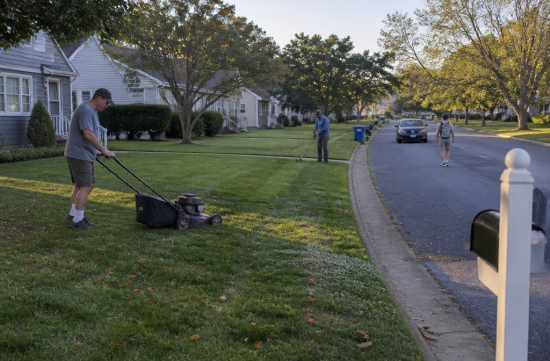
On a weekend morning, I set out early to hit the trails, but the neighborhood was already noisy. The sound of lawnmowers was echoing from house to house.
The man next door was trimming the edges of his freshly cut grass. Honestly, the only thought I had at that moment was: why are Americans so serious about their lawns?
Curious, I did some research and found that this has a surprisingly deep history. Today, I want to summarize that story.
The starting point is the estates of British nobility. A neatly mowed expanse of grass was something only those with plenty of land and labor could afford.
In the days before machines, people had to use scythes to cut the grass and heavy rollers to flatten the ground. So, having a lawn was a sign that one could afford to maintain it.
In early America, a notable figure representing this culture was George Washington. At Mount Vernon, not far from our neighborhood, there is a large lawn known as the Bowling Green in front of the mansion.
According to Mount Vernon's description, Washington designed and created this landscape between 1784 and 1787. It served as a garden for receiving guests and a space to showcase wealth.
However, the people who selected the grass and cut it evenly with scythes were enslaved individuals. It was a task that only skilled workers could handle, so thinking about the labor behind that green lawn complicates my feelings.
Jefferson's Monticello is similar. The western lawn was a place where his grandchildren played, but records show that enslaved laborers would cut the grass once or twice a year and let sheep graze on it.
The game-changer was machinery. In 1830, Edwin Budding from England invented a lawnmower with cylindrical blades.
This allowed for maintaining short, even grass without needing skilled scythe users. From this point on, lawns began to gradually move away from being solely a luxury of the nobility.
The next key figure was Frederick Law Olmsted, who designed Central Park. In 1869, he planned the suburb of Riverside on the west side of Chicago with Calvert Vaux.
Here, homes were required to be set back at least 30 feet from the road. They planted trees and laid down grass in the front space to create a natural connection with neighboring yards.
This was the origin of the "front yard lawn without fences" landscape we see today. This was the most fascinating part for me while writing this.
The decisive factor was the post-World War II suburban boom. Levittown, built on Long Island, New York, starting in 1947, became a symbol of mass-produced housing.
Levitt included rules in the house documents. From April to November, residents had to mow their lawns at least once a week, and they couldn't build fences as they pleased.
Lawn maintenance became not just a personal preference but an obligation tied to neighborhood agreements and, ultimately, property values. It makes sense that HOA regulations today still include lawn care as an extension of this trend.
So, how much lawn is there in America today? A team led by Christina Milessi, in collaboration with NASA's Ames Research Center, estimates that the lawn area in the contiguous 48 states is about 40 million acres. This figure was calculated using satellite images, aerial photos, and census data.
This research has spread with the claim that "lawns are America's largest irrigated crop," but it actually means that if you assume all of it is watered, then that's the case. In reality, not all lawns are watered, so some argue that calling it the largest crop is an exaggeration.
Still, the number itself is quite shocking. It means we are cultivating such a vast area of grass that we don't even eat.
And this obsession is still alive in regulations today. Fairfax County has set a rule that residential lots under half an acre cannot have grass taller than 12 inches.
Complaints are only accepted from late April to mid-October. Right around this time, the submission period is coming to an end.
If you receive a violation notice and don't resolve it by the deadline, the county can mow the lawn themselves and charge the homeowner for the cost. Lots over half an acre or managed landscaping like flowers and shrubs are not subject to enforcement.
New Korean residents often find this aspect the most surprising. In Korean apartments, the concept of yard maintenance doesn't exist. Many homes hire lawn care services during the busy season.
Looking at it this way, Americans' love for lawns is not just a preference. It started as a display of nobility, became popularized through machinery, and solidified into a cultural norm through suburban development and regulations.
Nowadays, some homes mix native plants or clover to save water. There are also movements like "bee lawns" that intentionally grow flowering grasses.
Personally, I find that more appealing than perfectly carpet-like grass. The wildflowers I see on the trails feel much more alive.
Still, living in a neighborhood with neighbors means I have to adhere to the 12-inch rule. Next weekend, I plan to mow the lawn before heading out to the trails.
 SunnyFox


 Peter Pan Pet |
 horse |
 Sunset Oregon |
 daisypat |
 Anjollinya Blog |
 Alpha and Omega World |

 Yellow Snowman |
 Fairfax Fox |
 korvex93 |
  draxen |
  gallery |
  milkyotter |
  Zoom Zoom Zoom |
  Minnesota Lakes and Clouds |
  noraro |
  tervox95 |
  vale vale |
  yentra |
  Golden life |
  andrew park |
  Balan |
  Cali M Law Group |
  neroyo |
  Dreams Come True as Desired |
  Khan Film Blog Production |
  coloradoman |
  Living Economy Information Blog |
  rustley |