
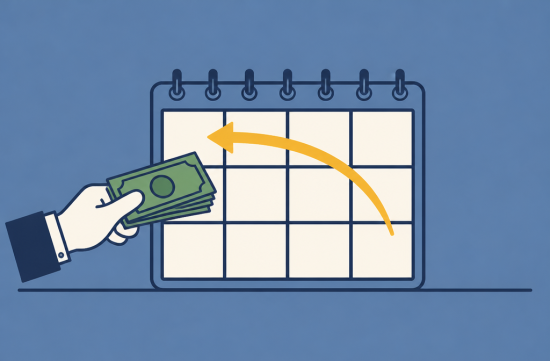
Recently, I met an old acquaintance at a local café. After some hesitation over coffee, he confessed that he thought he applied for Social Security benefits too early.
He received a sudden request from his company to come back to work, and he heard that working while receiving benefits could be a loss. He was wondering if it was possible to reverse his decision now that he had been receiving benefits for several months.
I wasn't sure either, so that evening I looked up information from the Social Security Administration (SSA). To cut to the chase, there is a way to reverse the decision. However, the conditions are stricter than expected.
The SSA refers to canceling a retirement benefit application as a "withdrawal." This is only possible within 12 months from the first month you became eligible.
There was a time when cancellations could be made without a deadline. However, as cases of using it like an interest-free loan emerged, it was restricted to the current 12-month limit.
The application form is SSA-521. You need to fill it out and submit it to your local Social Security office.
If the cancellation is accepted, it will be treated as if you never applied in the first place. When you reapply later, the benefit amount will be recalculated based on your age at that time.
At this point, it sounds like a pretty good system. However, many people hesitate at the next condition.
You must repay all the benefits you received. This includes not only your share but also the share of family members who benefited from your record, such as a spouse or children.
Any money that has been deducted from your benefits must also be repaid. The SSA considers all received funds, including Medicare premiums, withheld taxes, and amounts lost due to garnishments.
I was a bit surprised at this point. I thought I only had to repay the actual money that went into my account, but that wasn't the case.
For example, if the Part B premium was deducted from your monthly benefits, you must include that amount in your repayment. If you received benefits for nearly ten months, that means you'll need a significant sum.
Another important point is that this cancellation can only be done once in a lifetime. Once you use it, you cannot use the same method again.
Your mind might change again. The SSA allows you to withdraw the cancellation itself within 60 days after approval.
You also need to consider Medicare separately. If you are already enrolled in Medicare, you can choose whether to cancel it along with your benefits.
If you cancel Medicare, you will also have to repay any medical expenses covered under Part A. Conversely, if you keep Medicare, the Part B premium will not be deducted from your benefits, and you will receive separate bills quarterly.
So what if 12 months have already passed or you have no money to repay? In this case, whether you have reached your Full Retirement Age (FRA) becomes a turning point.
If you are past your FRA, you can request a "suspension" of your benefits voluntarily. In this case, you do not need to repay any money received.
During the suspended period, delayed retirement credits will accumulate. They increase by two-thirds of a percent each month, totaling 8 percent per year, and will stop increasing once you turn 70.
If, like my acquaintance, you return to work before reaching your FRA, you also need to consider the income limits. As of 2026, if your earnings before FRA exceed $24,480 per year, your benefits will be reduced by $1 for every $2 over that limit.
In the year you reach FRA, the limit increases to $65,160, and your benefits will be reduced by $1 for every $3 over that amount. Starting from the month you reach FRA, this limit disappears entirely.
So the question my acquaintance was pondering was actually quite simple. It was about how much the money he earns from working exceeds this limit and whether he has the means to repay all the benefits he received at once.
If he has the means to repay and plans to work for a long time, canceling could be advantageous. This is because he could start receiving a higher amount later.
On the other hand, if he only plans to work for a few months, it might not be necessary to repay a large sum. The reduced benefits due to the income limit will be reflected when recalculating the monthly benefit amount after reaching FRA.
If I were in his position, I would mark the 12-month deadline on my calendar. This option disappears over time.
Next, I would call the SSA directly or visit the office to get the exact repayment amount. Seeing the numbers visually makes decision-making much quicker.
However, when spousal benefits, taxes, and Medicare are involved, the calculations can quickly become complicated. The results can vary significantly depending on individual circumstances, so I recommend confirming with an SSA representative or a financial expert.
That day, my acquaintance said he would go home and discuss it with his wife first. After hearing that he had to repay his family's share as well, he realized it wasn't something he could decide alone.
Social Security is said to be a decision that lasts a lifetime once made. However, knowing that there is a one-year grace period can provide some peace of mind.
 SandraBulldog





 sparkling |
 oh my salami |
 saffronroute |
 You Only Live Once |
 Texas Real Estate Blog |
 Lemon Kim |
 forestcloud |
 Living in New Jersey blog |
 forestbon |
 springw |
  Golden life |
  andrew park |
  Peter Pan Pet |
  Balan |
  Cali M Law Group |
  neroyo |
  Dreams Come True as Desired |
  Khan Film Blog Production |
  coloradoman |
  Living Economy Information Blog |
  rustley |
  Shim Ramen |
  Cool Beach Freeway |
  Exploring American Life Information |
  Mental Health Psychiatrist |
  element |
  Koreab Date |
  CA Real Estate |
  yolanda78 |
  Round and Round Children's Song Kingdom |