
A few days ago, I stood in front of the frozen food section at the grocery store for quite a while. Every time the door opened, white steam billowed out like a cloud, revealing trays filled with neatly divided meals.
While looking at those partitioned trays, I suddenly became curious. Where did this idea first come from?
Upon researching, I found the answer surprisingly close. The company that popularized the name TV dinner was C.A. Swanson & Sons from Omaha.
The most famous part of this story is the turkey. Due to an overly optimistic estimate for Thanksgiving demand, 260 tons of frozen turkey were left unsold.
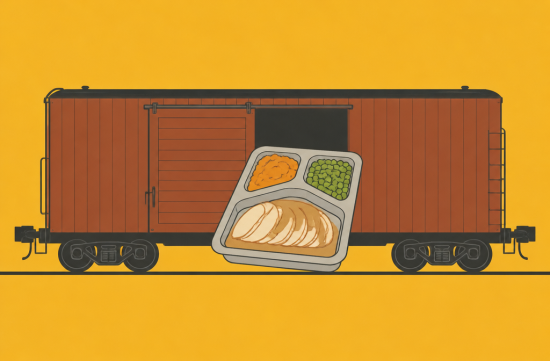
According to Smithsonian Magazine, those turkeys were loaded into ten refrigerated railroad cars. The cooling system only operated while the train was moving, so the turkeys were transported back and forth between the East Coast and Nebraska.
Isn't it a bit funny to imagine? A train racing across the continent with turkeys on board to keep them from spoiling.
The problem-solver in this story is Gary Thomas, a salesman for Swanson. He saw the aluminum trays used for in-flight meals and came up with the idea to serve a complete meal in a divided tray.
The first menu was a classic Thanksgiving spread. Turkey with gravy, cornbread stuffing, sweet potatoes, and buttered peas all fit onto one tray.
According to Thomas, the first order of aluminum trays was for 5,000 units. That initial batch sold out quickly.
And in 1954, the first full production year, 10 million units were sold, as noted by Smithsonian Magazine. The number was so large for a solution to leftover turkey that I had to read it twice. A headache turned into a hit product in just one year.
The name was also clever. At that time, televisions were rapidly entering American homes, so the image of sitting down with a tray in front of the TV for dinner would have come to mind immediately.
However, the story gets a bit complicated here. The famous tale of the 260 tons of turkey primarily comes from Gary Thomas himself.
Betty Cronin, who worked at Swanson during the same period, remembers it differently. She was a microbiologist responsible for ensuring that the meat, vegetables, and potatoes were heated at the same time.
Cronin stated that the concept itself came from Gilbert and Clark Swanson. She publicly expressed confusion over why Thomas was recognized as the inventor.
The Chicago Tribune referred to Cronin as the "mother of the TV dinner" in 1989. So, there still isn't a clear answer to the question of who the true inventor is. In fact, that ambiguity seems to have helped this story endure over time.
The dates also vary slightly by source. Some records state it was first sold in 1953, while Omaha's recollections mention the first product was introduced on April 6, 1954.
There are also discrepancies regarding the price, with some sources claiming it was 98 cents and others stating it was $1.09. So, rather than getting hung up on a single number, I decided to trust the overall trend.
What is certain is that this tray spread from Omaha to dinner tables across America. The speed of its success can be seen in the following year.
In 1955, Campbell Soup Company acquired Swanson. It was Campbell's first major acquisition, indicating that just over a year after its launch, it became a product worth pursuing by a big company.
The story of the Swanson family is also interesting. Founder Carl Swanson immigrated from Sweden to Nebraska at the age of 17, starting work on a farm in Blair while learning English.
From a company founded by immigrants came one of the most American dinners. This part made me feel a bit sentimental.
It reminded me of my first days in a foreign land, struggling to read English labels. The frozen meals that I could choose based on pictures were surprisingly comforting.
Hearing stories from Korean neighbors is similar. Many have memories of feeding their kids frozen dinners during the busy early days of dual-income households.
Of course, nowadays, TV dinners are often seen as synonymous with unhealthy food. I don't intend to argue that assessment.
However, I prefer to view this tray as a product born from solving a problem. The leftover 260 tons of turkey changed someone's dinner time.
Whoever the true inventor was, it likely wasn't the work of just one person. It required a chain of ideas from a salesperson, calculations from a lab, and decisions from management.
In that sense, the partitioned tray is a product that connects people. Just as clouds gather and disperse, changing shape, ideas also take form through many hands.
This winter, I think I will take a little longer in front of the frozen food section. If I think about how the path of the turkey train is contained in one tray, it sounds like a pretty good dinner.
 KimDelivery





 Peter Pan Pet |
 horse |
 Sunset Oregon |
 daisypat |
 Anjollinya Blog |
 selvon |
 lunexa |

 Nebraska Center Director TOP |
 Eagle in America for Five Years |
 Minnesota Lakes and Clouds |
  noraro |
  tervox95 |
  vale vale |
  yentra |
  Golden life |
  andrew park |
  Balan |
  Cali M Law Group |
  neroyo |
  Dreams Come True as Desired |
  Khan Film Blog Production |
  coloradoman |
  Living Economy Information Blog |
  rustley |
  Shim Ramen |
  Cool Beach Freeway |
  Exploring American Life Information |
  Mental Health Psychiatrist |