
While sorting through last month's electricity bill, one line caught my eye. The Base Services Charge, a monthly fee of around $24, is applied regardless of usage.
At first, I thought they had raised the rates again, but it turns out the situation is a bit different. For homes like apartments in San Francisco that use less electricity, this is definitely worth calculating.
PG&E changed the structure of electricity bills starting March 2026. Some costs that were previously included in the rate per kWh have been separated and charged as a fixed fee.
This fixed fee is the Base Services Charge. For regular households, it is set at $24 per month, while CARE households pay $6, and FERA households pay $12.
According to PG&E, this charge covers costs such as grid connection, meters, customer service, billing, and energy assistance programs. Since it is calculated on a daily basis, the amount may vary slightly depending on the number of billing days.
PG&E's position is clear. This is not a new fee, and it does not mean an increase in the company's overall revenue. It applies to all customers under AB 205, which was passed by the state legislature.
On the other hand, the rate per kWh has decreased. As of March 1, the average rate for residential customers receiving both generation and delivery from PG&E dropped from 41.46 cents in January to 40.60 cents.
For reference, PG&E data from the same March shows that the average bill for a typical household using 500 kWh dropped from $208.68 to $203.54, a decrease of $5.14. Overall, this is not bad news.
So, what will my actual bill look like? Looking at the example graph provided by PG&E makes it clear.
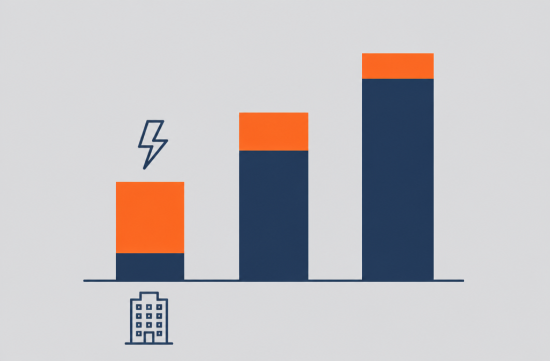
A low-usage household consuming 200 kWh per month is projected to see their bill rise from $75 to $91. That's a $16 difference, which is quite significant in percentage terms.
A medium-usage household consuming 450 kWh will see their bill increase from $184 to $188, a $4 rise. That's almost the same level.
However, a high-usage household consuming 700 kWh will actually see their bill decrease from $304 to $296, an $8 reduction. This means that the more you use, the better off you are.
Of course, PG&E has clearly stated that these numbers are illustrative examples. Taxes and other fees are not included.
This brings us to the topic of San Francisco apartments. One-bedroom or two-bedroom apartments rarely use air conditioning, and the weather is cool, so their usage tends to be low.
This means that many homes are likely closer to the 200 kWh example. The fixed fee of $24 will take up a larger portion of their bills.
The calculation is simple. Check the monthly usage kWh on your last bill, multiply it by the new rate, and then add $24.
In PG&E's example, the delivery charge for a 200 kWh household drops from $46 to $38, an $8 reduction. Adding the new $24 charge makes it impossible for the calculations to match.
There's one more thing to check. Many homes in San Francisco receive electricity from CleanPowerSF, and in this case, the Base Services Charge is billed through PG&E.
CleanPowerSF sets only the generation rate, while the delivery charge and this fixed fee are handled by PG&E. The SFPUC approved a 25% reduction in CleanPowerSF residential generation rates on January 27, which took effect on March 1.
As a result, CleanPowerSF customers may see different outcomes compared to PG&E's examples. Ultimately, you have to calculate based on your own bill.
If you are a low-income household, check your eligibility for CARE or FERA. CARE reduces the fixed fee to $6, and according to PG&E, it provides an overall discount of 42% on electricity costs based on a usage of 500 kWh per month.
You can apply at pge.com/billhelp. Eligibility is determined based on household size and income, so if you think you qualify, don't hesitate to check.
If you live in an older building with a master meter, the landlord's bill may reflect this, so tenants might not see it directly. PG&E has issued separate guidance for these types of buildings, so asking your management office could be a good idea.
Honestly, I understand the intention behind wanting to divide costs transparently. It makes sense that there are costs associated with maintaining the power grid, whether you use electricity or not.
However, it is a bit disappointing that those who conserve energy end up at a relative disadvantage. They keep telling us to save.
So, here's what I would do. First, I would check the Base Services Charge line and usage on my last three months of bills.
Next, I would check my eligibility for CARE or FERA, and if I don't qualify, I would compare whether a time-of-use rate plan fits my lifestyle. PG&E has a rate plan comparison tool on their site.
The fixed fee is money I can't reduce. The only things I can control are my usage and rate plan selection, so focusing on those is the realistic answer.
 RegularChun







 mykiwi blog |

 Sugar Cream Door Bulletproof Noodles |

 Nuchuhan Exploration BLOG |

 Peter Pan Pet |






 Scade Studio |

 Nevada Vegas UNLV |

 Things to know |
 West Kong |

 havero70 |
 American Food Information & Calories |
 Sammy Beach |
 monalisa blog |
 Pronunciation Yo |
 Softy |
 rigid |
 Website Design Artisan |
 Raccoon Ramen Night |
 Folding Instructions |
 hulu 1978 |
 average life |
 Casa Mia |
 aaoaa |
 Mr. Midwest America |
 Taek Jun |
 molten |
 Kondae Garusong Blog |
 micos |
 Living Economy Information Blog |
 vintage |