
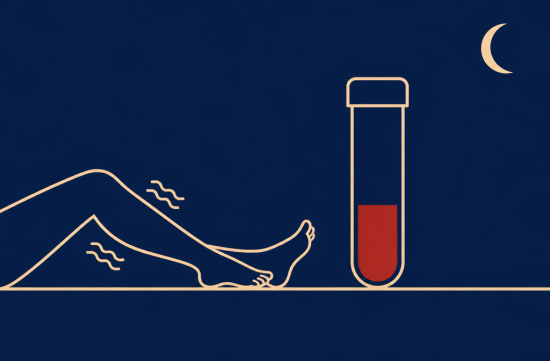
Last week, a long-time friend called me late at night. They said that lately, when they lie down to sleep, it feels like something is crawling inside their calves, making it impossible to stay still.
In the end, they said they walk back and forth in the living room every dawn. Their voice over the phone sounded very tired.
As soon as I heard that, the term Restless Legs Syndrome came to mind. In English, it's called Restless Legs Syndrome, abbreviated as RLS.
The National Institute of Neurological Disorders and Stroke (NINDS) describes this condition as a neurological disorder characterized by an irresistible urge to move the legs. It is also known by another name, Willis-Ekbom Disease.
The symptoms are quite clear. Unpleasant sensations arise in the legs when sitting or lying down, and they improve temporarily with movement.
Moreover, it usually worsens in the evening and at night. It means that during the time when one should be resting comfortably, the body is unable to relax.
Initially, my friend thought it was just due to aging or fatigue. In fact, this was the most unfortunate part.
Many people consider these symptoms to be related to circulation issues and start looking for massagers or supplements. However, there is something else that should be checked first.
That is iron. NINDS materials also list iron deficiency as a common condition associated with Restless Legs Syndrome and recommend treating iron deficiency as one of the suggested measures.
The Mayo Clinic also explains that iron deficiency can cause or worsen symptoms. Frequent blood donations, gastrointestinal bleeding, and heavy menstrual flow can be contributing factors.
Interestingly, it can be a problem even without anemia. This is why some people continue to experience leg symptoms even after being told their blood tests are "normal."
The new clinical guidelines released by the American Academy of Sleep Medicine (AASM) in 2024 strongly emphasized this point. They recommend that all patients with clinically significant symptoms undergo regular iron testing, including ferritin and transferrin saturation.
Ferritin is a measure of the amount of stored iron in the body. The guidelines state that for adults, if ferritin is below 75 ng/mL or transferrin saturation is below 20%, iron supplementation should be initiated.
If ferritin is between 75 and 100 ng/mL, they advised considering only intravenous iron rather than oral iron. For children, the criteria differ, recommending supplementation when ferritin is below 50 ng/mL.
I was a bit surprised to see these numbers. Even if the values exceed the normal range in a general check-up, they could still be in the range where supplementation is considered for Restless Legs Syndrome.
So, when you receive your test results, it's better not to just look for the "normal" label but to ask for the actual numbers. This small question can make a significant difference.
Another notable change in the same guidelines was a conditional recommendation against the standard use of dopamine agonists, which have been commonly prescribed for a long time.
This is due to accumulating evidence that long-term use can lead to a phenomenon called "augmentation," where symptoms appear earlier and more intensely. Instead, medications like gabapentin from the alpha-2-delta class received strong recommendations.
Of course, not all experts agree with this direction. Some believe the language is too strong, and there are concerns about what to do with patients already taking those medications, which the guidelines do not address.
So, do not stop or change your current medications on your own. Whether it's adjusting medications or iron supplementation, you must consult with a doctor or pharmacist before making any decisions.
The same goes for iron supplements. If you think taking more is better and take them on your own, you might experience gastrointestinal issues or excessive iron accumulation.
I advised my friend to ask their primary care physician next time if they could check ferritin and transferrin saturation levels due to their nightly leg symptoms.
They should also ask whether it's better to have blood drawn on an empty stomach in the morning and if any of their current medications could be worsening the symptoms. NINDS also notes that some medications can be related to symptoms.
It's worth reflecting on lifestyle habits as well. The Mayo Clinic suggests that reducing caffeine, alcohol, and nicotine may help.
Evening walks, light stretching, and warm baths are commonly recommended methods. The effectiveness may vary from person to person, but there's no harm in trying.
Our bodies are more honest than we think. Ignoring the signals our legs send every night just because of age is similar to pretending not to see the fallen leaves outside that indicate the change of seasons.
These days, it's a bit disappointing that people tend to look for medication first. I believe it's more fundamental to examine what might be lacking in our bodies.
If it were me, I would pull out my blood test results before buying a massager or supplements. Just one ferritin number could help reclaim a long night.
 ChickenNap







 US Embassy |


 Archaic Kim |

 Thou Thou |












 Sammy Beach |

 molten |

 Joyce 77 |

 zestorbit |

 hihihi |
 American Food Information & Calories |
 monalisa blog |
 Pronunciation Yo |
 Softy |
 rigid |
 Website Design Artisan |
 Raccoon Ramen Night |
 Folding Instructions |
 hulu 1978 |
 average life |
 Casa Mia |
 aaoaa |
 Mr. Midwest America |
 Taek Jun |
 Kondae Garusong Blog |
 micos |
 Living Economy Information Blog |
 vintage |