
On a weekend evening, I walked slowly down the aisles of the grocery store with a basket in hand. I examined the labels on the shelves, putting items back if they didn't appeal to me.
While waiting in line at the checkout, I suddenly wondered when this method of choosing items with my own hands became the norm.
As I searched for an answer, the story took me back to downtown Memphis. In September 1916, a grocery store named Piggly Wiggly opened at 79 Jefferson Avenue.
The company records state that the establishment date was September 6. However, there are also records indicating that due to construction delays, the actual opening was a few days later, so the date varies slightly across sources.
Before that, the appearance of grocery stores in the U.S. was quite different from today. Customers would tell the clerk what they needed, and the clerk would retrieve the items from the shelves.
Piggly Wiggly flipped that process. Customers could take a basket and walk through the aisles to select their items, paying at the checkout at the end.
It may seem like a minor change now, but at the time, it was likely a rather unfamiliar experience. The structure allowed products and customers to face each other directly without a clerk in between.
The person who opened this store was Clarence Saunders. According to the Tennessee Encyclopedia, he was born in 1881 into a poor family in Virginia and later moved to Tennessee.
He patented this method. The "self-serving store" patent was filed in October 1916 and registered on October 9, 1917.
However, there were later disputes over the rights claim in court, and some were declared invalid, indicating that monopolizing an idea was not as easy as it seemed.
One point to clarify is whether Piggly Wiggly was the first self-service store in America.
While it is often introduced that way, an article in Tennessee Magazine argues that there were earlier self-service stores. The conclusion of that article is that Piggly Wiggly was the first large self-service chain.
I believe this interpretation is more honest. Often, it is the person who systematizes and spreads an idea widely who changes history, rather than the one who first conceived it.
In fact, Piggly Wiggly spread rapidly through a franchise model. Even today, the stores continue to operate independently owned and managed.
However, Saunders's story does not end with success. In early 1923, he engaged in a stock buyback against forces short-selling his company's stock.
The outcome turned unfavorable for him. Records indicate that the New York Stock Exchange gave the short-sellers more time to transfer the stocks, turning the tide against him.
Ultimately, he stepped down as the company's representative and lost both his stocks and the mansion he was building to creditors. A year later, he even filed for bankruptcy.
The mansion, built with pink marble, earned the nickname Pink Palace. It was bittersweet to read that it left the owner's hands before it was even completed.
The house passed to the city and opened as Memphis's first museum in 1930. It now remains part of the Museum of Science and History.
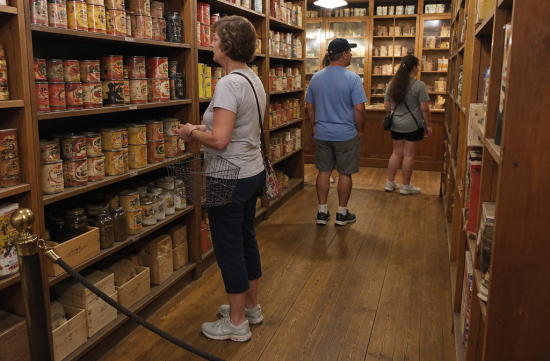
Interestingly, there is a space inside that recreates the first Piggly Wiggly store. After renovations in 2018, this recreated store has become one of the museum's attractions.
According to a 1980 UPI article, the recreated store displayed between 2,500 and 3,000 products that were sold in 1916. It's as if a house that could not live under its own name became a place to remember its store.
Saunders did not stop there. He later conceived an automated store called Kiduzl and continued experimenting until his death in 1953.
Kiduzl did not achieve great success. Still, his idea of entrusting calculations and displays to machines reminds us of today's self-checkout systems.
When people think of Memphis, they usually first think of blues, barbecue, and the Mississippi River. However, the fact that the prototype of the grocery stores we visit weekly originated in this city is surprisingly not well known.
Going to a Korean grocery store and spending time comparing packages of red pepper powder is ultimately an extension of that freedom to see and choose for oneself.
Of course, self-service may not have changed everything for the better. The brief conversations with clerks and the small courtesies received as a regular customer have likely diminished.
Still, I enjoy the time spent walking down the aisles with a basket in hand. Those few minutes of choosing slowly without worrying about anyone else can become a small pause in my week.
If you happen to pass by Jefferson Avenue downtown, I encourage you to slow down for a moment. A hundred years ago, the way we shop quietly changed there.
And if you have time, stop by the Pink Palace and take a walk through that recreated store. The stories contained in a single basket are deeper than you might think.
 BroccoliMove
 ChocoBuddy



 moodansa 77 |

 Conflite Teacher |

 US Snowboard Information Exchange |

 There Are Such Things in the World |

 San Diego TOP Idol |

 greenloop |



 lunarpath |


 freshmint |
 Shining Our Own World |
 Raymond K. |
 gravity |
 714 Success Era Real Estate |
 Investment Beginner Company Information Encyclopedia |
 musicque |
 The Gelaton |
 ovelion |
 Chicagonian |
 Freedom Yea |
 AZ Road Master |
 glenix39 |
 Something is popping in the situation |
 orvella |
 vella |
 comets |
 Banana |
 Yes Dorian |
 Minnesota Sonata N |
 zentar |