

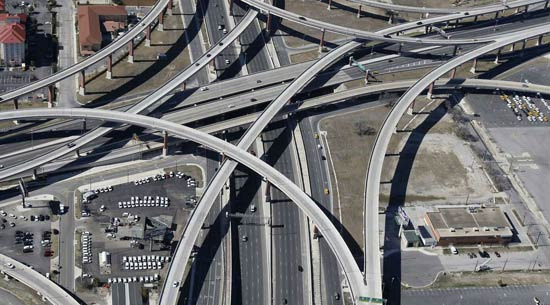
Interstate 35 (I-35) is one of the major transcontinental highways in the United States and serves as a crucial transportation corridor in Texas. The segment connecting San Antonio and Austin is the central axis of the Central Texas Corridor, playing a vital role economically, culturally, and logistically.
Overview of I-35 History
-
Initial Introduction (Late 1950s)
I-35 was planned in accordance with the Federal-Aid Highway Act established during President Eisenhower's administration in 1956. It was part of a national infrastructure project aimed at improving the efficiency of automobile use and logistics between cities during a time of rapid growth. -
Construction of the San Antonio to Austin Segment (1960s)
-
In San Antonio, the I-35 segment was fully opened in 1962, becoming the first completed urban segment in Texas.
-
The downtown segment in Austin was completed in 1962 by constructing an elevated roadway over the existing road known as East Avenue.
-
The entire segment connecting the two cities was mostly completed by the mid-1960s, accelerating economic and population growth in the Central Texas region.
-
-
Issues and Traffic Congestion
-
Due to rapid expansion of urban and suburban areas, this segment began to be recognized as one of the most congested roads in the United States starting in the 1990s.
-
In particular, the downtown segment in Austin has been selected multiple times as the 'most congested highway segment in the United States.'
-
Modernization and Expansion Projects
-
San Antonio NEX Project (Northeast Expansion)
-
Construction began in 2022, with a completion target of 2027-2028.
-
Key details: new elevated roadways, addition of express lanes, congestion relief.
-
-
Austin Capital Express Project
-
Scheduled to begin construction in 2024, with a completion target of 2033.
-
Key details: major redesign of the downtown segment, installation of underground tunnels in some areas, addition of managed lanes.
-
Current Role of I-35
-
Formation of an economic belt connecting San Antonio, New Braunfels, San Marcos, and Austin.
-
Connecting clusters of advanced industries such as IT, biotechnology, and manufacturing.
-
A key route for North American logistics handling trade between the U.S. and Mexico.
In conclusion, I-35 has served as a vital artery for the economic and cultural development of Texas, and large-scale modernization projects are currently underway to expand its role.
Recommended Sites to View I-35 Historical Photos
Texas Highway Man – San Antonio Segment
This site provides detailed descriptions along with early construction photos of I-35 in the San Antonio area. You can see the road construction from the 1950s to 1960s and the changes in the downtown area.
TexasFreeway.com – Austin Segment
This site collects photos before and after the construction of I-35 in the Austin area, featuring valuable materials documenting the transformation of East Avenue into a highway.
Austin Chronicle – Austin Highway Construction Photos
The Austin Chronicle features photos from the I-35 construction sites from the 1950s to 1970s, vividly showcasing the city's appearance and the changes in the road.







 candytip |
 Gold Bar |
 Pirate Ship Popcorn Maker |
 Montgomery Mom |
 Anjollinya Blog |
 quanta7 |
 Living with a Consistent Heart |
 |
| 
 U.S. Weather Bureau News |
 History Repeats Itself |
  US Embassy |
  Korean Mom |
  My NYC |
  moo moo |
  Mr Oh |
  forevergee |
  festival |
  manchester |
  constant |
  Leapfrog Move |
  vibranto |
  Tora Tora |
  yellowbutter |
  Dolly |
  NYC saladbar |
  Finding Superfoods |
  lightyear |
  song bang |
  vexomo |
  Indiana Jones |