
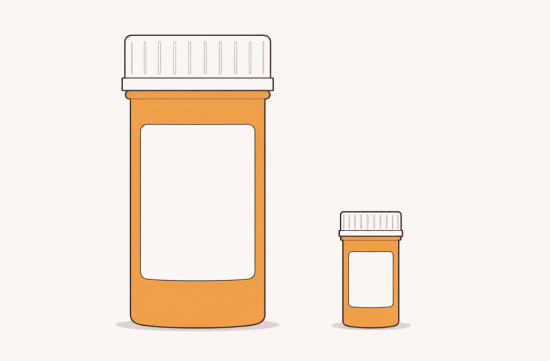
A few days ago, I went to the hospital and then to the pharmacy with a prescription, and I was momentarily taken aback by the total amount I had to pay.
It seemed like a minor medication, but the number on the card reader was surprisingly high, prompting me to double-check.
At that moment, the pharmacist asked, "Would you like to switch to a generic?"
When I agreed, the price dropped significantly, making me wonder if it was really the same medication.
Since then, I've been curious about how much of a difference it really makes to switch to a generic. I had always just accepted whatever was prescribed, and I felt a bit regretful for not asking about it sooner.
In simple terms, generics are medications made using the same ingredients after the patent has expired.
They may have different names, but they work the same way in the body as brand-name drugs.
The FDA requires that generics prove they are equivalent in absorption rate and effectiveness to the brand-name drug before they can be approved. If they don't meet this standard, they can't be sold at all, so if a generic is available, you don't have to worry much about its effectiveness.
If the ingredients and effects are the same but the prices differ, it's natural to wonder where that difference comes from.
The answer is simple: brand-name companies add the costs of new drug development, clinical trials, and advertising to the price of their medications.
In contrast, generic companies only need to produce already validated ingredients, which significantly reduces their costs.
According to FDA data, generic drugs are about 80 to 85 percent cheaper than brand-name drugs on average.
To get a better sense of this, I looked for specific examples.
The brand-name cholesterol medication Lipitor has a retail price of around $450 to $530 for a 30-count bottle.
The generic version, atorvastatin, costs only about $4 for a month's supply at Walmart, and you can get it for $8 at Costco.
When I compared the two prices side by side, the difference was over a hundred times, which honestly seemed a bit absurd. Moreover, with discount cards, the price can drop by nearly 90 percent compared to the usual retail price, making it hard to understand how such a large price difference exists for the same ingredient.
I also learned that this isn't just about one specific medication.
Ninety percent of prescription drugs dispensed in the U.S. are generics, yet they account for only about 12 percent of total drug spending.
This means that the brand-name drugs, which make up only 10 percent of prescriptions, account for 88 percent of total spending.
Looking at the broader picture, similar trends are evident across the country.
In 2024 alone, generics and biosimilars are projected to save the U.S. $467 billion, with Medicare saving $142 billion and Medicaid saving $62.1 billion. There are also statistics showing that newly approved generics in 2023 alone generated a net savings effect of $18.6 billion within a year of approval.
Seeing these figures made me realize that the few thousand dollars I save is not a small amount at all.
So, how should you actually ask about this? The method is surprisingly straightforward.
When receiving a prescription from your doctor, simply ask, "Is there a generic version of this medication?"
If the doctor indicates on the prescription that a generic is acceptable, the pharmacy will automatically switch to the cheaper option.
On the other hand, if the prescription specifies that only the brand-name drug should be used, the pharmacist cannot change it, so it's good to check this in advance. Depending on the insurance company, some may require you to try the generic first and only approve the brand-name drug if it doesn't work, so reviewing your insurance policy can also be helpful.
Even if you already have the prescription, it's not too late; just ask the pharmacy, "If there's a generic, please give me that one. How much is the price difference?"
From what I've heard from people who have made this switch, the price difference can range from $50 to $300 a month, depending on the type of medication.
If it's a medication you need to take regularly, like for blood pressure or diabetes, the difference can add up to a significant amount over a year. Since prices for the same generic can vary between pharmacies, comparing with discount cards or apps can help you save even more.
However, it's important to note that not all medications have generics available. You can often find similar price differences when comparing brand-name and ingredient labels for over-the-counter cold or headache medications as well.
Recently released new drugs or biologics may still be under patent, meaning generics are not available yet, but in such cases, it can be helpful to ask if there are cheaper alternatives in the same class.
What surprised me the most during my research was how much larger the price differences are than I expected, and if a simple question can save me money, I will definitely make it a point to ask every time I get a prescription in the future.
 RunToYouBro

 Silent Sea |
 Pointy |
 Idaho's Sumi's House |
 holy cheese |
 Michigan Enthusiast |
 mini hometown |
 harvest |
 forward |
 kingdom |
 Seattle - Emerald City |
  rouge88 |
  toffee |
  King County |
  DREAM BIG |
  Good News Good Thoughts |
  peelynew |
  Helpful Life Stories |
  chicpo |
  monorama tone |
  Kentucky Fried Chicken |
  bloomberg |
  morninpo |
  my town K blog |
  bravik31 |
  Various Knowledge and Information in the USA |
  orvik90 |
  San Gabriel Mountains |
  quanta7 |
  Fransco Family |
  leonee |