

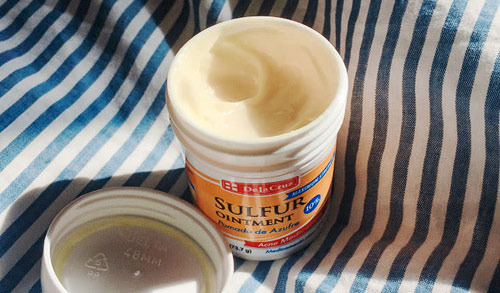
Living in the U.S. for a long time, you encounter many medications that you never saw in Korea.
Whenever I went to CVS or Walgreens in LA, I often found myself wondering, "What is this?" as I browsed the pharmacy section.
One day, I noticed something called Sulfur Ointment, which translates to 유황 연고 in Korean.
At first, I thought it sounded like a harsh medication because of the sulfur, and I wondered if it would sting when applied to the skin. However, it turns out that it has been used as a skin ointment for a surprisingly long time.
It contains ingredients that help inhibit the growth of bacteria and some microorganisms on the skin, as well as reduce sebum and dead skin cells, making it a long-utilized product in the U.S.
The most common use is for acne. Many people use it, especially when they have oily skin and are experiencing whiteheads or inflammatory acne.
It is also used as an adjunct treatment for seborrheic dermatitis, folliculitis, and rosacea symptoms.
Historically, it was widely used for treating scabies. While prescription medications are more common now, sulfur ointment was also frequently used for scabies treatment.
It can be used for seborrheic dermatitis on the scalp, oily skin, and thickened areas, but since the usage range varies by product, it's best to check the product instructions.
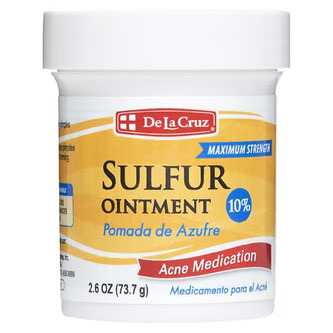
However, it is not a universal ointment for all skin conditions.
It may not be suitable for eczema, allergic rashes, burns, deep wounds, or severely infected skin.
If there is a lot of oozing or severe swelling, or if symptoms continue to worsen, it is safer to seek treatment from a dermatologist rather than self-treating.
Many households keep sulfur ointment on hand.
Especially in homes with teenage children or family members who frequently experience acne, it is often stored as an emergency skin ointment.
However, it is not as common as products like 후시딘 or 마데카솔 in every household in Korea.
In Korea, many people visit a dermatologist when skin troubles arise, but in the U.S., making an appointment can take a long time and be costly, so there is a culture of first looking for over-the-counter (OTC) medications at pharmacies.
As a result, it is common to see people consulting pharmacy staff, asking, "Is this good for acne?" or "Can I use this on my red skin?"
However, be prepared for the smell.
When you first open the lid, there is a distinct sulfur smell reminiscent of boiled eggs or matches.
Another point to remember is that sulfur ointment can dry out the skin.
Therefore, it is advisable to use a moisturizer afterward, and it is safer to apply it to a small area first to check for skin reactions before using it more widely.
 SunnyBridge92
 blueseabuilder2023
 MintCreator







 choi family |
 What can make money? |
 road98 |
 Baguette Blog |
 Khan Film Blog Production |
 Weekend Movie Blog |
 Beauty, Health, Lifestyle Blog |
 Victory 1988 |
 coloradoman |
 Superman Cat Blog |
  lumbus |
  Texas Migration Story |
  Scade Studio |
  love ya |
  biscuit90 |
  chicpo |
  Helpful Life Stories |
  Kitchen Ideas |
  Diana Blues |
  Agenda Center |
  Community Cross |
  journey |
  heeve |
  leman |
  corner kick |
  treasure |
  strawberry |
  Augusta Univ |
  B.I.G. Victor |