
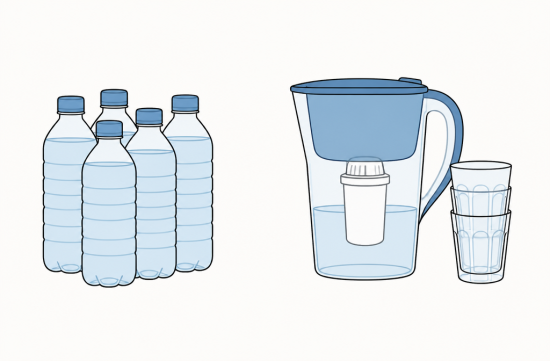
A few days ago, I saw a colleague buying a bottle of water from the convenience store every lunch hour. I wondered how much that would add up to in a year.
That evening, I got curious and looked up the data myself. The numbers were more specific than I expected.
It turns out that an average American drinks about 47.7 gallons of bottled water per year. When converted to 16.9-ounce bottles, that amounts to around 380 bottles.
In terms of cost, statistics show that this translates to over $100 per person annually. For someone living alone, that's not a small amount.
When considering a family, the numbers get even bigger. If the whole family drinks only bottled water as recommended, some studies suggest that the annual cost can exceed $1,000.
Looking at the price of bottled water per gallon, the national average is about $1.22. It's common for individual bottles at the store to be much more expensive than that.
A case of 24 bottles typically costs between $5 and $7, so if you buy one case each week, that adds up to between $260 and $364 a year. It was something I used to toss into my cart without a second thought, but adding it all up made the total feel quite significant.
So, I became curious about how much I could save by switching to a water filter.
I calculated based on the most commonly used Brita water filter pitcher. The price for one filter is about $18.
According to the manufacturer's specifications, one filter can purify about 120 gallons of water. This breaks down to a cost of about $0.15 per gallon.
Compared to the $1.22 per gallon for bottled water, that's about one-eighth of the cost. At this level of difference, it's worth doing the math.
In fact, official comparisons from Brita indicate that even when factoring in the costs of the filtration system and filters, you can save $289 annually compared to bottled water. This calculation includes the initial purchase of the pitcher and the cost of filter replacements in the first year, making it a fairly realistic figure.
It was also noted that two filters can replace the need for 1,800 bottles of water. While saving money is important, reducing plastic waste is an added benefit.
Recycling bottled water doesn't end the problem. There are costs and energy involved in the collection and processing as well.
I was personally surprised by this aspect. Seeing the numbers made it clear that the cost of a case of bottled water I used to buy weekly is almost the same as the price of one filter.
Of course, there are some points to keep in mind. If you miss the timing for replacing the filter, the purification efficiency drops, and eventually, the taste of the water deteriorates.
Therefore, I recommend setting a reminder for filter replacement in your phone calendar. If you find this minor maintenance bothersome, the advantages of the water filter are half lost.
The initial cost of buying a water filter and pitcher might feel burdensome. Together, they can cost around $40.
However, after just one to two months, this initial cost is quickly recouped. After that, you simply accumulate savings.
Tap water is regularly tested according to EPA standards. In contrast, bottled water is criticized for having a relatively lax testing schedule, so purified tap water is not necessarily less safe.
There are various filtration methods, from activated carbon to reverse osmosis, but for most households, a single activated carbon pitcher is often sufficient. There's no need to invest in an expensive system from the start.
Many people are skeptical about tap water. In such cases, considering a sink-mounted or refrigerator-integrated filter instead of a pitcher is also an option.
While sink-mounted filters have a higher initial installation cost, the cost per gallon tends to decrease in households that use a lot of water. This is worth considering for larger families.
In older apartments or underdeveloped areas, there are real cases where people rely more on bottled water due to issues with tap water infrastructure. In such neighborhoods, the cost of bottled water directly translates to living expenses.
In these situations, a water filter can be more than just a money-saving tip; it can be a practical solution for managing living costs. A few hundred dollars for water can feel like a significant amount to someone.
I recently switched from buying bottled water to using a water filter completely. Now that I keep filtered water in my fridge, I no longer have to bring bottled water home from the store.
In the first few weeks, I forgot the timing for changing the filter and struggled a bit. However, once I got used to it, the maintenance wasn't that cumbersome.
Looking at the numbers, the answer is already clear. As long as you get past the initial cost of around $40, the savings are definitely there.
There's also a certain satisfaction in seeing the bottled water item disappear from my monthly grocery receipts. It's a small change, but the impact feels bigger than I expected.
If it were up to me, I would definitely choose a water filter over bottled water. Considering the hassle of carrying cases of water every week and the increasing plastic waste, it makes even more sense.
If you haven't yet changed your bottled water habit, I encourage you to do the math this time. You'll likely find that you can recoup your costs faster than you think.
 MayoBike





 Silent Sea |
 Pointy |
 Idaho's Sumi's House |
 holy cheese |
 Michigan Enthusiast |
 Sunny Fullerton |
 Until the Day It Gets Better |

 Agenda Center |
  chicpo |
  monorama tone |
  Good News Good Thoughts |
  Kentucky Fried Chicken |
  bloomberg |
  morninpo |
  my town K blog |
  bravik31 |
  Various Knowledge and Information in the USA |
  orvik90 |
  San Gabriel Mountains |
  quanta7 |
  Fransco Family |
  leonee |
  Augusta 90 |
  Project Tomorrow |
  DOCTOR MED |
  Say IT Now |
  Alpha and Omega World |
  Always Dreaming of Big Success |