

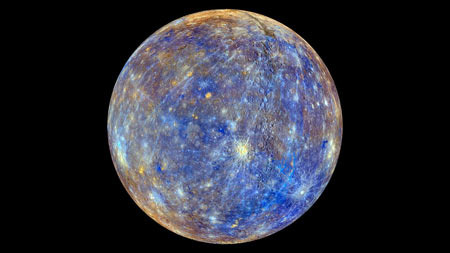
Mercury is the smallest planet in the solar system and the closest planet to the Sun.
Mercury is the closest planet to Earth, but due to its characteristics, there are many aspects that are not well known to us. Here is some basic information about Mercury:
- Radius: about 2,439.7 km
- Distance from Earth: an average of 91.7 million km (distance from the Sun)
- Mass: 3.3011 x 10^23 kg (about 0.055 times that of Earth)
- Rotation period: 59 days (Mercury rotates slowly, taking 88 days to complete one orbit around the Sun)
- Revolution period: 88 days (Mercury has a fast revolution speed, completing an orbit around the Sun in 88 days)
- Surface temperature: about 430 degrees Celsius during the day, about -180 degrees Celsius at night
- Atmosphere: almost nonexistent, with only a very thin atmosphere. It mainly contains oxygen, sodium, hydrogen, etc., but at a very low density.
Surface
- Structure: Mercury has a core made of rock and metal, with many traces of past volcanic activity and impact craters similar to Earth.
- Craters: The surface of Mercury features large impact pits such as the Mariner crater and the Caloris basin. These craters provide evidence of Mercury's impact history and the early collision events in the solar system.
- Temperature difference: Due to the almost nonexistent atmosphere, there is an extreme temperature difference between day and night. During the day, it becomes very hot as it gets closer to the Sun, but at night, the temperature can drop sharply and freeze.
Rotation and Revolution
- Slow rotation: Mercury's rotation speed is very slow, with a day equivalent to 59 days. In contrast, a year on Mercury is only 88 days, making the lengths of a day and a year significantly different.
- Relationship between revolution and rotation: Mercury has a unique ratio of rotation to revolution, resulting in the unusual phenomenon that it rotates three times for every one revolution. In other words, Mercury rotates three times on its axis while orbiting the Sun once, leading to a kind of tidal locking phenomenon.
Atmosphere
- Mercury has a very thin atmosphere. The low density of the atmosphere means that there is no atmosphere like Earth. The main components of Mercury's atmosphere are oxygen, sodium, hydrogen, helium, etc., but these gases are very sparse and almost nonexistent. As a result, Mercury lacks the protective effects of an atmosphere and water like Earth, leading to extreme temperature variations.
Climate and Environment
- Extreme temperature differences: Due to the almost nonexistent atmosphere, there is a stark temperature difference between day and night on Mercury. During the day, temperatures can rise to 430 degrees Celsius, while at night, temperatures can drop to -180 degrees Celsius. These extreme temperature differences create an environment that is highly unsuitable for life.
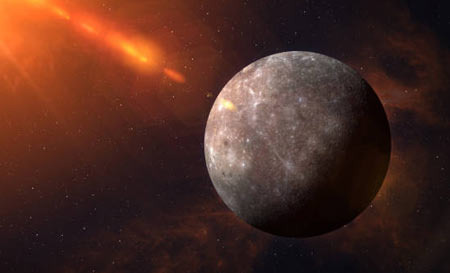
Exploration of Mercury
Mercury is the smallest planet in the solar system and has a very extreme environment, making it a challenging target for exploration. However, several space exploration programs have directly explored Mercury.
Messenger: NASA's Messenger spacecraft collected detailed data from orbit around Mercury from 2011 to 2015, investigating Mercury's surface, atmosphere, magnetic field, and geological characteristics. This mission provided important information about Mercury's composition and evolution.
BepiColombo is a joint mission by the European Space Agency (ESA) and the Japan Aerospace Exploration Agency (JAXA), launched in 2018. This spacecraft is expected to reach Mercury in 2025 and plans to study Mercury's internal structure and surface characteristics in more detail.
Mercury orbits very close to the Sun, so it is significantly affected by the Sun's strong gravity and magnetic field. Mercury's orbit is elliptical, resulting in a large difference in distance between its closest and farthest points from the Sun. Solar wind and magnetic fields also affect Mercury's atmosphere and surface, potentially causing phenomena like flames on its surface.
Mercury, being the closest planet to the Sun, is characterized by its small size, unique rotation period, and extreme temperature differences. With almost no atmosphere, it presents a very extreme environment for human habitation and is difficult to explore, but missions like the Messenger spacecraft and BepiColombo are uncovering Mercury's secrets. Mercury is one of the important targets in space exploration, providing crucial information about the origin of the solar system and the evolution of planets.







 Moscow Kim |
 coloradoman |
 Montgomery Mom |
 GOGO SING |
 Hajiwon Blog Hair Salon |
 U.S. Weather Bureau News |
 Things to know |
 Premium Gas Camp |
 Texas Real Estate Blog |
 action blog 101 |
  Korean Mom |
  My NYC |
  moo moo |
  Mr Oh |
  forevergee |
  festival |
  manchester |
  constant |
  Leapfrog Move |
  vibranto |
  Tora Tora |
  yellowbutter |
  Dolly |
  US Embassy |
  NYC saladbar |
  Finding Superfoods |
  lightyear |
  song bang |
  vexomo |
  Indiana Jones |