
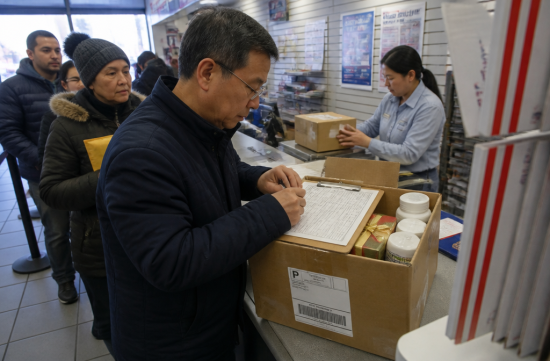
Last December, a package I sent to my sister's house arrived in early January, well after the New Year. Over the phone, my sister laughed and said, "The Christmas gift turned into a New Year gift," and I felt quite awkward.
So this year, I'm starting to prepare now, in early October. For those who want to send year-end gifts to their Korean families, I'll summarize the information I've gathered.
First, let's look at the dates. According to the recommended shipping dates announced by USPS this year, for the Asia/Pacific Rim region, including Korea, both Priority Mail International and First-Class Package International must be sent by Wednesday, December 9.
Priority Mail Express International has a bit more leeway, with a deadline of Wednesday, December 16. However, this is just a recommended date for arrival before December 25, not a guarantee.
From my experience, sending right on that date always made me anxious. If it gets held up for even a day or two in Korean customs, it can be delayed significantly.
So, I set my own deadline for the last week of November. The lines at the post office get longer around Thanksgiving, so it's more comfortable to send it before then.
The second point is the amount. Gifts sent by mail are exempt from customs duties in Korea if the item value is under $150 and is something the recipient will use personally.
Many people get confused about the $200 limit from the U.S. This applies only to items that come in through express shipping companies under the Korea-U.S. FTA.
Remember that when sending via EMS or USPS international mail, the limit is $150, even if it's sent from the U.S. I also initially thought it was $200.
Additionally, if you exceed the limit by even $1, taxes will apply to the entire amount, not just the excess. The recipient must pay taxes to receive the package, which can make the gift feel burdensome.
The third point is the items. The most commonly sent items by Koreans are vitamins and omega-3 supplements, but these can be tricky.
Health supplements are excluded from the list customs clearance and are subject to general import declaration. The quantity recognized for personal use is a maximum of 6 bottles per customs clearance.
If you exceed 6 bottles, not only the excess will be held, but the entire item will be subject to customs hold. This means you can't pack them all into one box for relatives.
You also need to be careful with food items. Processed meats like jerky, ham, and sausages are subject to animal quarantine and cannot be sent to Korea via international mail.
According to the Animal and Plant Quarantine Agency, even the beef broth in cup noodles is subject to quarantine. If caught, it will be returned or disposed of, so it's better to leave these out entirely.
I know someone who included several bags of Costco jerky and ended up having their package held for a long time. What was meant as a thoughtful gesture ended up causing more trouble.
The fourth point is filling out the customs declaration form. In the contents section, don't just write "Gift"; be specific about what items and how many there are.
Korean customs will determine whether to impose taxes based on the information on this declaration form attached to the package. Therefore, I do not recommend intentionally undervaluing the items.
If the declared amount doesn't match the actual items, it will lead to further inspections and delays in arrival. I believe that being honest is ultimately the fastest way.
If you have multiple family members, consider dividing the items into separate boxes rather than cramming everything into one. It's easy for the total to exceed $150 if everything is packed together.
Of course, splitting the boxes will increase shipping costs. So, I usually send one box for my parents and use Korean online mall gift cards for my siblings.
In fact, these days, buying from Korean shopping malls and sending directly can often be cheaper in terms of shipping and taxes. It makes sense to only send items that can only be found in the U.S.
The sixth point is tracking. After sending, make sure to send the tracking number to your family in Korea. They can check it on the Korean post office website, which helps ease their minds while waiting for the package.
It's also important to write the recipient's Korean phone number accurately along with the address. If taxes arise or documents are needed, the contact will go to that number.
To summarize, the recommended shipping date is December 9, but I will send it at the end of November. The mail should be under $150, supplements should be under 6 bottles, and processed meat should be excluded.
The customs declaration should be specific and honest. And for items that can be purchased in Korea, it's best to buy them there and send them.
Since it's not someone else's responsibility to take care of this, ultimately, the sender must know the regulations and act in advance. This year, my goal is to receive a call from my sister saying, "I received it well" before Christmas.
 AcornHero








 Let's Be Like a Salt-like City Person |
 Springs Korea |
 US Legal Consultation on Trials |
 Study Abroad Life Know-How Tips |
 Best Frozen Yogurt |
 Why Not Me |
 Chili Boy Club |
 Tomato Health Club blog |

 Queens Blues |
  Great TOWN NEWS |
  Open Flex Mind |
  Hartford Blog |
  unified |
  Generation X |
  ringwinds |
  American Food Information & Calories |
  Hawaii Maui Kahului |
  calvorn |
  fernando park |
  newyorker 101 |
  coffeee |
  |
|  Christopher |
  sylven |
  Sammy Beach |
  Bliss O |
  blue ocean |
  greenlight |
  Watanaka Karametibaksa |