
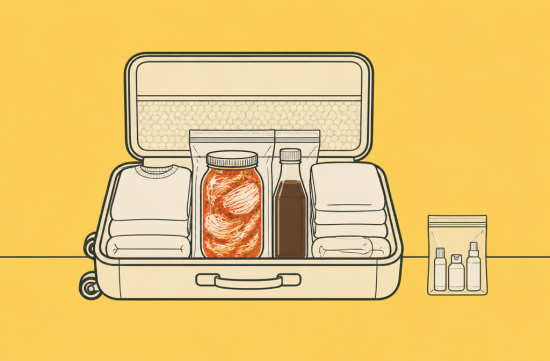
As Thanksgiving approaches, there's a common question that comes up when visiting family or friends: Can you bring a jar of kimchi or a bottle of sesame oil on the plane?
I once had a tube of gochujang taken away at the airport security a few years ago. Since that day, I've made it a point to look up TSA regulations properly.
To get straight to the point, kimchi and sesame oil are not prohibited items for carry-on. However, both are treated as liquids according to TSA guidelines.
The basic principle is the 3-1-1 rule. Liquids, gels, and aerosols in your carry-on bag must be in containers of 3.4 ounces or less, which is 100ml.
Those small containers must fit into a single quart-sized clear zip-top bag. Each passenger is allowed only one of those zip-top bags.
So, what qualifies as a liquid is the real issue. TSA's explanation is straightforward: if it can spill, spray, spread, squeeze, or pour, it is considered a liquid.
That means peanut butter is also classified as a liquid. When TSA announced this again in 2023, many Americans were quite surprised.
Items like jam, jelly, hummus, cream cheese, and yogurt are frequently flagged at security for the same reason. Foods that fall into the gray area between solid and liquid are the most problematic.
Applying this standard to kimchi, kimchi with a bit of liquid is more likely to be classified as a liquid.
In fact, the word kimchi does not appear in TSA's official guidance. Therefore, even kimchi without liquid is subject to the judgment of the security personnel on-site.
From my experience, dividing kimchi into 100ml containers is not practical. That amount wouldn't even be enough for one meal. Plus, since you have to fit cosmetics and toothpaste into that zip-top bag as well, there's hardly any room left.
Sesame oil, on the other hand, is undoubtedly a liquid. If the bottle exceeds 100ml, you will have to leave it behind at security if you try to bring it in your carry-on. Even if the bottle is half full, the size of the container is what matters.
However, that doesn't mean you can't bring it at all. Checked baggage does not have the 3.4-ounce limit.
The best solution is to send large jars of kimchi or bottles of sesame oil as checked luggage. The issue is not the regulations, but the smell and potential leaks.
Kimchi is a fermented food, so it produces gas. It's quite common for the lid of a sealed container to bulge or for liquid to leak.
So, here's how I pack it. I put the kimchi in a zip-top bag, squeezing out as much air as possible, and then place that into a sealed container.
For sesame oil, I wrap plastic wrap around the lid before closing it. Then, I place it in a zip-top bag and put it in the middle of my clothes in the suitcase. This way, if it leaks, it will only ruin a piece or two of clothing.
Avoid the outer pockets of your suitcase. They are more susceptible to breakage due to the impact of being tossed around.
Solid foods are a completely different story. Items like kimbap, rice cakes, dry side dishes, seaweed, and snacks can be brought on board without any quantity restrictions.
However, during security checks, you may be asked to take food out of your bag. It's convenient to place it on top so it can be easily put in the bin. This way, you'll have less to worry about with the people waiting behind you.
There are also cases where you bring liquids purchased at duty-free shops in Korea and transfer to a domestic flight in the U.S. TSA allows duty-free items over 100ml if they are in a transparent sealed bag with a receipt and purchased within 48 hours. If the bag is opened or there's no receipt, they are treated like regular liquids.
Some of you may have heard that the 3-1-1 rule is going away. In the summer of 2025, the Secretary of Homeland Security mentioned reviewing liquid regulations.
However, as far as I can confirm, nothing has officially changed yet. The capacity limits remain the same even at security checkpoints with new CT scanners.
It seems there's some confusion due to news about Heathrow Airport in the UK lifting the 100ml limit. That's a UK issue and separate from U.S. TSA regulations.
If you're arriving on an international flight from Korea, there's one more thing to keep in mind. Upon arrival, there's a separate customs step, known as CBP.
CBP advises you to declare food and agricultural products. According to USDA, simply declaring can help you avoid fines even if your items are denied entry.
Kimchi containing meat or seafood may have different inspection results. Keeping the original packaging and ingredient label makes it much easier to explain. If you're bringing homemade kimchi, be prepared to explain what's in it.
To summarize: only 100ml or less is allowed in carry-on, large containers should go in checked luggage, and international flights require declaration.
Before you depart, check the TSA website's What Can I Bring search tool for your items. Airline regulations may be stricter, so be sure to check those as well.
Honestly, if it were me, I would just buy kimchi at a local Korean market once I arrive. It may not taste like mom's, but it's better than having my clothes smell like kimchi in my suitcase.
 GoldenTrail88
 RubyMooner






 Noodle Noodle |
 figtop |

 Toaster Pizza Magic Show |

 DO Main TODAY |

 Caribbean |

 Queens Blues |

 skykong |

 Open Flex Mind |

 Why Not Me |
 strawberry |
 US Regional Information Local News |
 USA Business News |
 Blondee |
 E whisper |
 Potato House |
 freshmint |
 Ansaso |
 Golado |
 babybay |
 honeycom |
 French Macarons |
 Exploring American Life Information |
 Sunshine Blog |
 Community Cross |
 Sayonara H |
 What can make money? |
 Information Search LifeMAN |
 morvex37 |
 neontrail |