
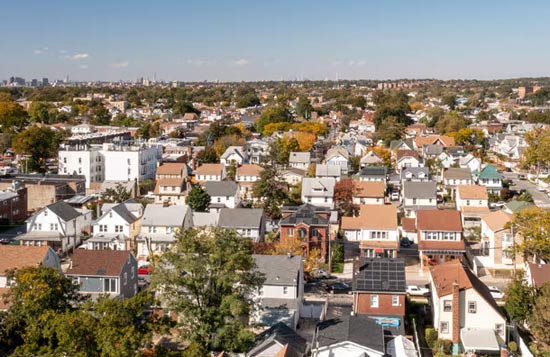
Queens Village is a residential neighborhood located at the eastern edge of the Queens borough of New York City.
With a different atmosphere from the hustle and bustle of Manhattan, it features impressive quiet streets lined with single-family homes and semi-detached houses. The area covers about 3.5 square miles (9 km²) and has been a steady destination for those seeking a more spacious living environment within New York City.
Geographically, Queens Village is situated between Jamaica and Bellerose, bordered to the north by Parsons Blvd and Hollis Hills, and to the south by Jamaica Estates. The Queens Village Blvd runs north-south through the center of the neighborhood, serving as the main commercial axis of the area. This street is densely populated with essential services such as supermarkets, dry cleaners, pharmacies, and nail salons.
In terms of transportation, the Long Island Rail Road (LIRR) Queens Village station provides access to Penn Station in about 30 to 40 minutes. This line serves as a branch of the Port Washington line, with relatively short intervals during weekday rush hours. Bus routes Q1, Q2, Q3, and Q85 connect to the Jamaica bus terminal, linking to the New York subway lines E, J, and Z. If driving, residents can easily access central Queens and Long Island via Springfield Blvd or Hollis Ave.
The housing market in this area has traditionally focused on single-family and two-family homes. For a long time, Irish, Italian, and Jewish communities have made up the neighborhood, and since the 1990s, South Asian (Indian, Pakistani), Caribbean, and Korean residents have steadily moved in, making it culturally much more diverse. You can experience a unique lifestyle with a mix of Korean supermarkets, Indian grocery stores, and Guyanese restaurants.
As for attractions, the charm lies more in the everyday simplicity rather than grand landmarks. Alley Pond Park, located in the northern part of Queens Village, is known as the second-largest park in New York City and is home to an ancient English Oak estimated to be over 11,000 years old. It features nature trails, birdwatching areas, and wetland education facilities, making it popular among family visitors. Additionally, the cherry blossom tree-lined streets around Cherry Ave create a beautiful scene in the spring.
For shopping and dining, the area where 232nd St meets Jamaica Ave serves as the commercial center of Queens Village. This district is home to chain convenience stores, fast food outlets, and a variety of restaurants from different immigrant communities. In particular, there are many small restaurants specializing in Indian and Trinidadian cuisine, attracting food enthusiasts from New York who come specifically to explore local dining spots. While coffee shops and café culture are still developing, there has been a recent trend of small independent cafes emerging.
For those planning to move to or visit Queens Village for the first time, a practical tip is that parking is generally not too difficult. Most residential areas have private driveways, and there is considerable street parking available around commercial zones. However, be sure to check for time-restricted parking signs on major commercial streets. In terms of safety, the NYPD 105th Precinct oversees the area, which is known to be relatively safe compared to other parts of eastern Queens. If you are looking for a quiet and practical residence while living in New York, Queens Village is definitely worth considering.
 foxdreamtraveler1986
 MacaronJoyy
 MyHeadBack








 ultron78 |
 garlic bread |

 urbanmint |
 |
| 
 Tomato Health Club blog |
 Open Flex Mind |
 Bushing Around Life |
  Tora Tora |
  yellowbutter |
  Dolly |
  US Embassy |
  NYC saladbar |
  Finding Superfoods |
  lightyear |
  song bang |
  vexomo |
  Indiana Jones |
  meloncat |
  novapixel |
  mortrix |
  Esther 1983 |
  fortbliss |
  Moscow Kim |
  My Two Way |
  toastyfox |
  FLORIDA Acus |
  tracker |