
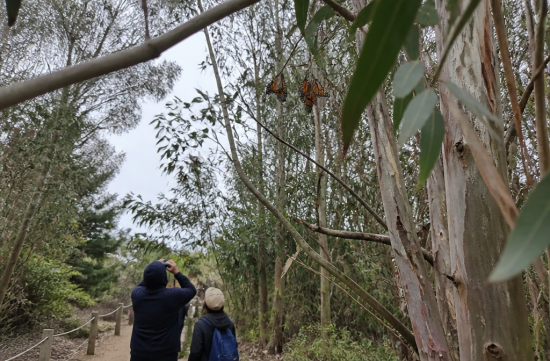
Last week, while passing by Lighthouse Avenue, I saw a few tourists standing with their heads tilted back under the eucalyptus trees. Even though it was still late September, they were already looking for butterflies. I completely understand the excitement, but the timing is just a bit early.
According to the Pacific Grove Monarch Grove Sanctuary, monarch butterflies typically arrive around mid-October and leave in February. The peak time for their gathering is from mid-November to December.
In simple terms, mid-October is the opening act, while the week of Thanksgiving is the main event. There's certainly some fun in catching the opening act.
First, let me share some good news. There is no entrance fee for the sanctuary.
The address is 250 Ridge Road, and it is open daily from sunrise to sunset. It only closes on days with very severe weather.
The parking lot is small. However, nearby street parking is free, so it's just a short walk. Instead of circling around looking for a spot during the weekend lunch rush, it's more convenient to park in the alley from the start.
Now for the bad news. You may need to adjust your expectations a bit.
According to the Xerces Society, the count of monarchs in this sanctuary during the 2025 Thanksgiving count was just 188. In the 2022-23 season, over 10,000 had gathered, so the numbers are honestly a bit disheartening.
Even when looking at the entire West Coast, the 2025 count was 12,260 across 249 sites. This is reportedly the third-lowest record since counting began in 1997.
On the bright side, this is an increase from 9,119 in 2024. It's a small step up from the bottom.
So, I recommend this: if you go expecting a cloud of butterflies, you might be disappointed, but if you think of it as a hidden picture game, it will be much more enjoyable.
The first observation tip is temperature. Monarchs rest on trees when the temperature is below 55°F, and they fly around looking for nectar when it gets warmer.
If you want to see them flying, aim for a sunny day between noon and 3 PM. Conversely, if you want to see them clustered together, early morning or cloudy days are better.
Everyone knows about the morning fog on the peninsula. On foggy mornings, the butterflies fold their wings and look like dry leaf piles. First-time visitors often pass by without realizing they are right above their heads.
The second tip is binoculars. The Xerces Society recommends 8x42 or 10x50 models.
The clusters are often high up in the branches, making it hard to see with the naked eye. I can't be the only one who has relied on my phone's zoom only to come back with a screen full of branches, right?
The third tip is to look for docents. Volunteers from the Pacific Grove Museum of Natural History come out to the sanctuary from October to February to provide information.
They are usually there between 11 AM and 3 PM, depending on the weather. If they point out the location of the clusters, you can quickly find what you might have spent 20 minutes searching for on your own.
I can't avoid mentioning the rules here. True to its nickname, Butterfly Town USA, this city imposes a $1,000 fine for actions that disturb the butterflies.
Dogs are not allowed. If you were planning to walk your dog, you'll need a plan B.
Stick to the marked paths, and the Xerces Society advises against using insect repellent sprays. Touching the butterflies is prohibited unless you are a licensed researcher in California.
The fourth tip is to combine your visit with the museum for a full day trip. The museum at 165 Forest Avenue is open from Wednesday to Sunday, 10 AM to 4 PM.
Admission is $12 for adults, and $8 for youth, students, seniors, and military personnel. Monterey County residents can enter for free with ID, so there's no reason not to go if you're a local.
If a family of four from out of state visits, it would be $24 for two adults and $16 for two kids, totaling $40. Since the sanctuary is free, it's a decent value for a day out.
The museum's website also posts weekly butterfly counts. Checking the numbers before you go can significantly reduce the chances of a wasted trip.
Lastly, there are things you can do at home. Many people plant milkweed to help the butterflies, but the coastal situation is different.
The Xerces Society advises against planting milkweed within five miles of wintering sites along the northern Santa Barbara coast, as it can disrupt the butterflies' winter dormancy and lead to continued breeding.
What is meant to be helpful can actually become a hindrance. If you're on the peninsula, it's better to plant native flowering plants instead of milkweed.
In summary, mid-October is fun for spotting the first arrivals, while late November to early December is when you can see the largest numbers.
If it were me, I would choose a sunny day during the Thanksgiving holiday, pack my binoculars, and go around noon. No matter how many I see, the joy of spotting those orange wings with my own eyes is worth more than the numbers.
 CrystalLake93






 Let's Be Like a Salt-like City Person |
 Springs Korea |
 US Legal Consultation on Trials |
 Study Abroad Life Know-How Tips |
 Best Frozen Yogurt |
  Monte Sori |
 Rocky Mountains |
 Roman Pan |
 Hardworking Running Bobby Kim |
 La Bean |
  American History This and That |
  U donn |
  Sarah's Blog |
  Holy Cow |
  monster |
  houston mama |
  Reggae Party |
  Thou Thou |
  Tennessee Land |
  custardnew |
  Chimhanbang Korea ACU |
  See South Carolina |
  dorex |
  Taek Jun |
  Choi Cho |
  Anova US Beauty Information |
  whiskerbread |
  Yo Lock Me Up |