
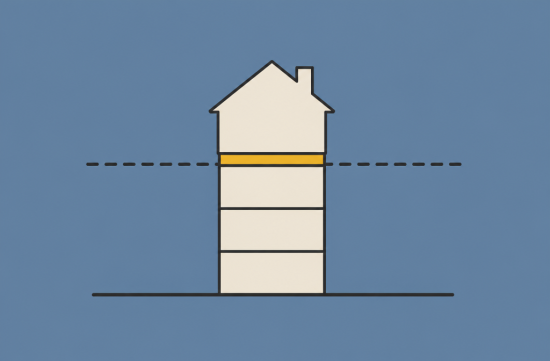
People still often hear that buying a home reduces taxes. The logic is that mortgage interest deductions make it better than renting. However, many are disappointed after filing their taxes.
The reason is simple. Mortgage interest deductions are only available to those who choose itemized deductions. If you take the standard deduction, the amount of interest paid is not reflected in the deduction.
You can only choose one of the two. You cannot receive both the standard deduction and itemized deductions at the same time. Therefore, itemized deductions must exceed the standard deduction to be worthwhile.
The problem is that the standard deduction amount is quite large. According to the IRS, the standard deduction for married couples filing jointly in 2026 is $32,200. For individuals, it is $16,100, and for heads of household, it is $24,150.
In 2025, the standard deduction for married couples filing jointly was $31,500. The One Big Beautiful Bill Act passed last summer made this level permanent and it will increase slightly each year to keep up with inflation.
If you remember before 2017, you will feel the difference. Back then, the standard deduction was half of what it is now. Most homeowners benefited from itemized deductions during that time.
Let's consider an example. Suppose a married couple filing jointly paid $20,000 in mortgage interest in a year. They also have $6,000 in property taxes and $8,000 in state income taxes.
Adding up the itemized deductions gives $20,000 in interest, $14,000 in state and local taxes (SALT), totaling $34,000. This is $1,800 more than the standard deduction of $32,200.
So, the additional deduction this home receives from the mortgage is not $20,000, but $1,800. At a 22% tax bracket, the actual tax savings would be $396. In numbers, it seems smaller than expected.
If the interest is around $10,000, the standard deduction is better. In this case, the benefit of the mortgage interest deduction is zero. As the loan balance decreases and interest decreases, this phenomenon occurs more quickly.
However, not every case lacks benefits. Last year's tax law changes significantly raised the SALT deduction limit. The limit for 2026 is $40,400, and it was $40,000 in 2025.
The previous limit was $10,000. In California, where property taxes and state income taxes are high, this change is significant. Homes that exceed the standard deduction by combining interest and SALT may increase again.
However, if income is high, this limit decreases. If modified adjusted gross income (MAGI) exceeds $505,000 in 2026, it will be gradually reduced. By 2030, it will revert to $10,000.
The loan limit for mortgage interest deductions is set at $750,000 federally. This was established in the 2017 tax law and made permanent by this legislation. This is based on the combined balance of the primary residence and one second home.
There are also new changes. Starting in 2026, mortgage insurance premiums (PMI) will again be deductible like interest. This also applies only when itemizing deductions.
California state taxes need to be considered separately. The state standard deduction is much smaller than the federal one. According to FTB, the state standard deduction for 2025 is $11,412 for married couples filing jointly and $5,706 for individuals.
Therefore, it is common to take the standard deduction federally and itemize deductions at the state level. California allows this separate choice.
Additionally, California did not follow the federal limit of $750,000. The existing limit of $1,000,000 applies for state filings. This is a significant difference for homeowners in high-cost coastal areas.
Married individuals filing separately need to be cautious. If one spouse itemizes deductions, the other must also itemize. One spouse cannot take the standard deduction while the other itemizes.
In practice, many people misunderstand this when buying a home. When comparing renting and buying, they calculate the full interest as a tax benefit. Most of those calculations are incorrect.
To be accurate, you need to analyze step by step. First, add up the expected interest, property taxes, and state income taxes. Include other items like donations.
Subtract the standard deduction for that year from that total. The remaining amount is the actual additional deduction. Multiply this by your marginal tax rate to find the true tax savings.
In the early years of a loan, the interest portion is large, making it easy to exceed the standard deduction. After about ten years, the interest decreases, and many find themselves falling back under the standard deduction. You should not judge based only on the first few years.
The same applies when considering refinancing. Lowering the interest rate reduces interest and also reduces the deduction benefit. However, the reduction in the interest paid itself is a much greater advantage.
Taxes can vary greatly depending on individual circumstances. Income brackets, filing methods, and other deduction items are all variables. Before making significant decisions, it is advisable to consult a tax professional.
My opinion is clear. A home should be considered as a place to live or as an investment return. It is better to think of mortgage interest deductions as a bonus.
There is no reason to take on a large loan just because there is a deduction. When you do the actual calculations, the monthly payment is much heavier than the tax. Please make sure to input the numbers accurately.
 TingWitness
 skyvalleydreamer1990








 B.I.G. Victor |

 Amber H |

 uplifted |

 Dr. Kelso |

 silents |

 Roman Pan |

 U.S. Weather Bureau News |

 Raymond K. |


 strawberry |
 US Regional Information Local News |
 USA Business News |
 Blondee |
 E whisper |
 Potato House |
 freshmint |
 Ansaso |
 Golado |
 babybay |
 honeycom |
 French Macarons |
 Exploring American Life Information |
 Sunshine Blog |
 Community Cross |
 Sayonara H |
 What can make money? |
 Information Search LifeMAN |
 morvex37 |
 neontrail |