


These days, when discussing commercial real estate in LA, you often hear that "the vacancy rate is close to 40%" and "there are many buildings with vacancy rates over 40%."
However, it's important to understand that this does not mean that 40% of all commercial real estate (markets, warehouses) in LA is empty.
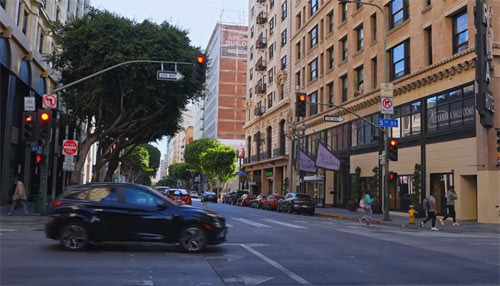
The most serious issue lies with buildings that are solely offices, particularly in Downtown LA.
According to Colliers data from the second quarter of 2026, the office vacancy rate in Greater Los Angeles is 25.6%.
In Downtown LA, it has risen to a staggering 34.5%.
In simple terms, this means that more than one out of three office spaces in Downtown is vacant.
For someone who has been in real estate for a long time, this is a truly frightening number.
This is because commercial real estate is completely different from apartments.
Let's say there are 100 apartment units, and 15 of them are vacant.
If you're a landlord, you might not feel great about it, but you still have rent coming in from the remaining 85 units.
However, in an office building, a large company might occupy 5 or 10 floors.
If that one company leaves, the building's cash flow can drop dramatically overnight.
The problem doesn't stop there. Let's take a $1 million commercial building as an example.
If the net income after paying rent, taxes, management fees, and insurance is $60,000 a year, that would yield a return of about 6%.
But if the tenant leaves and the rental income drops to $30,000, the situation changes.
You might want to insist that the building is still worth $1 million.
However, a potential buyer won't calculate it that way.
"This building can only earn $30,000 now, so why would I pay $1 million?" they would say.
Applying the same 6% return would mean the value drops to $500,000. This is the frightening aspect of commercial real estate.
A vacancy rate doubling doesn't simply mean the building's price drops by 20% or 30%. As rental income collapses, the assessed value of the building can be significantly affected.
When interest rates rise, another problem arises. Unlike residential properties, which can be locked in with a 30-year fixed mortgage, commercial real estate often requires refinancing after a certain period.
Let's say you borrowed $30 million when the building was valued at $50 million. A few years later, when the loan matures, the building's value has dropped to $30 million.
Will the bank lend you another $30 million? No, they won't. "The building's value has dropped, so you need to put in more money," they will say.
However, the property owner is already struggling to collect rent due to vacancies. They might offer several months of free rent to attract tenants and even cover renovation costs.
While money isn't coming in, expenses keep piling up. Ultimately, if they can't hold on, they will have to sell the building. The problem is that at that time, other property owners are likely in the same situation.
If one or two properties are sold cheaply, it's an opportunity. But if many buildings flood the market at once, that becomes the market price. This is why a vacancy rate of 30% or 40% is so alarming.
Even more concerning is that surrounding businesses also suffer.
If 5,000 people commute to an office daily, they will buy lunch, grab coffee, pay for parking, and maybe have a drink after work.
But if remote work reduces the number of commuters to 2,000, the sandwich shop on the first floor will be the first to struggle.
Next, the coffee shop will close, and restaurants will follow. Retail vacancies will arise, and at night, the streets will become deserted. As the area becomes emptier, perceptions of safety decline, making it less likely for other companies to want to lease office space in that neighborhood.
It's a vicious cycle. However, it's also incorrect to think that the entire LA real estate market is collapsing.
In the second quarter of 2026, the industrial real estate vacancy rate in Central Los Angeles was only 3.2%. In LA, warehouses and logistics facilities are in a completely different situation.
Therefore, real estate should not be viewed as simply "LA is good" or "LA is bad." You need to look at whether it's office, apartment, retail, or industrial, and even within offices, Century City and Downtown LA are different.
These days, my perspective on real estate has changed a bit. When I was younger, I only looked at how much building prices would rise. Now, I first look at who is paying rent.
Buildings don't generate income on their own; it's the tenants who bring in the money. That's why a vacancy rate of 30% or 40% is so frightening.
It doesn't mean buildings are disappearing; it means there are fewer people inside those buildings paying rent each month.
There's not much scarier than that in real estate investment.
 FixItBros







 Jellia Angel |
 zenvior |
 El Dorado |
 SAY YOU SAY ME |
 California Dreamer |
 There Are Such Things in the World |
 Happy Together 213 |
 Superman Cat Blog |
 Sunny's Travel in America |
 U.S. Retirement Pension Information |
  Texas Migration Story |
  Bearded Strawberry Smoothie |
  Heart Ticker |
  Moo Tang Clan |
  Khan Film Blog Production |
  Unknown Dog Walk blog |
  yenne |
  Peter Pan Pet |
  Investment Campus Home Ownership |
  virex |
  Yoyma |
  timemachine |
  Taco Seattle |
  breaddough |
  Fortress K |
  arion9 |