

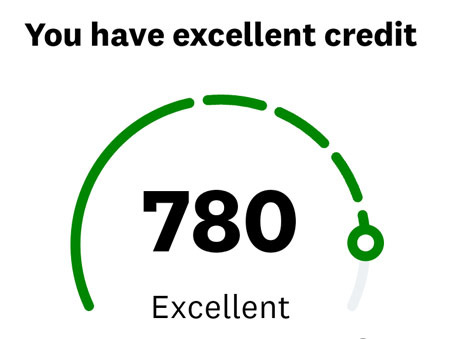
A credit score around 700 is not considered bad in the U.S.
There are usually no major issues getting a credit card, and auto loans are generally available.
However, once you start exceeding 780, you increase your chances of receiving better terms when buying a home or a car.
Even a few points may not seem significant, but when borrowing large sums, it ultimately comes down to the difference in interest rates.
So, if someone with a score around 700 aims for 780, I recommend first looking at their credit utilization.
For example, if your credit limit is $10,000 and you spend $4,000 each month, your utilization rate is 40%. The problem is that even someone who pays off their balance every month cannot be too confident.
This is because the credit card company may report a balance of $4,000 at the time they send the information to the credit bureaus.
Therefore, you need to pay attention not only to the payment date but also to the statement closing date.
Pay off a significant portion before the closing date to lower the reported balance. Ideally, keep it below 10% of your total limit.
Increasing your credit limit is also an option. If your spending remains the same but your limit increases from $10,000 to $20,000, your utilization rate drops to half.
You can request a limit increase through the card issuer's app or website, but it's wise to check if a hard inquiry will occur before applying.
If it's a soft inquiry, it's an opportunity to increase your limit without affecting your credit score.
It's generally advisable not to remove old cards unnecessarily. Especially if you close a card that has no annual fee after not using it for a few years, your total credit limit may decrease.
Old accounts also help show the length of your credit history. Instead of just leaving them in a drawer, maintain them by making small purchases occasionally and paying them off right away.
If you're aiming for 780, it's also wise to avoid opening new cards for a while.
Applying for new cards or loans can result in hard inquiries. While one inquiry won't ruin your score, having several in a short period is not beneficial.
If you don't need a loan immediately, it's important to reduce new applications and manage existing accounts steadily.
Surprisingly, one thing you must check is your credit report. Some people assume that since their score is 700, there are no issues with their records, but that's not always the case.
There may be accounts you've paid off that are incorrectly reported or accounts you're unaware of that are listed.
You can check your records with Equifax, Experian, and TransUnion through AnnualCreditReport.com, and if you find any discrepancies, you can dispute them with the respective credit bureau.
Ultimately, there's no special secret to moving from 700 to 780.
Not missing payments is fundamental, and after that, it's about keeping your utilization low, maintaining old accounts, and reducing unnecessary new applications.
Especially from the mid-700s, your score may not rise as quickly as when you first established credit. Time plays a significant role here.
Start by addressing your utilization and any incorrect records, and then manage the rest steadily over several months.
Before you know it, you'll pass 750, reach 770, and get close to 780. In the U.S., a credit score is not just a number to boast about.
When you later buy a home worth hundreds of thousands of dollars or finance a car, the credit history you've maintained will translate into real money.
 SesameSoup
 GarlicNinja







 SKy Face |

 gleeful |

 forevergee |

 mortrix |

 cherrydino |

 Weekend Movie Blog |

 Superman Cat Blog |

 Valley Hong |
 prixon74 |

 Beauty, Health, Lifestyle Blog |
 Nevada Teppanyaki |
 aerion99 |
 Golado |
 Maximum Pro |
 Joyce blog |
 Atlanta Business Information |
 Ansaso |
 Soft Feeling That Feeling |
 assa man |
 Yugo Girl I'm So Hot |
 nexaro |
 Experiences Living in America |
 arsnack |
 Nebraska Center Director TOP |
 Florida Gario |
 menmo |
 Arizona AZ Cowboy |
 springw |
 Woooooah |
 frostpup |